

site being 3 bp upstream of the PAM site (Ran
et al. 2013), were found as well.
Due to the successful genome editing event in
W. australiana, the plants became tolerant to
allyl alcohol treatment, through which they were
easily selected. The addition of allyl alcohol to
ADH1-expressing cells causes the production of
the highly toxic acrolein. Genomic DNA of the
tolerant plants was isolated and further analyzed.
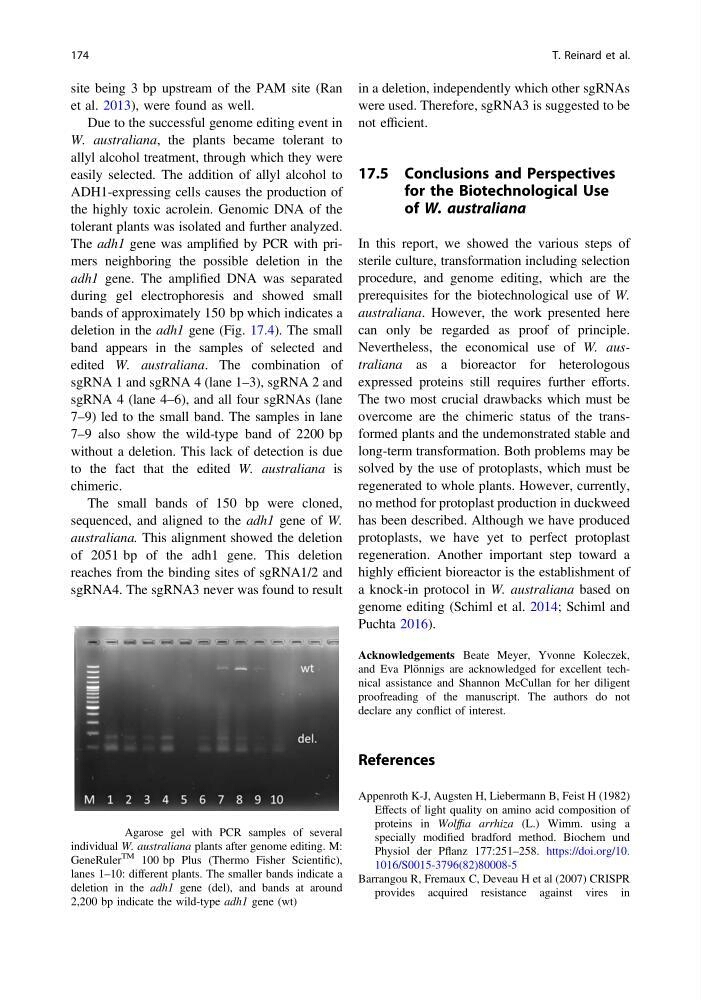
The adh1 gene was amplified by PCR with primers neighboring the possible deletion in the
adh1 gene. The amplified DNA was separated
during gel electrophoresis and showed small
bands of approximately 150 bp which indicates a
deletion in the adh1 gene (Fig. 17.4). The small
band appears in the samples of selected and
edited W. australiana. The combination of
sgRNA 1 and sgRNA 4 (lane 1–3), sgRNA 2 and
sgRNA 4 (lane 4–6), and all four sgRNAs (lane
7–9) led to the small band. The samples in lane
7–9 also show the wild-type band of 2200 bp
without a deletion. This lack of detection is due
to the fact that the edited W. australiana is
chimeric.
The small bands of 150 bp were cloned,
sequenced, and aligned to the adh1 gene of W.
australiana. This alignment showed the deletion
of 2051 bp of the adh1 gene. This deletion
reaches from the binding sites of sgRNA1/2 and
sgRNA4. The sgRNA3 never was found to result
in a deletion, independently which other sgRNAs
were used. Therefore, sgRNA3 is suggested to be
not efficient.
17.5 Conclusions and Perspectives
for the Biotechnological Use
of W. australiana
In this report, we showed the various steps of
sterile culture, transformation including selection
procedure, and genome editing, which are the
prerequisites for the biotechnological use of W.
australiana. However, the work presented here
can only be regarded as proof of principle.
Nevertheless, the economical use of W. australiana as a bioreactor for heterologous
expressed proteins still requires further efforts.
The two most crucial drawbacks which must be
overcome are the chimeric status of the transformed plants and the undemonstrated stable and
long-term transformation. Both problems may be
solved by the use of protoplasts, which must be
regenerated to whole plants. However, currently,
no method for protoplast production in duckweed
has been described. Although we have produced
protoplasts, we have yet to perfect protoplast
regeneration. Another important step toward a
highly efficient bioreactor is the establishment of
a knock-in protocol in W. australiana based on
genome editing (Schiml et al. 2014; Schiml and
Puchta 2016).
Acknowledgements Beate Meyer, Yvonne Koleczek,
and Eva Plönnigs are acknowledged for excellent technical assistance and Shannon McCullan for her diligent
proofreading of the manuscript. The authors do not
declare any conflict of interest.
References
Appenroth K-J, Augsten H, Liebermann B, Feist H (1982)
Effects of light quality on amino acid composition of
proteins in Wolffia arrhiza (L.) Wimm. using a
specially modified bradford method. Biochem und
Physiol der Pflanz 177:251–258. https://doi.org/10.
1016/S0015-3796(82)80008-5
Barrangou R, Fremaux C, Deveau H et al (2007) CRISPR
provides acquired resistance against vires in
Fig. 17.4 Agarose gel with PCR samples of several
individual W. australiana plants after genome editing. M:
GeneRuler
TM 100 bp Plus (Thermo Fisher Scientific),
lanes 1–10: different plants. The smaller bands indicate a
deletion in the adh1 gene (del), and bands at around
2,200 bp indicate the wild-type adh1 gene (wt)
174
T. Reinard et al.
et al. 2013), were found as well.
Due to the successful genome editing event in
W. australiana, the plants became tolerant to
allyl alcohol treatment, through which they were
easily selected. The addition of allyl alcohol to
ADH1-expressing cells causes the production of
the highly toxic acrolein. Genomic DNA of the
tolerant plants was isolated and further analyzed.
The adh1 gene was amplified by PCR with primers neighboring the possible deletion in the
adh1 gene. The amplified DNA was separated
during gel electrophoresis and showed small
bands of approximately 150 bp which indicates a
deletion in the adh1 gene (Fig. 17.4). The small
band appears in the samples of selected and
edited W. australiana. The combination of
sgRNA 1 and sgRNA 4 (lane 1–3), sgRNA 2 and
sgRNA 4 (lane 4–6), and all four sgRNAs (lane
7–9) led to the small band. The samples in lane
7–9 also show the wild-type band of 2200 bp
without a deletion. This lack of detection is due
to the fact that the edited W. australiana is
chimeric.
The small bands of 150 bp were cloned,
sequenced, and aligned to the adh1 gene of W.
australiana. This alignment showed the deletion
of 2051 bp of the adh1 gene. This deletion
reaches from the binding sites of sgRNA1/2 and
sgRNA4. The sgRNA3 never was found to result
in a deletion, independently which other sgRNAs
were used. Therefore, sgRNA3 is suggested to be
not efficient.
17.5 Conclusions and Perspectives
for the Biotechnological Use
of W. australiana
In this report, we showed the various steps of
sterile culture, transformation including selection
procedure, and genome editing, which are the
prerequisites for the biotechnological use of W.
australiana. However, the work presented here
can only be regarded as proof of principle.
Nevertheless, the economical use of W. australiana as a bioreactor for heterologous
expressed proteins still requires further efforts.
The two most crucial drawbacks which must be
overcome are the chimeric status of the transformed plants and the undemonstrated stable and
long-term transformation. Both problems may be
solved by the use of protoplasts, which must be
regenerated to whole plants. However, currently,
no method for protoplast production in duckweed
has been described. Although we have produced
protoplasts, we have yet to perfect protoplast
regeneration. Another important step toward a
highly efficient bioreactor is the establishment of
a knock-in protocol in W. australiana based on
genome editing (Schiml et al. 2014; Schiml and
Puchta 2016).
Acknowledgements Beate Meyer, Yvonne Koleczek,
and Eva Plönnigs are acknowledged for excellent technical assistance and Shannon McCullan for her diligent
proofreading of the manuscript. The authors do not
declare any conflict of interest.
References
Appenroth K-J, Augsten H, Liebermann B, Feist H (1982)
Effects of light quality on amino acid composition of
proteins in Wolffia arrhiza (L.) Wimm. using a
specially modified bradford method. Biochem und
Physiol der Pflanz 177:251–258. https://doi.org/10.
1016/S0015-3796(82)80008-5
Barrangou R, Fremaux C, Deveau H et al (2007) CRISPR
provides acquired resistance against vires in
Fig. 17.4 Agarose gel with PCR samples of several
individual W. australiana plants after genome editing. M:
GeneRuler
TM 100 bp Plus (Thermo Fisher Scientific),
lanes 1–10: different plants. The smaller bands indicate a
deletion in the adh1 gene (del), and bands at around
2,200 bp indicate the wild-type adh1 gene (wt)
174
T. Reinard et al.