

efficiently for many seed plants, such as Ginkgo
and Podocarpus (Jansen et al. 2005). The only
problem was that the low annealing temperature
of the PCR reduced the specificity of the random
hexamer primers. The development of
genome-specific primers for chloroplast would
advance the specificity of the amplification.
10.2.2.2 Long PCR Amplification
To overcome the difficulty of isolating
high-quality chloroplast DNA, long polymerase
chain reaction (PCR) amplifying of large fragments (up to 40 Kb) of the genome using conserved chloroplast-specific primers gives an
alternative way to generate chloroplast DNA,
where it requires multiple reactions in order to
gain overlapping fragments of the chloroplast
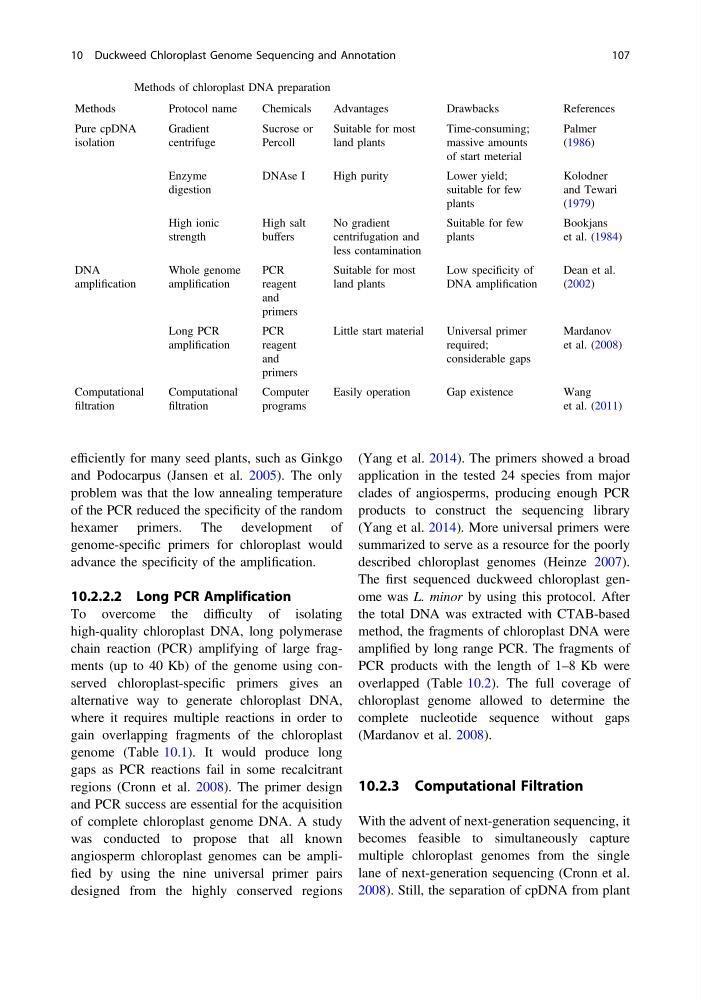
genome (Table 10.1). It would produce long
gaps as PCR reactions fail in some recalcitrant
regions (Cronn et al. 2008). The primer design
and PCR success are essential for the acquisition
of complete chloroplast genome DNA. A study
was conducted to propose that all known
angiosperm chloroplast genomes can be amplified by using the nine universal primer pairs
designed from the highly conserved regions
(Yang et al. 2014). The primers showed a broad
application in the tested 24 species from major
clades of angiosperms, producing enough PCR
products to construct the sequencing library
(Yang et al. 2014). More universal primers were
summarized to serve as a resource for the poorly
described chloroplast genomes (Heinze 2007).
The first sequenced duckweed chloroplast genome was L. minor by using this protocol. After
the total DNA was extracted with CTAB-based
method, the fragments of chloroplast DNA were
amplified by long range PCR. The fragments of
PCR products with the length of 1–8 Kb were
overlapped (Table 10.2). The full coverage of
chloroplast genome allowed to determine the
complete nucleotide sequence without gaps
(Mardanov et al. 2008).
10.2.3 Computational Filtration
With the advent of next-generation sequencing, it
becomes feasible to simultaneously capture
multiple chloroplast genomes from the single
lane of next-generation sequencing (Cronn et al.
2008). Still, the separation of cpDNA from plant
Table 10.1 Methods of chloroplast DNA preparation
Methods
Protocol name
Chemicals
Advantages
Drawbacks
References
Pure cpDNA
isolation
Gradient
centrifuge
Sucrose or
Percoll
Suitable for most
land plants
Time-consuming;
massive amounts
of start meterial
Palmer
(1986)
Enzyme
digestion
DNAse I
High purity
Lower yield;
suitable for few
plants
Kolodner
and Tewari
(1979)
High ionic
strength
High salt
buffers
No gradient
centrifugation and
less contamination
Suitable for few
plants
Bookjans
et al. (1984)
DNA
amplification
Whole genome
amplification
PCR
reagent
and
primers
Suitable for most
land plants
Low specificity of
DNA amplification
Dean et al.
(2002)
Long PCR
amplification
PCR
reagent
and
primers
Little start material
Universal primer
required;
considerable gaps
Mardanov
et al. (2008)
Computational
filtration
Computational
filtration
Computer
programs
Easily operation
Gap existence
Wang
et al. (2011)
10 Duckweed Chloroplast Genome Sequencing and Annotation
107
and Podocarpus (Jansen et al. 2005). The only
problem was that the low annealing temperature
of the PCR reduced the specificity of the random
hexamer primers. The development of
genome-specific primers for chloroplast would
advance the specificity of the amplification.
10.2.2.2 Long PCR Amplification
To overcome the difficulty of isolating
high-quality chloroplast DNA, long polymerase
chain reaction (PCR) amplifying of large fragments (up to 40 Kb) of the genome using conserved chloroplast-specific primers gives an
alternative way to generate chloroplast DNA,
where it requires multiple reactions in order to
gain overlapping fragments of the chloroplast
genome (Table 10.1). It would produce long
gaps as PCR reactions fail in some recalcitrant
regions (Cronn et al. 2008). The primer design
and PCR success are essential for the acquisition
of complete chloroplast genome DNA. A study
was conducted to propose that all known
angiosperm chloroplast genomes can be amplified by using the nine universal primer pairs
designed from the highly conserved regions
(Yang et al. 2014). The primers showed a broad
application in the tested 24 species from major
clades of angiosperms, producing enough PCR
products to construct the sequencing library
(Yang et al. 2014). More universal primers were
summarized to serve as a resource for the poorly
described chloroplast genomes (Heinze 2007).
The first sequenced duckweed chloroplast genome was L. minor by using this protocol. After
the total DNA was extracted with CTAB-based
method, the fragments of chloroplast DNA were
amplified by long range PCR. The fragments of
PCR products with the length of 1–8 Kb were
overlapped (Table 10.2). The full coverage of
chloroplast genome allowed to determine the
complete nucleotide sequence without gaps
(Mardanov et al. 2008).
10.2.3 Computational Filtration
With the advent of next-generation sequencing, it
becomes feasible to simultaneously capture
multiple chloroplast genomes from the single
lane of next-generation sequencing (Cronn et al.
2008). Still, the separation of cpDNA from plant
Table 10.1 Methods of chloroplast DNA preparation
Methods
Protocol name
Chemicals
Advantages
Drawbacks
References
Pure cpDNA
isolation
Gradient
centrifuge
Sucrose or
Percoll
Suitable for most
land plants
Time-consuming;
massive amounts
of start meterial
Palmer
(1986)
Enzyme
digestion
DNAse I
High purity
Lower yield;
suitable for few
plants
Kolodner
and Tewari
(1979)
High ionic
strength
High salt
buffers
No gradient
centrifugation and
less contamination
Suitable for few
plants
Bookjans
et al. (1984)
DNA
amplification
Whole genome
amplification
PCR
reagent
and
primers
Suitable for most
land plants
Low specificity of
DNA amplification
Dean et al.
(2002)
Long PCR
amplification
PCR
reagent
and
primers
Little start material
Universal primer
required;
considerable gaps
Mardanov
et al. (2008)
Computational
filtration
Computational
filtration
Computer
programs
Easily operation
Gap existence
Wang
et al. (2011)
10 Duckweed Chloroplast Genome Sequencing and Annotation
107