

4.3 The Positive and Negative Gravisensing Mechanism
As mentioned before, gravity sensing in rhizoids and protonemata is based on
gravity-mediated sedimentation of statoliths (Fig. 4.3). Only when rhizoids and
protonemata grow exactly in the nominal vertical orientation statoliths are kept in
a dynamically balanced position close to the tip. Any deviation of the cell’s axis from
the direction of gravity is followed immediately by sedimentation of statoliths onto
the lateral cell flank, where graviperception occurs and the gravitropic growth
response is initiated (Sievers et al. 1996; Braun 2002).
Experiments in microgravity (TEXUS sounding rocket and Space Shuttle missions), on centrifuges and in simulated weightlessness (3D-clinostats, fast-rotating
clinostats and random-positioning machines) have provided clear evidence for the
complexly organized actomyosin forces both cell types use to precisely balance and
regulate the position of the statoliths close to the tip (Sievers et al. 1991a; Volkmann
et al. 1991; Braun and Sievers 1993; Buchen et al. 1993, 1997; Hoson et al. 1997;
Braun 2002; Krause et al. 2018).
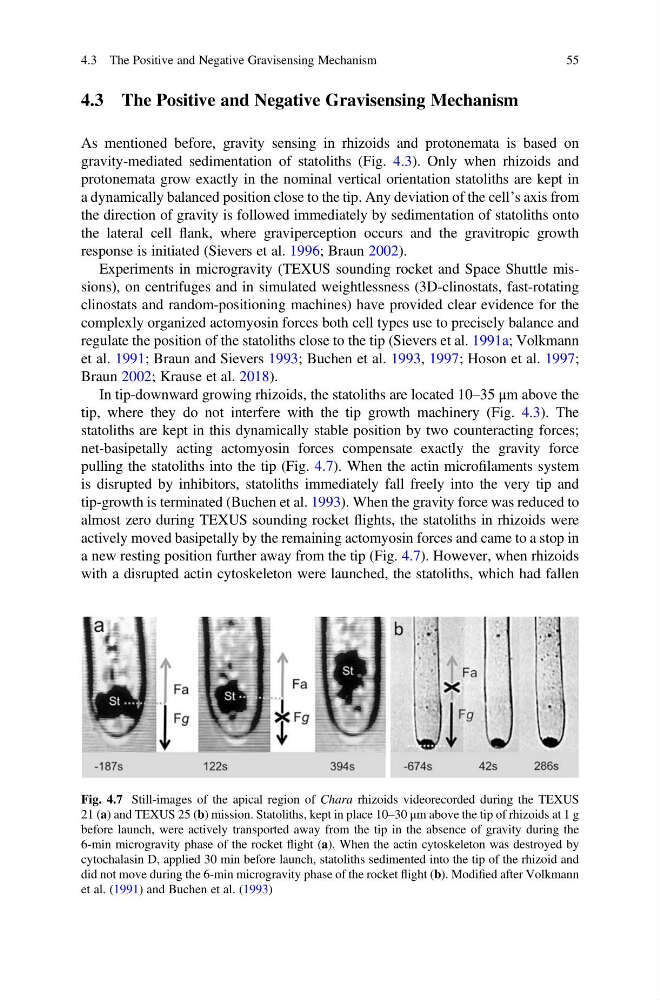
In tip-downward growing rhizoids, the statoliths are located 10–35 μm above the
tip, where they do not interfere with the tip growth machinery (Fig. 4.3). The
statoliths are kept in this dynamically stable position by two counteracting forces;
net-basipetally acting actomyosin forces compensate exactly the gravity force
pulling the statoliths into the tip (Fig. 4.7). When the actin microfilaments system
is disrupted by inhibitors, statoliths immediately fall freely into the very tip and
tip-growth is terminated (Buchen et al. 1993). When the gravity force was reduced to
almost zero during TEXUS sounding rocket flights, the statoliths in rhizoids were
actively moved basipetally by the remaining actomyosin forces and came to a stop in
a new resting position further away from the tip (Fig. 4.7). However, when rhizoids
with a disrupted actin cytoskeleton were launched, the statoliths, which had fallen
Fig. 4.7 Still-images of the apical region of Chara rhizoids videorecorded during the TEXUS
21 (a) and TEXUS 25 (b) mission. Statoliths, kept in place 10–30 μm above the tip of rhizoids at 1 g
before launch, were actively transported away from the tip in the absence of gravity during the
6-min microgravity phase of the rocket flight (a). When the actin cytoskeleton was destroyed by
cytochalasin D, applied 30 min before launch, statoliths sedimented into the tip of the rhizoid and
did not move during the 6-min microgravity phase of the rocket flight (b). Modified after Volkmann
et al. (1991) and Buchen et al. (1993)
4.3 The Positive and Negative Gravisensing Mechanism
55
As mentioned before, gravity sensing in rhizoids and protonemata is based on
gravity-mediated sedimentation of statoliths (Fig. 4.3). Only when rhizoids and
protonemata grow exactly in the nominal vertical orientation statoliths are kept in
a dynamically balanced position close to the tip. Any deviation of the cell’s axis from
the direction of gravity is followed immediately by sedimentation of statoliths onto
the lateral cell flank, where graviperception occurs and the gravitropic growth
response is initiated (Sievers et al. 1996; Braun 2002).
Experiments in microgravity (TEXUS sounding rocket and Space Shuttle missions), on centrifuges and in simulated weightlessness (3D-clinostats, fast-rotating
clinostats and random-positioning machines) have provided clear evidence for the
complexly organized actomyosin forces both cell types use to precisely balance and
regulate the position of the statoliths close to the tip (Sievers et al. 1991a; Volkmann
et al. 1991; Braun and Sievers 1993; Buchen et al. 1993, 1997; Hoson et al. 1997;
Braun 2002; Krause et al. 2018).
In tip-downward growing rhizoids, the statoliths are located 10–35 μm above the
tip, where they do not interfere with the tip growth machinery (Fig. 4.3). The
statoliths are kept in this dynamically stable position by two counteracting forces;
net-basipetally acting actomyosin forces compensate exactly the gravity force
pulling the statoliths into the tip (Fig. 4.7). When the actin microfilaments system
is disrupted by inhibitors, statoliths immediately fall freely into the very tip and
tip-growth is terminated (Buchen et al. 1993). When the gravity force was reduced to
almost zero during TEXUS sounding rocket flights, the statoliths in rhizoids were
actively moved basipetally by the remaining actomyosin forces and came to a stop in
a new resting position further away from the tip (Fig. 4.7). However, when rhizoids
with a disrupted actin cytoskeleton were launched, the statoliths, which had fallen
Fig. 4.7 Still-images of the apical region of Chara rhizoids videorecorded during the TEXUS
21 (a) and TEXUS 25 (b) mission. Statoliths, kept in place 10–30 μm above the tip of rhizoids at 1 g
before launch, were actively transported away from the tip in the absence of gravity during the
6-min microgravity phase of the rocket flight (a). When the actin cytoskeleton was destroyed by
cytochalasin D, applied 30 min before launch, statoliths sedimented into the tip of the rhizoid and
did not move during the 6-min microgravity phase of the rocket flight (b). Modified after Volkmann
et al. (1991) and Buchen et al. (1993)
4.3 The Positive and Negative Gravisensing Mechanism
55