

into the tip before launch, did not move at all during the microgravity phase
(Fig. 4.7).
Protonemata grow upward, against the direction of gravity, and, accordingly,
actomyosin forces act net-acropetally in order to prevent statoliths from sedimenting
towards the cell base (Hodick et al. 1998; Braun 2002). Protonemata statoliths are
kept in a dynamically stable resting position 10–100 μm below the cell tip (Fig. 4.3).
Microgravity experiments (Buchen et al. 1997; Braun et al. 2002) and optical
laser tweezers experiments (Leitz et al. 1995; Braun 2002) have been performed
to characterize in detail the complexly arranged actomyosin forces that regulate
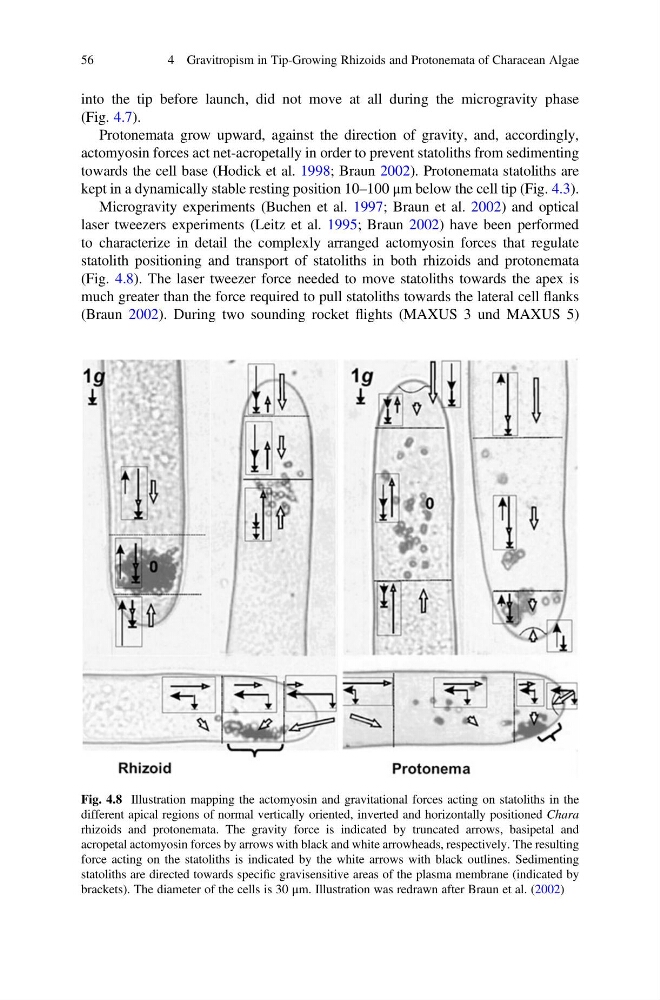
statolith positioning and transport of statoliths in both rhizoids and protonemata
(Fig. 4.8). The laser tweezer force needed to move statoliths towards the apex is
much greater than the force required to pull statoliths towards the lateral cell flanks
(Braun 2002). During two sounding rocket flights (MAXUS 3 und MAXUS 5)
Fig. 4.8 Illustration mapping the actomyosin and gravitational forces acting on statoliths in the
different apical regions of normal vertically oriented, inverted and horizontally positioned Chara
rhizoids and protonemata. The gravity force is indicated by truncated arrows, basipetal and
acropetal actomyosin forces by arrows with black and white arrowheads, respectively. The resulting
force acting on the statoliths is indicated by the white arrows with black outlines. Sedimenting
statoliths are directed towards specific gravisensitive areas of the plasma membrane (indicated by
brackets). The diameter of the cells is 30 μm. Illustration was redrawn after Braun et al. (2002)
56
4 Gravitropism in Tip-Growing Rhizoids and Protonemata of Characean Algae
(Fig. 4.7).
Protonemata grow upward, against the direction of gravity, and, accordingly,
actomyosin forces act net-acropetally in order to prevent statoliths from sedimenting
towards the cell base (Hodick et al. 1998; Braun 2002). Protonemata statoliths are
kept in a dynamically stable resting position 10–100 μm below the cell tip (Fig. 4.3).
Microgravity experiments (Buchen et al. 1997; Braun et al. 2002) and optical
laser tweezers experiments (Leitz et al. 1995; Braun 2002) have been performed
to characterize in detail the complexly arranged actomyosin forces that regulate
statolith positioning and transport of statoliths in both rhizoids and protonemata
(Fig. 4.8). The laser tweezer force needed to move statoliths towards the apex is
much greater than the force required to pull statoliths towards the lateral cell flanks
(Braun 2002). During two sounding rocket flights (MAXUS 3 und MAXUS 5)
Fig. 4.8 Illustration mapping the actomyosin and gravitational forces acting on statoliths in the
different apical regions of normal vertically oriented, inverted and horizontally positioned Chara
rhizoids and protonemata. The gravity force is indicated by truncated arrows, basipetal and
acropetal actomyosin forces by arrows with black and white arrowheads, respectively. The resulting
force acting on the statoliths is indicated by the white arrows with black outlines. Sedimenting
statoliths are directed towards specific gravisensitive areas of the plasma membrane (indicated by
brackets). The diameter of the cells is 30 μm. Illustration was redrawn after Braun et al. (2002)
56
4 Gravitropism in Tip-Growing Rhizoids and Protonemata of Characean Algae