

however, is limited to a relative small number of cell types like the rhizoids and
protonema of characean algae and the apical protonema and caulonema cells of
mosses and ferns. In these cell types, the growth direction is strictly governed by the
gravity vector (Sievers et al. 1996; Braun 1997; Braun and Limbach 2006).
Characean rhizoids and protonemata exhibit a prominent polar cytoplasmic
organization. While actin is the essential cytoskeletal component for all motile
processes and is found in all regions of the cell, microtubules maintain the cytoplasmic zonation, stabilize the basal vacuolar zone and the position of the slowly rotating
nucleus as well as the organelle distribution in the relatively stationary subapical
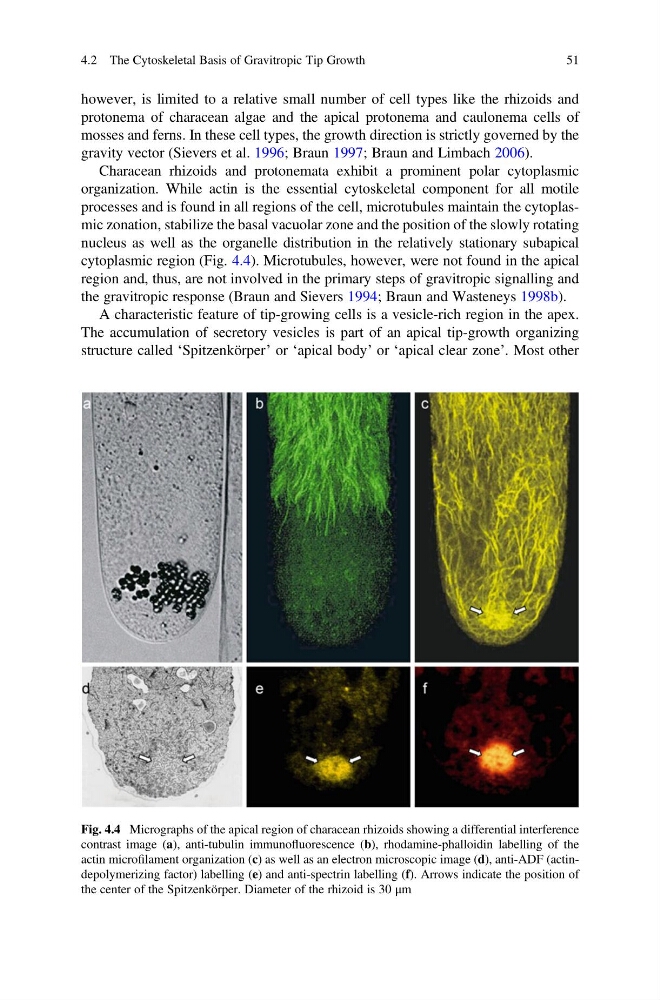
cytoplasmic region (Fig. 4.4). Microtubules, however, were not found in the apical
region and, thus, are not involved in the primary steps of gravitropic signalling and
the gravitropic response (Braun and Sievers 1994; Braun and Wasteneys 1998b).
A characteristic feature of tip-growing cells is a vesicle-rich region in the apex.
The accumulation of secretory vesicles is part of an apical tip-growth organizing
structure called ‘Spitzenkörper’ or ‘apical body’ or ‘apical clear zone’. Most other
Fig. 4.4 Micrographs of the apical region of characean rhizoids showing a differential interference
contrast image (a), anti-tubulin immunofluorescence (b), rhodamine-phalloidin labelling of the
actin microfilament organization (c) as well as an electron microscopic image (d), anti-ADF (actindepolymerizing factor) labelling (e) and anti-spectrin labelling (f). Arrows indicate the position of
the center of the Spitzenkörper. Diameter of the rhizoid is 30 μm
4.2 The Cytoskeletal Basis of Gravitropic Tip Growth
51
protonema of characean algae and the apical protonema and caulonema cells of
mosses and ferns. In these cell types, the growth direction is strictly governed by the
gravity vector (Sievers et al. 1996; Braun 1997; Braun and Limbach 2006).
Characean rhizoids and protonemata exhibit a prominent polar cytoplasmic
organization. While actin is the essential cytoskeletal component for all motile
processes and is found in all regions of the cell, microtubules maintain the cytoplasmic zonation, stabilize the basal vacuolar zone and the position of the slowly rotating
nucleus as well as the organelle distribution in the relatively stationary subapical
cytoplasmic region (Fig. 4.4). Microtubules, however, were not found in the apical
region and, thus, are not involved in the primary steps of gravitropic signalling and
the gravitropic response (Braun and Sievers 1994; Braun and Wasteneys 1998b).
A characteristic feature of tip-growing cells is a vesicle-rich region in the apex.
The accumulation of secretory vesicles is part of an apical tip-growth organizing
structure called ‘Spitzenkörper’ or ‘apical body’ or ‘apical clear zone’. Most other
Fig. 4.4 Micrographs of the apical region of characean rhizoids showing a differential interference
contrast image (a), anti-tubulin immunofluorescence (b), rhodamine-phalloidin labelling of the
actin microfilament organization (c) as well as an electron microscopic image (d), anti-ADF (actindepolymerizing factor) labelling (e) and anti-spectrin labelling (f). Arrows indicate the position of
the center of the Spitzenkörper. Diameter of the rhizoid is 30 μm
4.2 The Cytoskeletal Basis of Gravitropic Tip Growth
51