

whole cytoplasmic contents onto the cell membrane, this will only function when
the outer medium has a specific density which is smaller than that of the cytoplasm.
This principle cannot work, if the density of the outer medium and the one of the
cytoplasm are equal, resulting in a loss of graviorientation. If the density of the outer
medium exceeds that of the cytoplasm the cells will orient themselves in the opposite
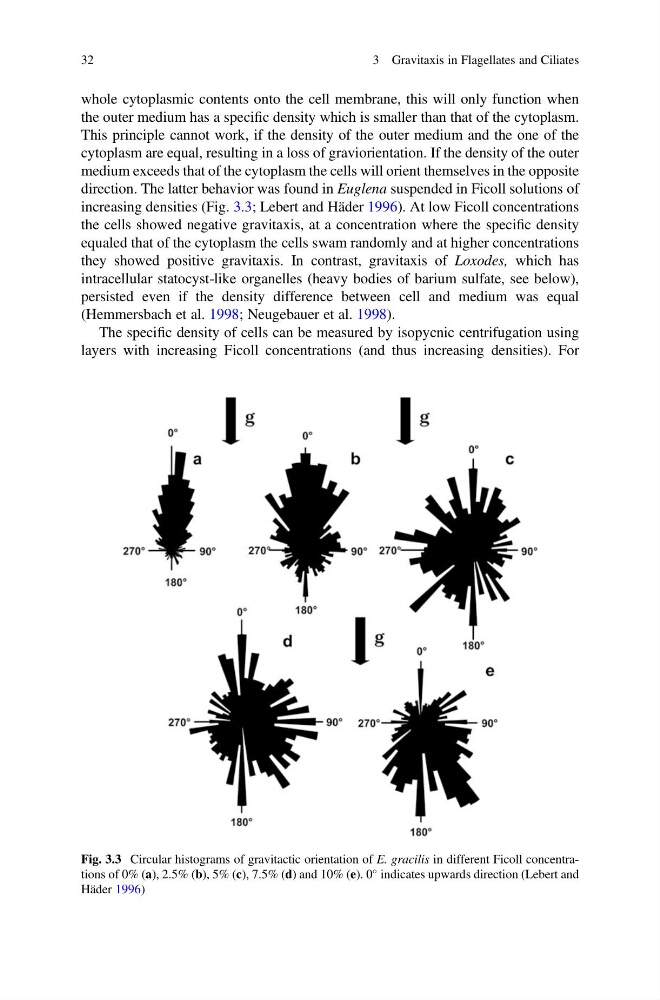
direction. The latter behavior was found in Euglena suspended in Ficoll solutions of
increasing densities (Fig. 3.3; Lebert and Häder 1996). At low Ficoll concentrations
the cells showed negative gravitaxis, at a concentration where the specific density
equaled that of the cytoplasm the cells swam randomly and at higher concentrations
they showed positive gravitaxis. In contrast, gravitaxis of Loxodes, which has
intracellular statocyst-like organelles (heavy bodies of barium sulfate, see below),
persisted even if the density difference between cell and medium was equal
(Hemmersbach et al. 1998; Neugebauer et al. 1998).
The specific density of cells can be measured by isopycnic centrifugation using
layers with increasing Ficoll concentrations (and thus increasing densities). For
Fig. 3.3 Circular histograms of gravitactic orientation of E. gracilis in different Ficoll concentrations of 0% (a), 2.5% (b), 5% (c), 7.5% (d) and 10% (e). 0
indicates upwards direction (Lebert and
Häder 1996)
32
3 Gravitaxis in Flagellates and Ciliates
the outer medium has a specific density which is smaller than that of the cytoplasm.
This principle cannot work, if the density of the outer medium and the one of the
cytoplasm are equal, resulting in a loss of graviorientation. If the density of the outer
medium exceeds that of the cytoplasm the cells will orient themselves in the opposite
direction. The latter behavior was found in Euglena suspended in Ficoll solutions of
increasing densities (Fig. 3.3; Lebert and Häder 1996). At low Ficoll concentrations
the cells showed negative gravitaxis, at a concentration where the specific density
equaled that of the cytoplasm the cells swam randomly and at higher concentrations
they showed positive gravitaxis. In contrast, gravitaxis of Loxodes, which has
intracellular statocyst-like organelles (heavy bodies of barium sulfate, see below),
persisted even if the density difference between cell and medium was equal
(Hemmersbach et al. 1998; Neugebauer et al. 1998).
The specific density of cells can be measured by isopycnic centrifugation using
layers with increasing Ficoll concentrations (and thus increasing densities). For
Fig. 3.3 Circular histograms of gravitactic orientation of E. gracilis in different Ficoll concentrations of 0% (a), 2.5% (b), 5% (c), 7.5% (d) and 10% (e). 0
indicates upwards direction (Lebert and
Häder 1996)
32
3 Gravitaxis in Flagellates and Ciliates