

Euglena two bands were found corresponding to specific densities of 1.046 and
1.054 g/mL; the lower value refers to young cells after cell division and the higher to
older cells (Lebert et al. 1999b). After keeping a Euglena culture for more than
600 days completely enclosed the cell density had dropped to 1.011 g/mL and these
cells had lost their ability for gravitactic orientation (Häder et al. 2005a). For
comparison the ciliates Bursaria truncatella and Paramecium caudatum were
found to have a specific density of 1.04 g/mL (Krause 1999), Loxodes striatus of
1.03 g/mL, while its Müller bodies consisting of barium sulfate and acting as
statoliths have a specific density of 4.4 g/mL (Hemmersbach et al. 1998).
Several hypotheses have been formulated to explain the mechanism of gravitaxis
(Machemer and Bräucker 1992; Barlow 1995; Hemmersbach et al. 1999). One
interpretation posits a purely passive phenomenon based on buoyancy. In a tailheavy cell the front end will point upward; in Euglena the apical trailing flagellum
would propel the cell away from the center of gravity (Fukui and Asai 1985).
However, microscopy does not reveal any heavy particles in the rear part of the
cell. In order to test the hypothesis, we immobilized cells by injecting them into
liquid nitrogen. These dead cells showed random orientation in the medium while
the living controls were oriented with their apical ends upwards (Häder et al. 2005c).
Roberts (1970) proposed an alternative model for graviperception in cells which lack
sedimenting statoliths, dubbed drag-gravity model. While in the gravity-buoyancy
model one Reynolds number describes sedimentation, in the drag-gravity model
separate Reynolds numbers are used for the front and rear ends. In this explanation
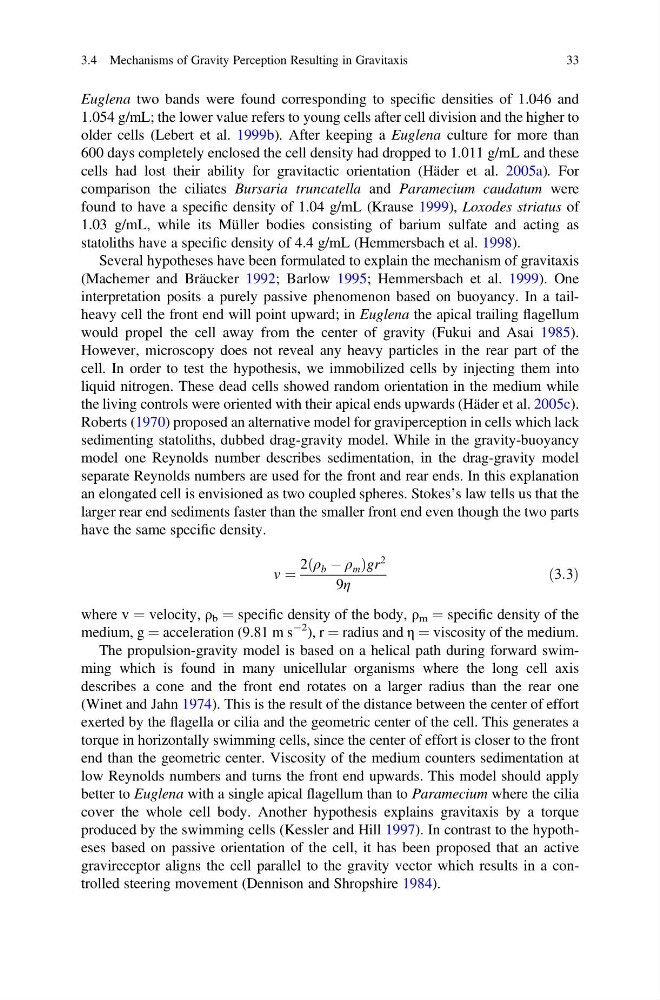
an elongated cell is envisioned as two coupled spheres. Stokes’s law tells us that the
larger rear end sediments faster than the smaller front end even though the two parts
have the same specific density.
v ¼
2 ρ b À ρ m
ð
Þ gr
2
9η
ð3:3Þ
where v ¼ velocity, ρ b ¼ specific density of the body, ρ m ¼ specific density of the
medium, g ¼ acceleration (9.81 m s
À2 ), r ¼ radius and η ¼ viscosity of the medium.
The propulsion-gravity model is based on a helical path during forward swimming which is found in many unicellular organisms where the long cell axis
describes a cone and the front end rotates on a larger radius than the rear one
(Winet and Jahn 1974). This is the result of the distance between the center of effort
exerted by the flagella or cilia and the geometric center of the cell. This generates a
torque in horizontally swimming cells, since the center of effort is closer to the front
end than the geometric center. Viscosity of the medium counters sedimentation at
low Reynolds numbers and turns the front end upwards. This model should apply
better to Euglena with a single apical flagellum than to Paramecium where the cilia
cover the whole cell body. Another hypothesis explains gravitaxis by a torque
produced by the swimming cells (Kessler and Hill 1997). In contrast to the hypotheses based on passive orientation of the cell, it has been proposed that an active
gravireceptor aligns the cell parallel to the gravity vector which results in a controlled steering movement (Dennison and Shropshire 1984).
3.4 Mechanisms of Gravity Perception Resulting in Gravitaxis
33
1.054 g/mL; the lower value refers to young cells after cell division and the higher to
older cells (Lebert et al. 1999b). After keeping a Euglena culture for more than
600 days completely enclosed the cell density had dropped to 1.011 g/mL and these
cells had lost their ability for gravitactic orientation (Häder et al. 2005a). For
comparison the ciliates Bursaria truncatella and Paramecium caudatum were
found to have a specific density of 1.04 g/mL (Krause 1999), Loxodes striatus of
1.03 g/mL, while its Müller bodies consisting of barium sulfate and acting as
statoliths have a specific density of 4.4 g/mL (Hemmersbach et al. 1998).
Several hypotheses have been formulated to explain the mechanism of gravitaxis
(Machemer and Bräucker 1992; Barlow 1995; Hemmersbach et al. 1999). One
interpretation posits a purely passive phenomenon based on buoyancy. In a tailheavy cell the front end will point upward; in Euglena the apical trailing flagellum
would propel the cell away from the center of gravity (Fukui and Asai 1985).
However, microscopy does not reveal any heavy particles in the rear part of the
cell. In order to test the hypothesis, we immobilized cells by injecting them into
liquid nitrogen. These dead cells showed random orientation in the medium while
the living controls were oriented with their apical ends upwards (Häder et al. 2005c).
Roberts (1970) proposed an alternative model for graviperception in cells which lack
sedimenting statoliths, dubbed drag-gravity model. While in the gravity-buoyancy
model one Reynolds number describes sedimentation, in the drag-gravity model
separate Reynolds numbers are used for the front and rear ends. In this explanation
an elongated cell is envisioned as two coupled spheres. Stokes’s law tells us that the
larger rear end sediments faster than the smaller front end even though the two parts
have the same specific density.
v ¼
2 ρ b À ρ m
ð
Þ gr
2
9η
ð3:3Þ
where v ¼ velocity, ρ b ¼ specific density of the body, ρ m ¼ specific density of the
medium, g ¼ acceleration (9.81 m s
À2 ), r ¼ radius and η ¼ viscosity of the medium.
The propulsion-gravity model is based on a helical path during forward swimming which is found in many unicellular organisms where the long cell axis
describes a cone and the front end rotates on a larger radius than the rear one
(Winet and Jahn 1974). This is the result of the distance between the center of effort
exerted by the flagella or cilia and the geometric center of the cell. This generates a
torque in horizontally swimming cells, since the center of effort is closer to the front
end than the geometric center. Viscosity of the medium counters sedimentation at
low Reynolds numbers and turns the front end upwards. This model should apply
better to Euglena with a single apical flagellum than to Paramecium where the cilia
cover the whole cell body. Another hypothesis explains gravitaxis by a torque
produced by the swimming cells (Kessler and Hill 1997). In contrast to the hypotheses based on passive orientation of the cell, it has been proposed that an active
gravireceptor aligns the cell parallel to the gravity vector which results in a controlled steering movement (Dennison and Shropshire 1984).
3.4 Mechanisms of Gravity Perception Resulting in Gravitaxis
33