

3.4 Mechanisms of Gravity Perception Resulting
in Gravitaxis
In Chap. 1 of this volume two principles for graviperception in single cells are being
discussed, based on sedimenting masses. One is based on intracellular statoliths and
the other on the force exerted by the whole mass of the cell itself. Both mechanisms
require the existence of a sensitive structure that transforms the signal and transfers it
to a motile apparatus and thus elicits a response. In gravitactically moving organisms, we can distinguish between the two postulated mechanisms of graviperception
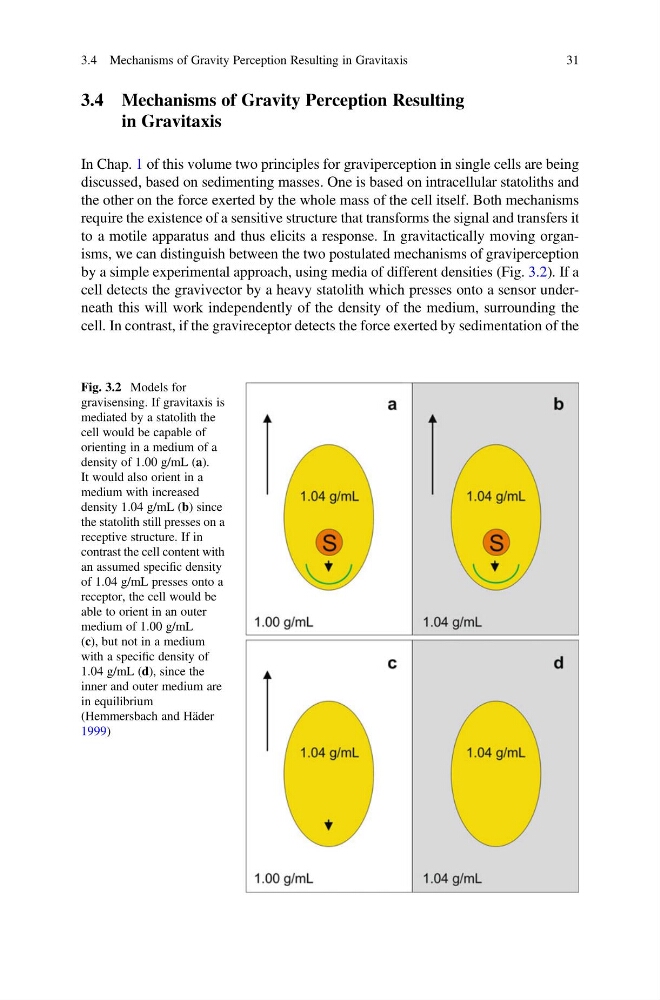
by a simple experimental approach, using media of different densities (Fig. 3.2). If a
cell detects the gravivector by a heavy statolith which presses onto a sensor underneath this will work independently of the density of the medium, surrounding the
cell. In contrast, if the gravireceptor detects the force exerted by sedimentation of the
Fig. 3.2 Models for
gravisensing. If gravitaxis is
mediated by a statolith the
cell would be capable of
orienting in a medium of a
density of 1.00 g/mL (a).
It would also orient in a
medium with increased
density 1.04 g/mL (b) since
the statolith still presses on a
receptive structure. If in
contrast the cell content with
an assumed specific density
of 1.04 g/mL presses onto a
receptor, the cell would be
able to orient in an outer
medium of 1.00 g/mL
(c), but not in a medium
with a specific density of
1.04 g/mL (d), since the
inner and outer medium are
in equilibrium
(Hemmersbach and Häder
1999)
3.4 Mechanisms of Gravity Perception Resulting in Gravitaxis
31
in Gravitaxis
In Chap. 1 of this volume two principles for graviperception in single cells are being
discussed, based on sedimenting masses. One is based on intracellular statoliths and
the other on the force exerted by the whole mass of the cell itself. Both mechanisms
require the existence of a sensitive structure that transforms the signal and transfers it
to a motile apparatus and thus elicits a response. In gravitactically moving organisms, we can distinguish between the two postulated mechanisms of graviperception
by a simple experimental approach, using media of different densities (Fig. 3.2). If a
cell detects the gravivector by a heavy statolith which presses onto a sensor underneath this will work independently of the density of the medium, surrounding the
cell. In contrast, if the gravireceptor detects the force exerted by sedimentation of the
Fig. 3.2 Models for
gravisensing. If gravitaxis is
mediated by a statolith the
cell would be capable of
orienting in a medium of a
density of 1.00 g/mL (a).
It would also orient in a
medium with increased
density 1.04 g/mL (b) since
the statolith still presses on a
receptive structure. If in
contrast the cell content with
an assumed specific density
of 1.04 g/mL presses onto a
receptor, the cell would be
able to orient in an outer
medium of 1.00 g/mL
(c), but not in a medium
with a specific density of
1.04 g/mL (d), since the
inner and outer medium are
in equilibrium
(Hemmersbach and Häder
1999)
3.4 Mechanisms of Gravity Perception Resulting in Gravitaxis
31