

Another advantage of gravitactic orientation is found in gametes which move to
the surface and have a higher chance of meeting their sexual partner than when being
distributed throughout the water column. In contrast, zoospores of many algae were
found to swim downward in order to anchor themselves at the bottom and to grow
into multicellular thalli (Callow et al. 1997).
While early studies of gravitational orientation were based on microscopic or
population observations, modern investigations are carried out using computerbased cell tracking (Häder and Lebert 1985, 2000; Häder and Vogel 1991). The
movements of orienting cells in a vertical swimming chamber are recorded by a
video camera in real time using a microscope objective in an infrared monitoring
light in order not to disturb gravitactic orientation by an interference of phototaxis
(Vogel and Häder 1990). Modern tracking systems can follow numerous cells in
parallel and calculate movement direction, swimming velocity and percentage of
motile organisms as well as cell size and form parameters (Häder and Erzinger 2015;
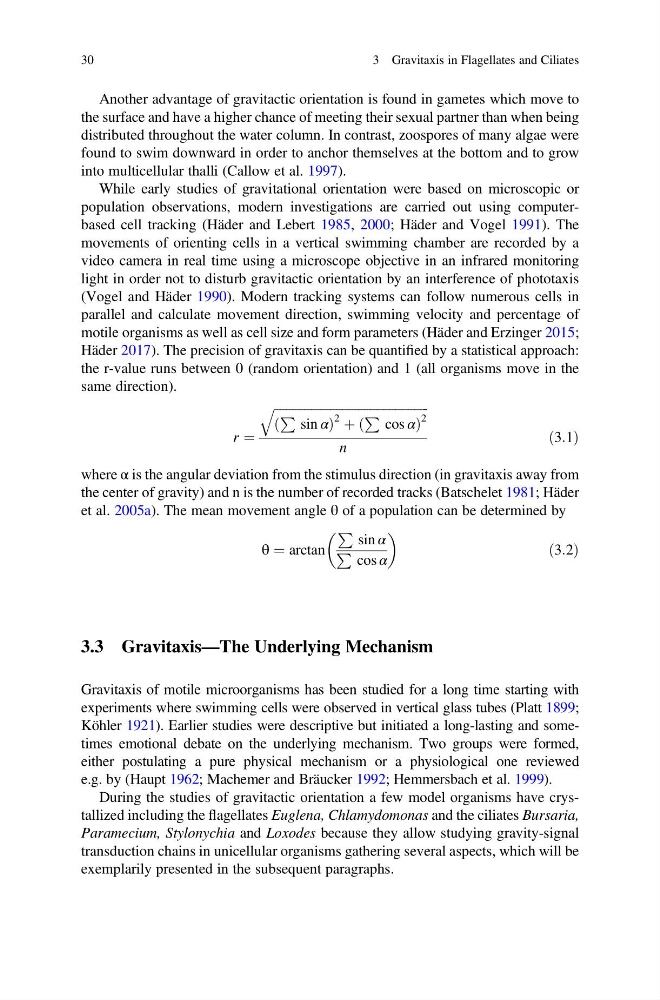
Häder 2017). The precision of gravitaxis can be quantified by a statistical approach:
the r-value runs between 0 (random orientation) and 1 (all organisms move in the
same direction).
r ¼
ffiffiffiffiffiffiffiffiffiffiffiffiffiffiffiffiffiffiffiffiffiffiffiffiffiffiffiffiffiffiffiffiffiffiffiffiffiffiffiffiffiffiffiffiffiffiffiffiffi ffi
P
sin α
ð
Þ
2 þ
P
cos α
ð
Þ
2
q
n
ð3:1Þ
where α is the angular deviation from the stimulus direction (in gravitaxis away from
the center of gravity) and n is the number of recorded tracks (Batschelet 1981; Häder
et al. 2005a). The mean movement angle θ of a population can be determined by
θ ¼ arctan
P
sin α
P
cos α
ð3:2Þ
3.3 Gravitaxis—The Underlying Mechanism
Gravitaxis of motile microorganisms has been studied for a long time starting with
experiments where swimming cells were observed in vertical glass tubes (Platt 1899;
Köhler 1921). Earlier studies were descriptive but initiated a long-lasting and sometimes emotional debate on the underlying mechanism. Two groups were formed,
either postulating a pure physical mechanism or a physiological one reviewed
e.g. by (Haupt 1962; Machemer and Bräucker 1992; Hemmersbach et al. 1999).
During the studies of gravitactic orientation a few model organisms have crystallized including the flagellates Euglena, Chlamydomonas and the ciliates Bursaria,
Paramecium, Stylonychia and Loxodes because they allow studying gravity-signal
transduction chains in unicellular organisms gathering several aspects, which will be
exemplarily presented in the subsequent paragraphs.
30
3 Gravitaxis in Flagellates and Ciliates
the surface and have a higher chance of meeting their sexual partner than when being
distributed throughout the water column. In contrast, zoospores of many algae were
found to swim downward in order to anchor themselves at the bottom and to grow
into multicellular thalli (Callow et al. 1997).
While early studies of gravitational orientation were based on microscopic or
population observations, modern investigations are carried out using computerbased cell tracking (Häder and Lebert 1985, 2000; Häder and Vogel 1991). The
movements of orienting cells in a vertical swimming chamber are recorded by a
video camera in real time using a microscope objective in an infrared monitoring
light in order not to disturb gravitactic orientation by an interference of phototaxis
(Vogel and Häder 1990). Modern tracking systems can follow numerous cells in
parallel and calculate movement direction, swimming velocity and percentage of
motile organisms as well as cell size and form parameters (Häder and Erzinger 2015;
Häder 2017). The precision of gravitaxis can be quantified by a statistical approach:
the r-value runs between 0 (random orientation) and 1 (all organisms move in the
same direction).
r ¼
ffiffiffiffiffiffiffiffiffiffiffiffiffiffiffiffiffiffiffiffiffiffiffiffiffiffiffiffiffiffiffiffiffiffiffiffiffiffiffiffiffiffiffiffiffiffiffiffiffi ffi
P
sin α
ð
Þ
2 þ
P
cos α
ð
Þ
2
q
n
ð3:1Þ
where α is the angular deviation from the stimulus direction (in gravitaxis away from
the center of gravity) and n is the number of recorded tracks (Batschelet 1981; Häder
et al. 2005a). The mean movement angle θ of a population can be determined by
θ ¼ arctan
P
sin α
P
cos α
ð3:2Þ
3.3 Gravitaxis—The Underlying Mechanism
Gravitaxis of motile microorganisms has been studied for a long time starting with
experiments where swimming cells were observed in vertical glass tubes (Platt 1899;
Köhler 1921). Earlier studies were descriptive but initiated a long-lasting and sometimes emotional debate on the underlying mechanism. Two groups were formed,
either postulating a pure physical mechanism or a physiological one reviewed
e.g. by (Haupt 1962; Machemer and Bräucker 1992; Hemmersbach et al. 1999).
During the studies of gravitactic orientation a few model organisms have crystallized including the flagellates Euglena, Chlamydomonas and the ciliates Bursaria,
Paramecium, Stylonychia and Loxodes because they allow studying gravity-signal
transduction chains in unicellular organisms gathering several aspects, which will be
exemplarily presented in the subsequent paragraphs.
30
3 Gravitaxis in Flagellates and Ciliates