

been attributed to the production of reactive oxygen species (ROS) as shown by
the fluorescent probe 2
0 ,7
0 -dichlorodihydrofluorescein diacetate (DCFA-DAL) and
the application of ROS scavengers (Richter et al. 2003b, c). Also the application of
15 g/L NaCl reversed the direction of negative gravitaxis into a positive one (Richter
et al. 2003a).
The precision of gravitactic orientation can be modulated by other environmental
factors, such as oxygen concentration: Loxodes shows a precise positive gravitaxis at
high O 2 concentrations and is less oriented at low concentrations (Finlay et al. 1993).
In contrast, Paramecium shows negative gravitaxis (Hemmersbach-Krause and
Häder 1990; Hemmersbach and Donath 1995) which is more pronounced at a low
oxygen tension than at a higher one (Hemmersbach-Krause et al. 1991). Also the
feeding status and temperature modify the direction and precision of gravitaxis in
Paramecium (Moore 1903). As some microorganisms, such as unicellular algae
(flagellates) orient with respect to light as well as to gravity, these two kinds of
stimuli might be competing environmental clues since gravitaxis was weak in strong
light while in low light the gravity signal outcompetes light (Wager 1911). When
phototactic organisms are exposed to light under microgravity conditions their
phototaxis is more precise than on Earth, clearly showing that these two stimuli
operate synergistically under normal gravity conditions (Häder 1997).
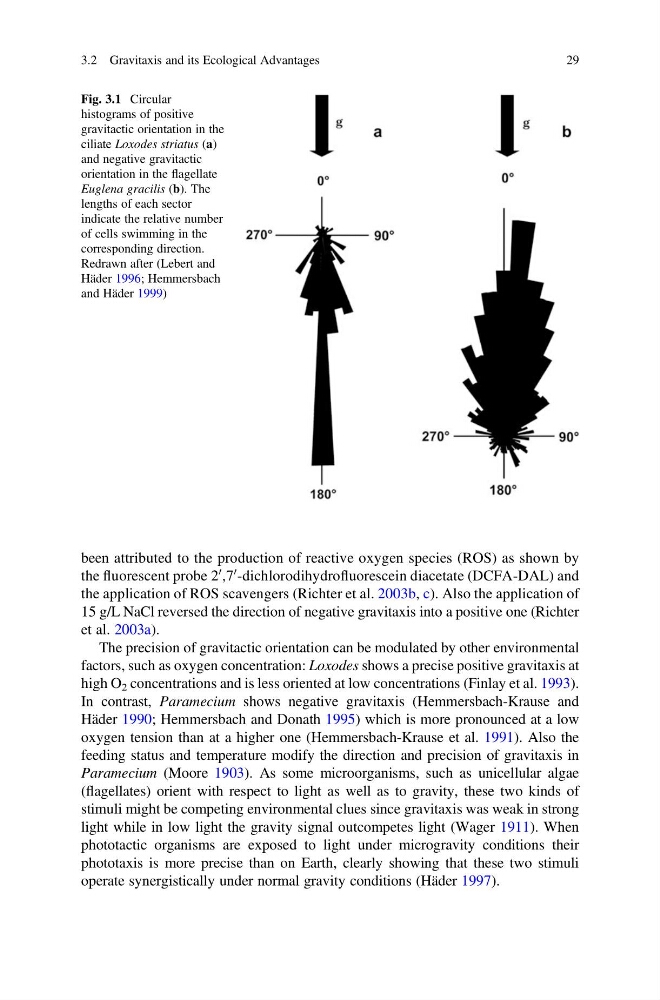
Fig. 3.1 Circular
histograms of positive
gravitactic orientation in the
ciliate Loxodes striatus (a)
and negative gravitactic
orientation in the flagellate
Euglena gracilis (b). The
lengths of each sector
indicate the relative number
of cells swimming in the
corresponding direction.
Redrawn after (Lebert and
Häder 1996; Hemmersbach
and Häder 1999)
3.2 Gravitaxis and its Ecological Advantages
29
the fluorescent probe 2
0 ,7
0 -dichlorodihydrofluorescein diacetate (DCFA-DAL) and
the application of ROS scavengers (Richter et al. 2003b, c). Also the application of
15 g/L NaCl reversed the direction of negative gravitaxis into a positive one (Richter
et al. 2003a).
The precision of gravitactic orientation can be modulated by other environmental
factors, such as oxygen concentration: Loxodes shows a precise positive gravitaxis at
high O 2 concentrations and is less oriented at low concentrations (Finlay et al. 1993).
In contrast, Paramecium shows negative gravitaxis (Hemmersbach-Krause and
Häder 1990; Hemmersbach and Donath 1995) which is more pronounced at a low
oxygen tension than at a higher one (Hemmersbach-Krause et al. 1991). Also the
feeding status and temperature modify the direction and precision of gravitaxis in
Paramecium (Moore 1903). As some microorganisms, such as unicellular algae
(flagellates) orient with respect to light as well as to gravity, these two kinds of
stimuli might be competing environmental clues since gravitaxis was weak in strong
light while in low light the gravity signal outcompetes light (Wager 1911). When
phototactic organisms are exposed to light under microgravity conditions their
phototaxis is more precise than on Earth, clearly showing that these two stimuli
operate synergistically under normal gravity conditions (Häder 1997).
Fig. 3.1 Circular
histograms of positive
gravitactic orientation in the
ciliate Loxodes striatus (a)
and negative gravitactic
orientation in the flagellate
Euglena gracilis (b). The
lengths of each sector
indicate the relative number
of cells swimming in the
corresponding direction.
Redrawn after (Lebert and
Häder 1996; Hemmersbach
and Häder 1999)
3.2 Gravitaxis and its Ecological Advantages
29