

155
Advantages
Limitations
Ref.
Fibroblast-like
cells
Fibroblast
• Patient specific
• Easily accessible
• Multipotent
• Perivascular potential
• Can act as pericyte-like cell when coupled with endothelial
cells
• Limited perivascular potential
• Characteristics vary based off of site of
isolation
• May alter electrophysiological properties
of CMs
[3, 15,
10, 65]
Cardiac
fibroblasts
• Cardiac specific
• Major cellular component of the native myocardium
• Maintain cardiac structure and function
• Found in wound healing post infarction
• Promoted sprouting of endothelial cells in co-culture
• Causes damage to myocardium upon
isolation
• Has experimentally slowed conduction in
co-culture with cardiomyoctes in vitro
[88,
120, 51,
6, 35,
109]
BM-MSC
• Immunomodulatory
• CD73, CD90, and CD105 positive
• Pericyte-like cell
• Multipotent
• Autologous/patient specific
• Stabilize vasculature
• Secrete VEGF, bFGF, Ang-1 and EGF when co-cultured with
ECs
• Painful isolation
• Limited cell numbers
• Can potentially differentiate down the
osteogenic lineage in the myocardium
• May alter electrophysiological properties
of CMs
[124,
49, 90]
hASC
• Pro-angiogenic
• High perivascular potential
• Differentiate down the smooth muscle lineage when
co-cultured with ECs
• Relatively easy isolation
• Immunomodulatory
• May develop gap junctions when coupled cardiomyocytes
• Limited mechanistic information on
effects when coupled with
cardiomyocytes
[76, 77,
47, 48,
34]
Pericytes
• Promote vascular stabilization
• Secrete pro-angiogenic growth factors
• When coupled with cardiomyocytes in vivo have shown
improvement post MI in ejection fraction and fractional
shortening
• Difficult to isolate
• Not an abundant cell source
• Limited data on the CM
electrophysiology when coupled
[62]
6 Strategies for Tissue Engineering Vascularized Cardiac Patches to Treat Myocardial…
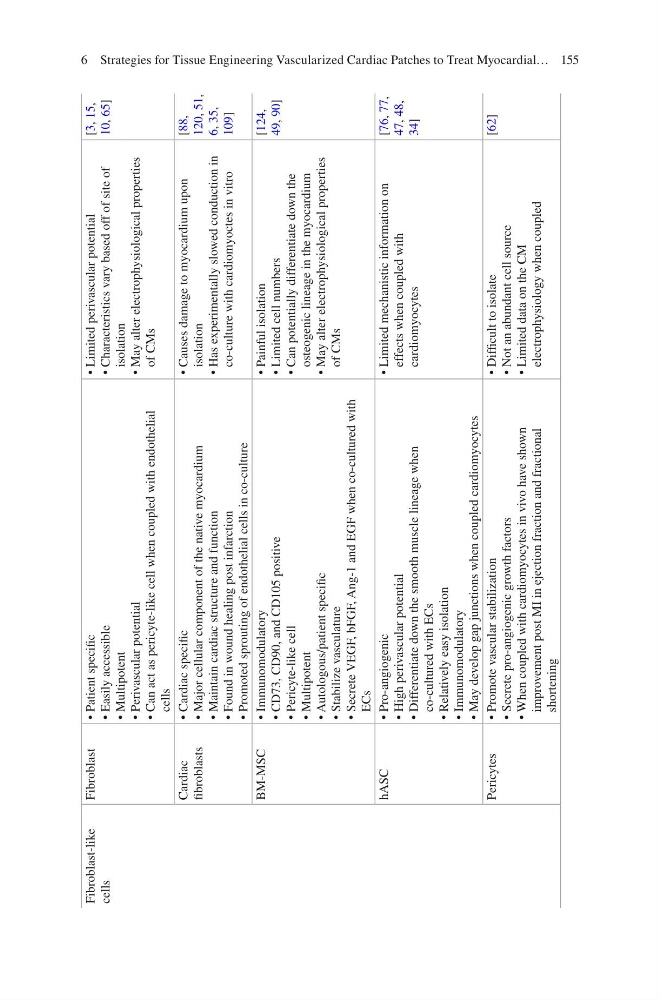
Advantages
Limitations
Ref.
Fibroblast-like
cells
Fibroblast
• Patient specific
• Easily accessible
• Multipotent
• Perivascular potential
• Can act as pericyte-like cell when coupled with endothelial
cells
• Limited perivascular potential
• Characteristics vary based off of site of
isolation
• May alter electrophysiological properties
of CMs
[3, 15,
10, 65]
Cardiac
fibroblasts
• Cardiac specific
• Major cellular component of the native myocardium
• Maintain cardiac structure and function
• Found in wound healing post infarction
• Promoted sprouting of endothelial cells in co-culture
• Causes damage to myocardium upon
isolation
• Has experimentally slowed conduction in
co-culture with cardiomyoctes in vitro
[88,
120, 51,
6, 35,
109]
BM-MSC
• Immunomodulatory
• CD73, CD90, and CD105 positive
• Pericyte-like cell
• Multipotent
• Autologous/patient specific
• Stabilize vasculature
• Secrete VEGF, bFGF, Ang-1 and EGF when co-cultured with
ECs
• Painful isolation
• Limited cell numbers
• Can potentially differentiate down the
osteogenic lineage in the myocardium
• May alter electrophysiological properties
of CMs
[124,
49, 90]
hASC
• Pro-angiogenic
• High perivascular potential
• Differentiate down the smooth muscle lineage when
co-cultured with ECs
• Relatively easy isolation
• Immunomodulatory
• May develop gap junctions when coupled cardiomyocytes
• Limited mechanistic information on
effects when coupled with
cardiomyocytes
[76, 77,
47, 48,
34]
Pericytes
• Promote vascular stabilization
• Secrete pro-angiogenic growth factors
• When coupled with cardiomyocytes in vivo have shown
improvement post MI in ejection fraction and fractional
shortening
• Difficult to isolate
• Not an abundant cell source
• Limited data on the CM
electrophysiology when coupled
[62]
6 Strategies for Tissue Engineering Vascularized Cardiac Patches to Treat Myocardial…