

154
Advantages
Limitations
Ref.
Endothelial
Cells
Primary
endothelial
cells
(HUVECs)
• Mature like endothelial cells from large vessels
• Easily expanded
• Positive for markers CD31, CD54, CD62e, vWF, and AcLDL
• Responsive to exogenous growth factors (i.e. VEGF, FGF2)
• Ability to anastomose with host vasculature in vivo
• Allogenic
• Typically are pooled from multiple
donors
• Sensitive to cell density during expansion
• Sensitive to hypoxia
[90, 25,
73, 87,
130]
hECFCs/
BOECs/
EPCs
• Progenitor cells
• Found in circulation
• CD31, CD34, CD105, CD144, CD146, vWF, eNOS,
VEGFR2 positive
• Autologous/patient specific
• Ability to anastomose with host vasculature
• Found in sites of ischemia and wound healing
• Paracrine support for myocytes
• Express Connexin 43 (Cx-43) and Cx-45
• Integrate with resident vasculature
• Can be used for many passages in vitro
• Low in number in peripheral blood
• Require many expansions
• Slow growing initially
[90, 22,
30]
hESC-ECs
• Can form tubes like structures in vitro with sorted pure
population
• Can anastomose with host vasculature in vivo
• CD31 positive
• Ethics
• Immunogenicity
• Teratocarcinoma formation
• Differentiation protocol varies causing
potential instability in passages post
differentiation
• Requires selection for EC specific cells
[17, 46,
66]
hiPSC-ECs
• Autologous/patient specific
• Can be disease specific
• Can form tubes like structures in vitro with sorted pure
population
• Can anastomose with host vasculature in vivo
• Have the ability to develop large numbers of endothelial cells
quickly
• Various differentiation protocols
• Interline variability due to
reprogramming methods. Differentiation
protocol varies causing high
heterogeneity in the derived ECs
• Requires flow sorting/magnetic sorting
for EC specific cells
[59, 58,
69,
105]
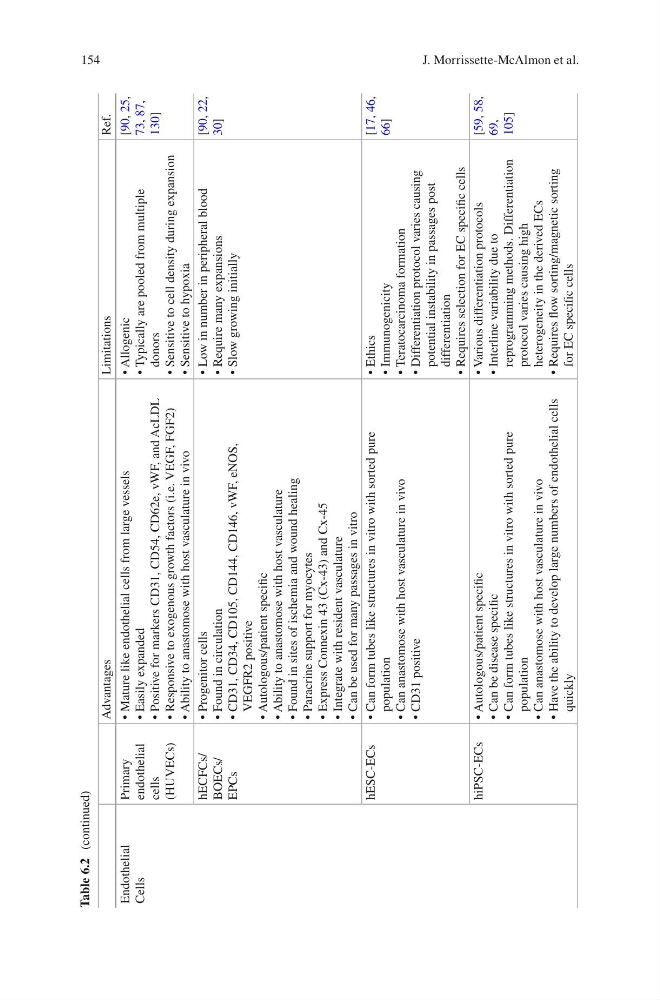
Table 6.2 (continued)
J. Morrissette-McAlmon et al.
Advantages
Limitations
Ref.
Endothelial
Cells
Primary
endothelial
cells
(HUVECs)
• Mature like endothelial cells from large vessels
• Easily expanded
• Positive for markers CD31, CD54, CD62e, vWF, and AcLDL
• Responsive to exogenous growth factors (i.e. VEGF, FGF2)
• Ability to anastomose with host vasculature in vivo
• Allogenic
• Typically are pooled from multiple
donors
• Sensitive to cell density during expansion
• Sensitive to hypoxia
[90, 25,
73, 87,
130]
hECFCs/
BOECs/
EPCs
• Progenitor cells
• Found in circulation
• CD31, CD34, CD105, CD144, CD146, vWF, eNOS,
VEGFR2 positive
• Autologous/patient specific
• Ability to anastomose with host vasculature
• Found in sites of ischemia and wound healing
• Paracrine support for myocytes
• Express Connexin 43 (Cx-43) and Cx-45
• Integrate with resident vasculature
• Can be used for many passages in vitro
• Low in number in peripheral blood
• Require many expansions
• Slow growing initially
[90, 22,
30]
hESC-ECs
• Can form tubes like structures in vitro with sorted pure
population
• Can anastomose with host vasculature in vivo
• CD31 positive
• Ethics
• Immunogenicity
• Teratocarcinoma formation
• Differentiation protocol varies causing
potential instability in passages post
differentiation
• Requires selection for EC specific cells
[17, 46,
66]
hiPSC-ECs
• Autologous/patient specific
• Can be disease specific
• Can form tubes like structures in vitro with sorted pure
population
• Can anastomose with host vasculature in vivo
• Have the ability to develop large numbers of endothelial cells
quickly
• Various differentiation protocols
• Interline variability due to
reprogramming methods. Differentiation
protocol varies causing high
heterogeneity in the derived ECs
• Requires flow sorting/magnetic sorting
for EC specific cells
[59, 58,
69,
105]
Table 6.2 (continued)
J. Morrissette-McAlmon et al.