

156
seeding strategy, whereby cardiomyocytes are cultured for a period of time before
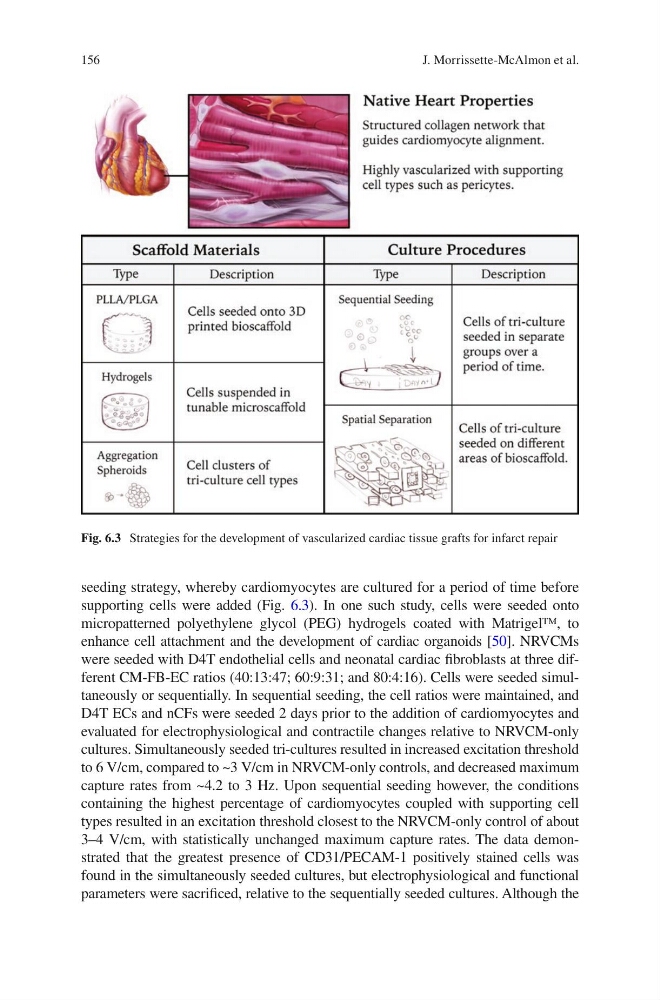
supporting cells were added (Fig. 6.3). In one such study, cells were seeded onto
micropatterned polyethylene glycol (PEG) hydrogels coated with Matrigel™, to
enhance cell attachment and the development of cardiac organoids [50]. NRVCMs
were seeded with D4T endothelial cells and neonatal cardiac fibroblasts at three different CM-FB-EC ratios (40:13:47; 60:9:31; and 80:4:16). Cells were seeded simultaneously or sequentially. In sequential seeding, the cell ratios were maintained, and
D4T ECs and nCFs were seeded 2 days prior to the addition of cardiomyocytes and
evaluated for electrophysiological and contractile changes relative to NRVCM-only
cultures. Simultaneously seeded tri-cultures resulted in increased excitation threshold
to 6 V/cm, compared to ~3 V/cm in NRVCM-only controls, and decreased maximum
capture rates from ~4.2 to 3 Hz. Upon sequential seeding however, the conditions
containing the highest percentage of cardiomyocytes coupled with supporting cell
types resulted in an excitation threshold closest to the NRVCM-only control of about
3–4 V/cm, with statistically unchanged maximum capture rates. The data demonstrated that the greatest presence of CD31/PECAM-1 positively stained cells was
found in the simultaneously seeded cultures, but electrophysiological and functional
parameters were sacrificed, relative to the sequentially seeded cultures. Although the
Fig. 6.3 Strategies for the development of vascularized cardiac tissue grafts for infarct repair
J. Morrissette-McAlmon et al.
seeding strategy, whereby cardiomyocytes are cultured for a period of time before
supporting cells were added (Fig. 6.3). In one such study, cells were seeded onto
micropatterned polyethylene glycol (PEG) hydrogels coated with Matrigel™, to
enhance cell attachment and the development of cardiac organoids [50]. NRVCMs
were seeded with D4T endothelial cells and neonatal cardiac fibroblasts at three different CM-FB-EC ratios (40:13:47; 60:9:31; and 80:4:16). Cells were seeded simultaneously or sequentially. In sequential seeding, the cell ratios were maintained, and
D4T ECs and nCFs were seeded 2 days prior to the addition of cardiomyocytes and
evaluated for electrophysiological and contractile changes relative to NRVCM-only
cultures. Simultaneously seeded tri-cultures resulted in increased excitation threshold
to 6 V/cm, compared to ~3 V/cm in NRVCM-only controls, and decreased maximum
capture rates from ~4.2 to 3 Hz. Upon sequential seeding however, the conditions
containing the highest percentage of cardiomyocytes coupled with supporting cell
types resulted in an excitation threshold closest to the NRVCM-only control of about
3–4 V/cm, with statistically unchanged maximum capture rates. The data demonstrated that the greatest presence of CD31/PECAM-1 positively stained cells was
found in the simultaneously seeded cultures, but electrophysiological and functional
parameters were sacrificed, relative to the sequentially seeded cultures. Although the
Fig. 6.3 Strategies for the development of vascularized cardiac tissue grafts for infarct repair
J. Morrissette-McAlmon et al.