

147
(continued)
Cells
Culture conditions
Cardiac characterization
Vascular characterization
Ref.
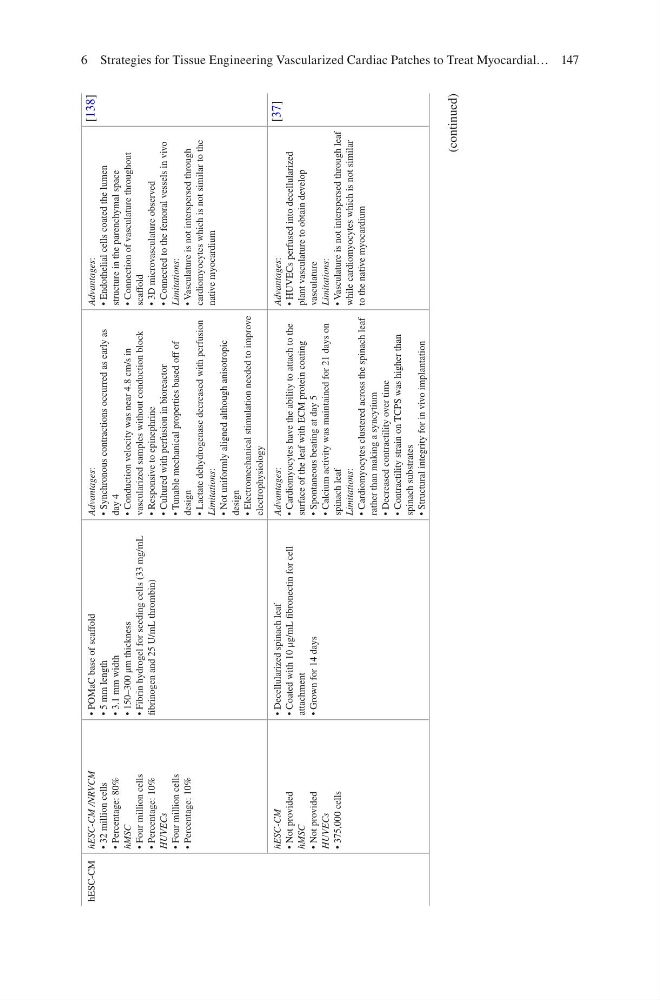
hESC-CM hESC-CM /NRVCM
• 32 million cells
• Percentage: 80%
hMSC
• Four million cells
• Percentage: 10%
HUVECs
• Four million cells
• Percentage: 10%
• POMaC base of scaffold
• 5 mm length
• 3.1 mm width
• 150–300 μm thickness
• Fibrin hydrogel for seeding cells (33 mg/mL
fibrinogen and 25 U/mL thrombin)
Advantages:
• Synchronous contractions occurred as early as
day 4
• Conduction velocity was near 4.8 cm/s in
vascularized samples without conduction block
• Responsive to epinephrine
• Cultured with perfusion in bioreactor
• Tunable mechanical properties based off of
design
• Lactate dehydrogenase decreased with perfusion
Limitations:
• Not uniformly aligned although anisotropic
design
• Electromechanical stimulation needed to improve
electrophysiology
Advantages:
• Endothelial cells coated the lumen
structure in the parenchymal space
• Connection of vasculature throughout
scaffold
• 3D microvasculature observed
• Connected to the femoral vessels in vivo
Limitations:
• Vasculature is not interspersed through
cardiomyocytes which is not similar to the
native myocardium
[138]
hESC-CM
• Not provided
hMSC
• Not provided
HUVECs
• 375,000 cells
• Decellularized spinach leaf
• Coated with 10 μg/mL fibronectin for cell
attachment
• Grown for 14 days
Advantages:
• Cardiomyocytes have the ability to attach to the
surface of the leaf with ECM protein coating
• Spontaneous beating at day 5
• Calcium activity was maintained for 21 days on
spinach leaf
Limitations:
• Cardiomyocytes clustered across the spinach leaf
rather than making a syncytium
• Decreased contractility over time
• Contractility strain on TCPS was higher than
spinach substrates
• Structural integrity for in vivo implantation
Advantages:
• HUVECs perfused into decellularized
plant vasculature to obtain develop
vasculature
Limitations:
• Vasculature is not interspersed through leaf
while cardiomyocytes which is not similar
to the native myocardium
[37]
6 Strategies for Tissue Engineering Vascularized Cardiac Patches to Treat Myocardial…
(continued)
Cells
Culture conditions
Cardiac characterization
Vascular characterization
Ref.
hESC-CM hESC-CM /NRVCM
• 32 million cells
• Percentage: 80%
hMSC
• Four million cells
• Percentage: 10%
HUVECs
• Four million cells
• Percentage: 10%
• POMaC base of scaffold
• 5 mm length
• 3.1 mm width
• 150–300 μm thickness
• Fibrin hydrogel for seeding cells (33 mg/mL
fibrinogen and 25 U/mL thrombin)
Advantages:
• Synchronous contractions occurred as early as
day 4
• Conduction velocity was near 4.8 cm/s in
vascularized samples without conduction block
• Responsive to epinephrine
• Cultured with perfusion in bioreactor
• Tunable mechanical properties based off of
design
• Lactate dehydrogenase decreased with perfusion
Limitations:
• Not uniformly aligned although anisotropic
design
• Electromechanical stimulation needed to improve
electrophysiology
Advantages:
• Endothelial cells coated the lumen
structure in the parenchymal space
• Connection of vasculature throughout
scaffold
• 3D microvasculature observed
• Connected to the femoral vessels in vivo
Limitations:
• Vasculature is not interspersed through
cardiomyocytes which is not similar to the
native myocardium
[138]
hESC-CM
• Not provided
hMSC
• Not provided
HUVECs
• 375,000 cells
• Decellularized spinach leaf
• Coated with 10 μg/mL fibronectin for cell
attachment
• Grown for 14 days
Advantages:
• Cardiomyocytes have the ability to attach to the
surface of the leaf with ECM protein coating
• Spontaneous beating at day 5
• Calcium activity was maintained for 21 days on
spinach leaf
Limitations:
• Cardiomyocytes clustered across the spinach leaf
rather than making a syncytium
• Decreased contractility over time
• Contractility strain on TCPS was higher than
spinach substrates
• Structural integrity for in vivo implantation
Advantages:
• HUVECs perfused into decellularized
plant vasculature to obtain develop
vasculature
Limitations:
• Vasculature is not interspersed through leaf
while cardiomyocytes which is not similar
to the native myocardium
[37]
6 Strategies for Tissue Engineering Vascularized Cardiac Patches to Treat Myocardial…