

11.4 Pre-Reconstruction Approaches
Computational approaches to signal optimization, including many of those already
described for post-reconstruction optimization, may be applied to image tilt series
prior to calculating a 3D reconstruction. Pre-reconstruction approaches may help
overcome the ill-posedness of reconstruction algorithms and reduce artefacts due to
the limited range of angular projections and the limited sampling rate.
A popular approach is to reduce the size of each tilt projection, by binning pixels
in the aligned tilt projection stack (while at the same time reducing noise). The
greater the bin size, the clearer is the output image, but at the expense of substantial
image resolution loss.
An alternative approach is to apply a 2D Gaussian filter to each tilt projection in
the stack. The pre-reconstruction application of a Gaussian filter may be preferred
over applying a 3D Gaussian blurring to the reconstructed images, for two reasons:
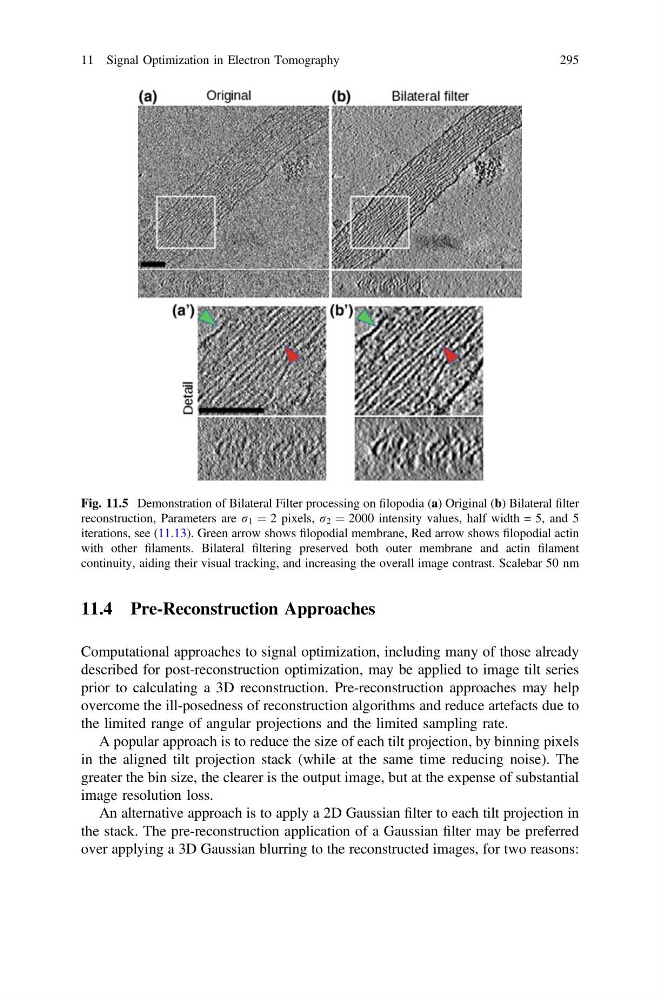
Fig. 11.5 Demonstration of Bilateral Filter processing on filopodia (a) Original (b) Bilateral filter
reconstruction, Parameters are r 1 ¼ 2 pixels, r 2 ¼ 2000 intensity values, half width = 5, and 5
iterations, see (11.13). Green arrow shows filopodial membrane, Red arrow shows filopodial actin
with other filaments. Bilateral filtering preserved both outer membrane and actin filament
continuity, aiding their visual tracking, and increasing the overall image contrast. Scalebar 50 nm
11 Signal Optimization in Electron Tomography
295
Computational approaches to signal optimization, including many of those already
described for post-reconstruction optimization, may be applied to image tilt series
prior to calculating a 3D reconstruction. Pre-reconstruction approaches may help
overcome the ill-posedness of reconstruction algorithms and reduce artefacts due to
the limited range of angular projections and the limited sampling rate.
A popular approach is to reduce the size of each tilt projection, by binning pixels
in the aligned tilt projection stack (while at the same time reducing noise). The
greater the bin size, the clearer is the output image, but at the expense of substantial
image resolution loss.
An alternative approach is to apply a 2D Gaussian filter to each tilt projection in
the stack. The pre-reconstruction application of a Gaussian filter may be preferred
over applying a 3D Gaussian blurring to the reconstructed images, for two reasons:
Fig. 11.5 Demonstration of Bilateral Filter processing on filopodia (a) Original (b) Bilateral filter
reconstruction, Parameters are r 1 ¼ 2 pixels, r 2 ¼ 2000 intensity values, half width = 5, and 5
iterations, see (11.13). Green arrow shows filopodial membrane, Red arrow shows filopodial actin
with other filaments. Bilateral filtering preserved both outer membrane and actin filament
continuity, aiding their visual tracking, and increasing the overall image contrast. Scalebar 50 nm
11 Signal Optimization in Electron Tomography
295