

inhomogeneous if D varies with pixel position. If the local diffusive flux does not
privilege any specific direction, the diffusion is called isotropic, which is the case of
Gaussian diffusion (Sects. 11.3.2 and 11.2.3). Otherwise it is called anisotropic.
The non-linear diffusion filter proposed by [36] employed an isotropic model of
the form D ¼ gðrI Á rIÞI, where g describes the scalar-valued, edge-driven, diffusivity flux gðs
2
Þ ¼ ð1 þ s
2
=l
2
Þ
À1 in which l is a real, positive, normalization
parameter.
The diffusion tensor D enables the diffusive flux to locally privilege specific
directions, leading to the case of non-linear anisotropic diffusion (NAD). Thus,
NAD allows directional diffusion to be coherent with structural features of the
image, under the assumption of local structural continuity. Structural details of a
3-dimensional image are inferred from local grayscale intensity variations (using
eigen-analysis). Structural details are encoded in components of the diffusion tensor
D together with the diffusivity parameters k 1 ; k 2 ; and k 3 that control the diffusive
flux ratio along the three major orthogonal axes of local intensity variation.
Different characterizations of diffusivity parameters k 1 ; k 2 ; ::; k N define different
NAD approaches. A 3-dimensional example of a NAD approach, Edge Enhancing
Diffusion (EED), is explained in Sect. 11.3.4.
11.3.4 Edge Enhancing Diffusion (EED)
Edge Enhancing Diffusion (EED) is a non-linear anisotropic diffusive (NAD) inhomogeneous approach, previously described by [44] as an anisotropic version of the
Perona-Malik model (described in Sect. 11.3.3). EED was introduced in electron
tomography by [15], combined with another NAD filter, Coherence Enhancing
Diffusion (CED), first described by [45]. However, current post-reconstruction
NAD-processing methods do not take into account unavoidable reconstruction artefacts due to incomplete, irregular sampling. An implementation of EED is included in
several software packages, used by the EM community, e.g. IMOD [26] and SPIDER
[39].
In its 3D implementation, EED varies from other NAD approaches primarily in
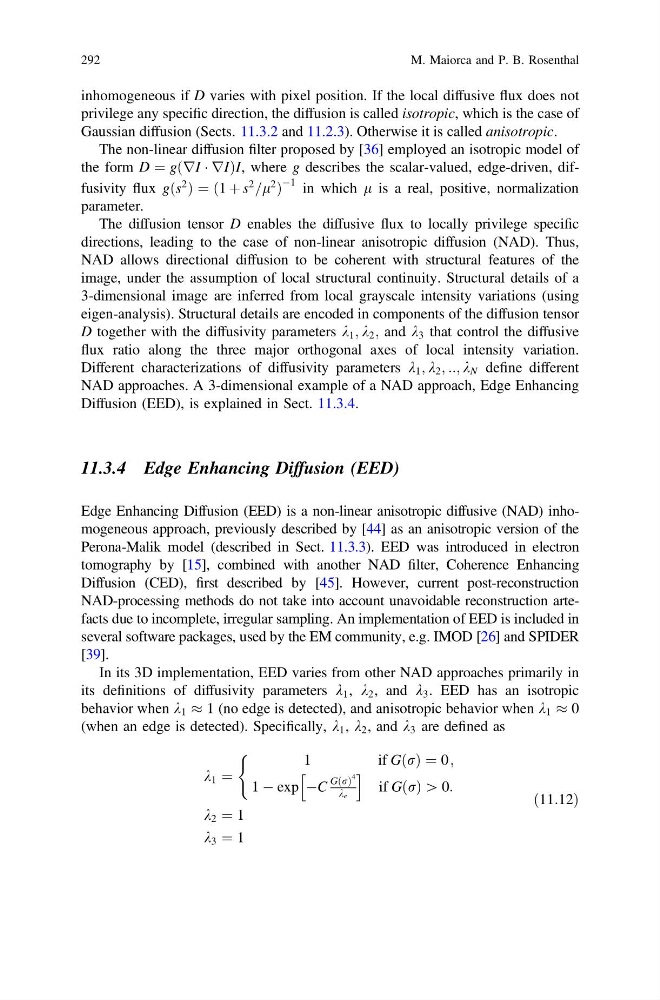
its definitions of diffusivity parameters k 1 , k 2 , and k 3 . EED has an isotropic
behavior when k 1 % 1 (no edge is detected), and anisotropic behavior when k 1 % 0
(when an edge is detected). Specifically, k 1 , k 2 , and k 3 are defined as
k 1 ¼
1
i fGðrÞ ¼ 0 ;
1 À exp ÀC
GðrÞ
4
k e
h
i
if GðrÞ [ 0:
(
k 2 ¼ 1
k 3 ¼ 1
ð11:12Þ
292
M. Maiorca and P. B. Rosenthal
privilege any specific direction, the diffusion is called isotropic, which is the case of
Gaussian diffusion (Sects. 11.3.2 and 11.2.3). Otherwise it is called anisotropic.
The non-linear diffusion filter proposed by [36] employed an isotropic model of
the form D ¼ gðrI Á rIÞI, where g describes the scalar-valued, edge-driven, diffusivity flux gðs
2
Þ ¼ ð1 þ s
2
=l
2
Þ
À1 in which l is a real, positive, normalization
parameter.
The diffusion tensor D enables the diffusive flux to locally privilege specific
directions, leading to the case of non-linear anisotropic diffusion (NAD). Thus,
NAD allows directional diffusion to be coherent with structural features of the
image, under the assumption of local structural continuity. Structural details of a
3-dimensional image are inferred from local grayscale intensity variations (using
eigen-analysis). Structural details are encoded in components of the diffusion tensor
D together with the diffusivity parameters k 1 ; k 2 ; and k 3 that control the diffusive
flux ratio along the three major orthogonal axes of local intensity variation.
Different characterizations of diffusivity parameters k 1 ; k 2 ; ::; k N define different
NAD approaches. A 3-dimensional example of a NAD approach, Edge Enhancing
Diffusion (EED), is explained in Sect. 11.3.4.
11.3.4 Edge Enhancing Diffusion (EED)
Edge Enhancing Diffusion (EED) is a non-linear anisotropic diffusive (NAD) inhomogeneous approach, previously described by [44] as an anisotropic version of the
Perona-Malik model (described in Sect. 11.3.3). EED was introduced in electron
tomography by [15], combined with another NAD filter, Coherence Enhancing
Diffusion (CED), first described by [45]. However, current post-reconstruction
NAD-processing methods do not take into account unavoidable reconstruction artefacts due to incomplete, irregular sampling. An implementation of EED is included in
several software packages, used by the EM community, e.g. IMOD [26] and SPIDER
[39].
In its 3D implementation, EED varies from other NAD approaches primarily in
its definitions of diffusivity parameters k 1 , k 2 , and k 3 . EED has an isotropic
behavior when k 1 % 1 (no edge is detected), and anisotropic behavior when k 1 % 0
(when an edge is detected). Specifically, k 1 , k 2 , and k 3 are defined as
k 1 ¼
1
i fGðrÞ ¼ 0 ;
1 À exp ÀC
GðrÞ
4
k e
h
i
if GðrÞ [ 0:
(
k 2 ¼ 1
k 3 ¼ 1
ð11:12Þ
292
M. Maiorca and P. B. Rosenthal