

current version of the reconstruction, calculation of the difference with the observed
image, and adjusting the reconstruction values based on this difference. The key
issues in such algorithms are (i) the starting volume, (ii) the way the projection is
calculated, (iii) the way the reconstruction is updated, and (iv) the number of
iterations (or stopping condition). The updating approach distinguishes the different
techniques called ART (algebraic reconstruction technique) [19], SIRT (simultaneous iterative reconstruction technique) [20] and SART (simultaneous algebraic
reconstruction technique) [21]. Alternative iterative methods include the maximum
entropy method (MEM) [6], the progressive stochastic reconstruction technique
(PSRT) [22], and frequency space methods [16, 17, 23]. The principle in the latter
is the same as for real space methods, with each image compared with its corresponding central section and the volume updated to minimize the difference.
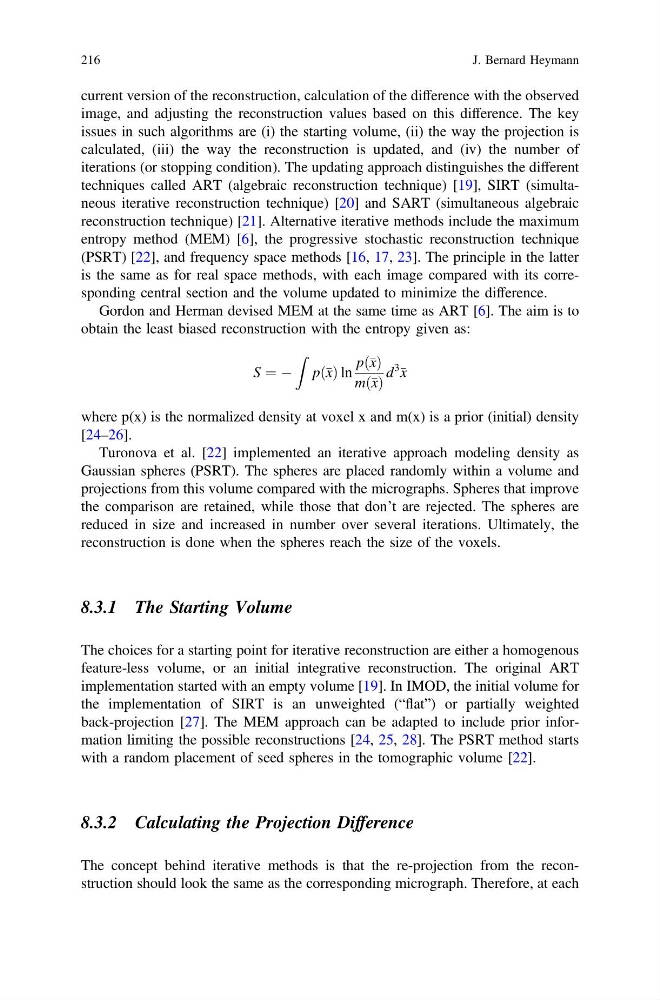
Gordon and Herman devised MEM at the same time as ART [6]. The aim is to
obtain the least biased reconstruction with the entropy given as:
S ¼ À
Z
pð xÞ ln
pð xÞ
mð xÞ
d
3
x
where p(x) is the normalized density at voxel x and m(x) is a prior (initial) density
[24–26].
Turonova et al. [22] implemented an iterative approach modeling density as
Gaussian spheres (PSRT). The spheres are placed randomly within a volume and
projections from this volume compared with the micrographs. Spheres that improve
the comparison are retained, while those that don’t are rejected. The spheres are
reduced in size and increased in number over several iterations. Ultimately, the
reconstruction is done when the spheres reach the size of the voxels.
8.3.1 The Starting Volume
The choices for a starting point for iterative reconstruction are either a homogenous
feature-less volume, or an initial integrative reconstruction. The original ART
implementation started with an empty volume [19]. In IMOD, the initial volume for
the implementation of SIRT is an unweighted (“flat”) or partially weighted
back-projection [27]. The MEM approach can be adapted to include prior information limiting the possible reconstructions [24, 25, 28]. The PSRT method starts
with a random placement of seed spheres in the tomographic volume [22].
8.3.2 Calculating the Projection Difference
The concept behind iterative methods is that the re-projection from the reconstruction should look the same as the corresponding micrograph. Therefore, at each
216
J. Bernard Heymann
image, and adjusting the reconstruction values based on this difference. The key
issues in such algorithms are (i) the starting volume, (ii) the way the projection is
calculated, (iii) the way the reconstruction is updated, and (iv) the number of
iterations (or stopping condition). The updating approach distinguishes the different
techniques called ART (algebraic reconstruction technique) [19], SIRT (simultaneous iterative reconstruction technique) [20] and SART (simultaneous algebraic
reconstruction technique) [21]. Alternative iterative methods include the maximum
entropy method (MEM) [6], the progressive stochastic reconstruction technique
(PSRT) [22], and frequency space methods [16, 17, 23]. The principle in the latter
is the same as for real space methods, with each image compared with its corresponding central section and the volume updated to minimize the difference.
Gordon and Herman devised MEM at the same time as ART [6]. The aim is to
obtain the least biased reconstruction with the entropy given as:
S ¼ À
Z
pð xÞ ln
pð xÞ
mð xÞ
d
3
x
where p(x) is the normalized density at voxel x and m(x) is a prior (initial) density
[24–26].
Turonova et al. [22] implemented an iterative approach modeling density as
Gaussian spheres (PSRT). The spheres are placed randomly within a volume and
projections from this volume compared with the micrographs. Spheres that improve
the comparison are retained, while those that don’t are rejected. The spheres are
reduced in size and increased in number over several iterations. Ultimately, the
reconstruction is done when the spheres reach the size of the voxels.
8.3.1 The Starting Volume
The choices for a starting point for iterative reconstruction are either a homogenous
feature-less volume, or an initial integrative reconstruction. The original ART
implementation started with an empty volume [19]. In IMOD, the initial volume for
the implementation of SIRT is an unweighted (“flat”) or partially weighted
back-projection [27]. The MEM approach can be adapted to include prior information limiting the possible reconstructions [24, 25, 28]. The PSRT method starts
with a random placement of seed spheres in the tomographic volume [22].
8.3.2 Calculating the Projection Difference
The concept behind iterative methods is that the re-projection from the reconstruction should look the same as the corresponding micrograph. Therefore, at each
216
J. Bernard Heymann