

Another source of problems during the alignment is the uneven distribution of
landmarks along the tilt series. Normally at high tilts it is more difficult to distinguish 2D landmarks due to the thicker sample and resulting low contrast.
Additionally, as the tilt increases, there are more chances of overlapping projections
of different 3D landmarks resulting in a lack of reliable landmark chains covering
high tilt angles. However, in spite of these difficulties, projection alignment and
determination of the tilt-axis orientation is frequently feasible, but in some cases
some advanced alignment methods are required.
7.3 Advanced Alignment Methods
In this section, we will explain and evaluate the interest of some improvements for
image registration between two images suitable for the alignment of tilt series in
electron tomography. Some of these improvements use global image information by
applying a multiscale scheme associated to change in similarity measure. Others are
based on registration of unique descriptors for points of interest.
7.3.1 Multiscale Registration
Most recent advances in image registration are based on multiscale scheme associated to gradient descent algorithms to determine the transformation between two
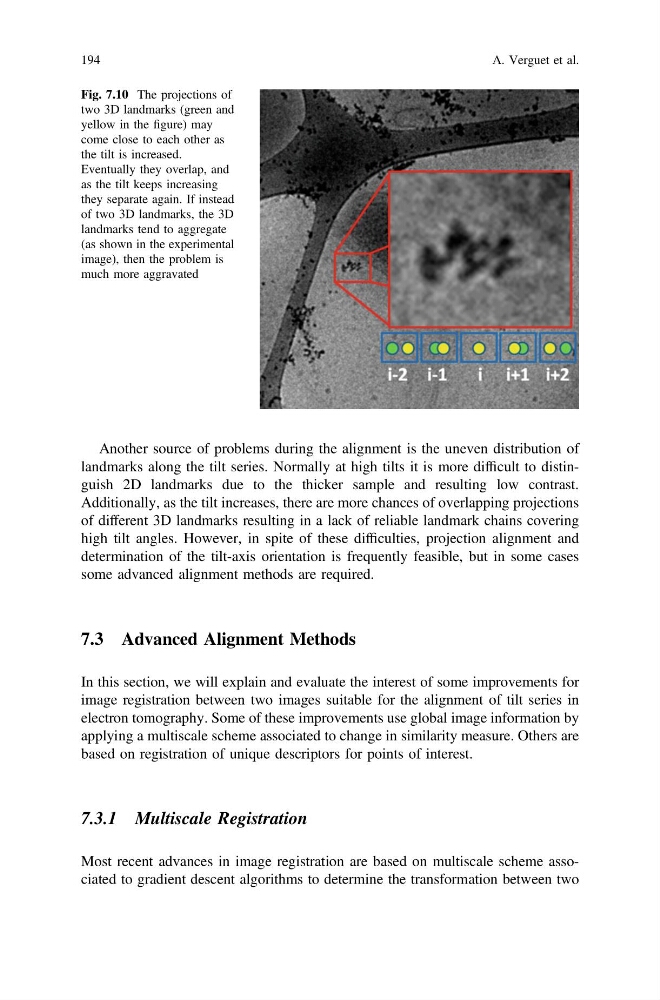
Fig. 7.10 The projections of
two 3D landmarks (green and
yellow in the figure) may
come close to each other as
the tilt is increased.
Eventually they overlap, and
as the tilt keeps increasing
they separate again. If instead
of two 3D landmarks, the 3D
landmarks tend to aggregate
(as shown in the experimental
image), then the problem is
much more aggravated
194
A. Verguet et al.
landmarks along the tilt series. Normally at high tilts it is more difficult to distinguish 2D landmarks due to the thicker sample and resulting low contrast.
Additionally, as the tilt increases, there are more chances of overlapping projections
of different 3D landmarks resulting in a lack of reliable landmark chains covering
high tilt angles. However, in spite of these difficulties, projection alignment and
determination of the tilt-axis orientation is frequently feasible, but in some cases
some advanced alignment methods are required.
7.3 Advanced Alignment Methods
In this section, we will explain and evaluate the interest of some improvements for
image registration between two images suitable for the alignment of tilt series in
electron tomography. Some of these improvements use global image information by
applying a multiscale scheme associated to change in similarity measure. Others are
based on registration of unique descriptors for points of interest.
7.3.1 Multiscale Registration
Most recent advances in image registration are based on multiscale scheme associated to gradient descent algorithms to determine the transformation between two
Fig. 7.10 The projections of
two 3D landmarks (green and
yellow in the figure) may
come close to each other as
the tilt is increased.
Eventually they overlap, and
as the tilt keeps increasing
they separate again. If instead
of two 3D landmarks, the 3D
landmarks tend to aggregate
(as shown in the experimental
image), then the problem is
much more aggravated
194
A. Verguet et al.