

images. The main principle of multiscale scheme is to separate information in
images at different scale. Coarse scales would then consist to main shapes and
general features of the images while fine scales consist to details and noise. The
decomposition allows a coarse-to-fine registration in which an initial transformation
is found for the coarsest scales of the images and then it is refined using finer scales
images. The use of this technique has many advantages:
• large transformations between two images can be found on coarser scales of
images
• the signal-to-noise-ratio increases with coarser scales thus making it easier the
finding of alignment
• as images at coarse level have less possible local minima, the robustness is
increased
• part of the computation is done on smaller data and it need less time than
computing everything on full size data
The multiscale decomposition can be done in several different ways. The simpler
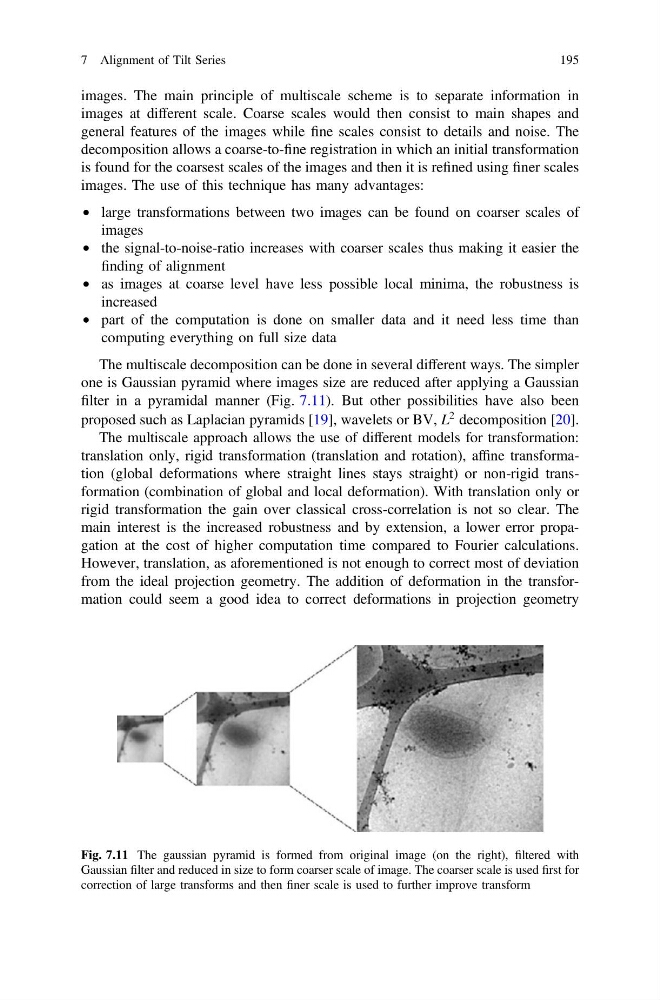
one is Gaussian pyramid where images size are reduced after applying a Gaussian
filter in a pyramidal manner (Fig. 7.11). But other possibilities have also been
proposed such as Laplacian pyramids [19], wavelets or BV, L
2 decomposition [20].
The multiscale approach allows the use of different models for transformation:
translation only, rigid transformation (translation and rotation), affine transformation (global deformations where straight lines stays straight) or non-rigid transformation (combination of global and local deformation). With translation only or
rigid transformation the gain over classical cross-correlation is not so clear. The
main interest is the increased robustness and by extension, a lower error propagation at the cost of higher computation time compared to Fourier calculations.
However, translation, as aforementioned is not enough to correct most of deviation
from the ideal projection geometry. The addition of deformation in the transformation could seem a good idea to correct deformations in projection geometry
Fig. 7.11 The gaussian pyramid is formed from original image (on the right), filtered with
Gaussian filter and reduced in size to form coarser scale of image. The coarser scale is used first for
correction of large transforms and then finer scale is used to further improve transform
7 Alignment of Tilt Series
195
images at different scale. Coarse scales would then consist to main shapes and
general features of the images while fine scales consist to details and noise. The
decomposition allows a coarse-to-fine registration in which an initial transformation
is found for the coarsest scales of the images and then it is refined using finer scales
images. The use of this technique has many advantages:
• large transformations between two images can be found on coarser scales of
images
• the signal-to-noise-ratio increases with coarser scales thus making it easier the
finding of alignment
• as images at coarse level have less possible local minima, the robustness is
increased
• part of the computation is done on smaller data and it need less time than
computing everything on full size data
The multiscale decomposition can be done in several different ways. The simpler
one is Gaussian pyramid where images size are reduced after applying a Gaussian
filter in a pyramidal manner (Fig. 7.11). But other possibilities have also been
proposed such as Laplacian pyramids [19], wavelets or BV, L
2 decomposition [20].
The multiscale approach allows the use of different models for transformation:
translation only, rigid transformation (translation and rotation), affine transformation (global deformations where straight lines stays straight) or non-rigid transformation (combination of global and local deformation). With translation only or
rigid transformation the gain over classical cross-correlation is not so clear. The
main interest is the increased robustness and by extension, a lower error propagation at the cost of higher computation time compared to Fourier calculations.
However, translation, as aforementioned is not enough to correct most of deviation
from the ideal projection geometry. The addition of deformation in the transformation could seem a good idea to correct deformations in projection geometry
Fig. 7.11 The gaussian pyramid is formed from original image (on the right), filtered with
Gaussian filter and reduced in size to form coarser scale of image. The coarser scale is used first for
correction of large transforms and then finer scale is used to further improve transform
7 Alignment of Tilt Series
195