

β c ¼ AD Â
κ
R
3
Â
f
ΔE
Â
1
n 2
ð12Þ
The value of the constant AD is equal to 1.615 Â 10
À18 m
2 cm
À1 if we express β C
in cm
À1 . The magnitude of the interaction β C caused by exciton coupling, and hence
the resulting splitting of the levels, depends on the oscillator strength f, Eq. (5), the
relative orientation κ of two neighboring ETDM explained in Fig. 23a, and the
distance R between the interacting ETDM. The expression for κ can be simplified in
the present case as κ ¼ 1 À 3cos
2 (θ), where θ is the angle between two adjacent
ETDMs. The coupling is largest for in-line orientation (θ ¼ 0
, κ ¼ À2), leading to
J-coupling, while H-coupling occurs at essentially parallel arrangement (θ ¼ 90
,
κ ¼ 1). β C further depends on the electronic excitation energy ΔE and on the
refractive index n of the environment. The validity of Eq. (12) depends on the
condition that the distance between the ETDM of two involved molecules is large
with respect to the length of the ETDM. It can be shown that the length l μà of the
ETDM can be expressed as follows, where the value of the parameter const is equal
to 3.036 Â 10
À6 cm
0.5 ; the oscillator strength f is dimensionless [181]:
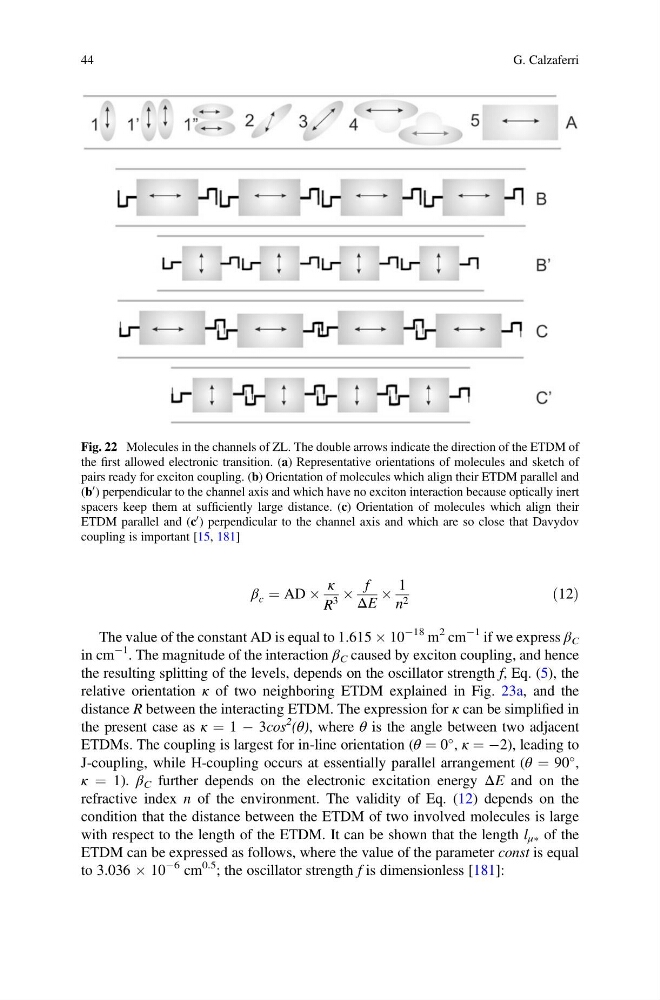
Fig. 22 Molecules in the channels of ZL. The double arrows indicate the direction of the ETDM of
the first allowed electronic transition. (a) Representative orientations of molecules and sketch of
pairs ready for exciton coupling. (b) Orientation of molecules which align their ETDM parallel and
(b
0 ) perpendicular to the channel axis and which have no exciton interaction because optically inert
spacers keep them at sufficiently large distance. (c) Orientation of molecules which align their
ETDM parallel and (c
0 ) perpendicular to the channel axis and which are so close that Davydov
coupling is important [15, 181]
44
G. Calzaferri
κ
R
3
Â
f
ΔE
Â
1
n 2
ð12Þ
The value of the constant AD is equal to 1.615 Â 10
À18 m
2 cm
À1 if we express β C
in cm
À1 . The magnitude of the interaction β C caused by exciton coupling, and hence
the resulting splitting of the levels, depends on the oscillator strength f, Eq. (5), the
relative orientation κ of two neighboring ETDM explained in Fig. 23a, and the
distance R between the interacting ETDM. The expression for κ can be simplified in
the present case as κ ¼ 1 À 3cos
2 (θ), where θ is the angle between two adjacent
ETDMs. The coupling is largest for in-line orientation (θ ¼ 0
, κ ¼ À2), leading to
J-coupling, while H-coupling occurs at essentially parallel arrangement (θ ¼ 90
,
κ ¼ 1). β C further depends on the electronic excitation energy ΔE and on the
refractive index n of the environment. The validity of Eq. (12) depends on the
condition that the distance between the ETDM of two involved molecules is large
with respect to the length of the ETDM. It can be shown that the length l μà of the
ETDM can be expressed as follows, where the value of the parameter const is equal
to 3.036 Â 10
À6 cm
0.5 ; the oscillator strength f is dimensionless [181]:
Fig. 22 Molecules in the channels of ZL. The double arrows indicate the direction of the ETDM of
the first allowed electronic transition. (a) Representative orientations of molecules and sketch of
pairs ready for exciton coupling. (b) Orientation of molecules which align their ETDM parallel and
(b
0 ) perpendicular to the channel axis and which have no exciton interaction because optically inert
spacers keep them at sufficiently large distance. (c) Orientation of molecules which align their
ETDM parallel and (c
0 ) perpendicular to the channel axis and which are so close that Davydov
coupling is important [15, 181]
44
G. Calzaferri