

7.4 Exciton Coupling of Organic Guests
Hashimoto studied the behavior of naphthalene and anthracene located inside of the
channels of ZL. The spectroscopic feature of these composites was a clear sign of
exciton coupling [177]. Exciton coupling was later observed for several composites
consisting of neutral and of cationic guests [15, 46, 155, 162, 166, 181]. Different
possibilities for packing the guests are schematically illustrated in Fig. 22. It shows
that the so-called H- and J-exciton coupling is possible for small molecules (a)1
0 and
(a)1
00 , respectively. The limited space provided by the channels favors J-coupling,
(see (a)4) for larger molecules if their shape allows for a sufficiently small distance
between their ETDMs. The double arrows indicate the direction of the ETDM of the
first allowed electronic transition of the guests. The figure also illustrates that
molecular engineering can be applied to fine-tune the distance between the chromophores, for example, by covalently binding optically inert spacers to the end of the
chromophores as seen in b and b
0 .
The Davydov coupling strength β c between two molecules (AÃ. . .A)$(A. . .AÃ),
with AÃ denoting an electronically excited molecule A, can be calculated by using
Eq. (12) [181, 188, 189].
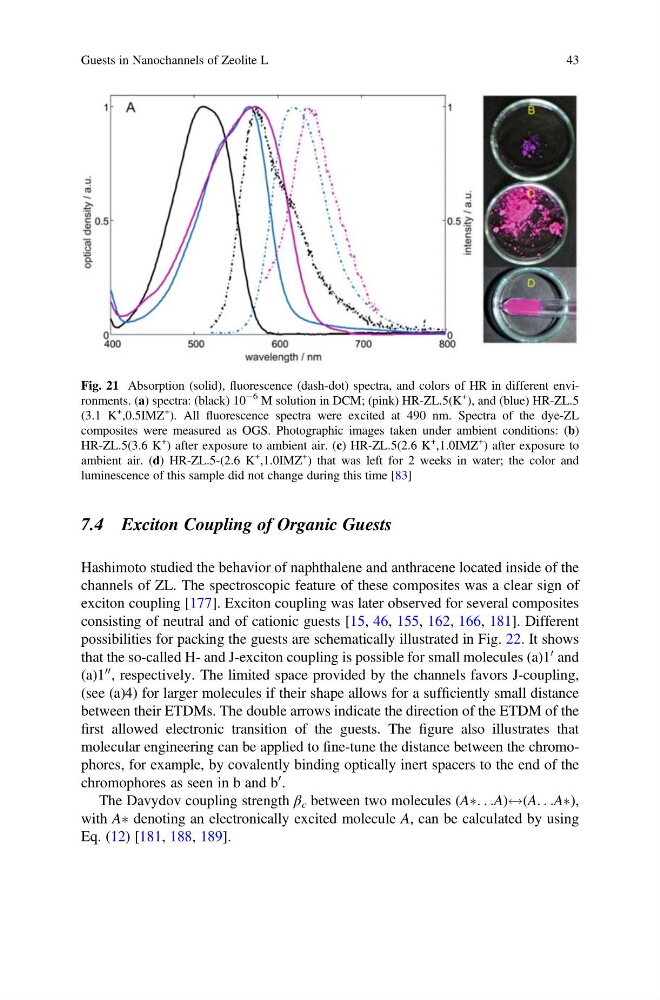
Fig. 21 Absorption (solid), fluorescence (dash-dot) spectra, and colors of HR in different environments. (a) spectra: (black) 10
À6 M solution in DCM; (pink) HR-ZL.5(K
+ ), and (blue) HR-ZL.5
(3.1 K
+ ,0.5IMZ
+ ). All fluorescence spectra were excited at 490 nm. Spectra of the dye-ZL
composites were measured as OGS. Photographic images taken under ambient conditions: (b)
HR-ZL.5(3.6 K
+ ) after exposure to ambient air. (c) HR-ZL.5(2.6 K
+ ,1.0IMZ
+ ) after exposure to
ambient air. (d) HR-ZL.5-(2.6 K
+ ,1.0IMZ
+ ) that was left for 2 weeks in water; the color and
luminescence of this sample did not change during this time [83]
Guests in Nanochannels of Zeolite L
43
Hashimoto studied the behavior of naphthalene and anthracene located inside of the
channels of ZL. The spectroscopic feature of these composites was a clear sign of
exciton coupling [177]. Exciton coupling was later observed for several composites
consisting of neutral and of cationic guests [15, 46, 155, 162, 166, 181]. Different
possibilities for packing the guests are schematically illustrated in Fig. 22. It shows
that the so-called H- and J-exciton coupling is possible for small molecules (a)1
0 and
(a)1
00 , respectively. The limited space provided by the channels favors J-coupling,
(see (a)4) for larger molecules if their shape allows for a sufficiently small distance
between their ETDMs. The double arrows indicate the direction of the ETDM of the
first allowed electronic transition of the guests. The figure also illustrates that
molecular engineering can be applied to fine-tune the distance between the chromophores, for example, by covalently binding optically inert spacers to the end of the
chromophores as seen in b and b
0 .
The Davydov coupling strength β c between two molecules (AÃ. . .A)$(A. . .AÃ),
with AÃ denoting an electronically excited molecule A, can be calculated by using
Eq. (12) [181, 188, 189].
Fig. 21 Absorption (solid), fluorescence (dash-dot) spectra, and colors of HR in different environments. (a) spectra: (black) 10
À6 M solution in DCM; (pink) HR-ZL.5(K
+ ), and (blue) HR-ZL.5
(3.1 K
+ ,0.5IMZ
+ ). All fluorescence spectra were excited at 490 nm. Spectra of the dye-ZL
composites were measured as OGS. Photographic images taken under ambient conditions: (b)
HR-ZL.5(3.6 K
+ ) after exposure to ambient air. (c) HR-ZL.5(2.6 K
+ ,1.0IMZ
+ ) after exposure to
ambient air. (d) HR-ZL.5-(2.6 K
+ ,1.0IMZ
+ ) that was left for 2 weeks in water; the color and
luminescence of this sample did not change during this time [83]
Guests in Nanochannels of Zeolite L
43