

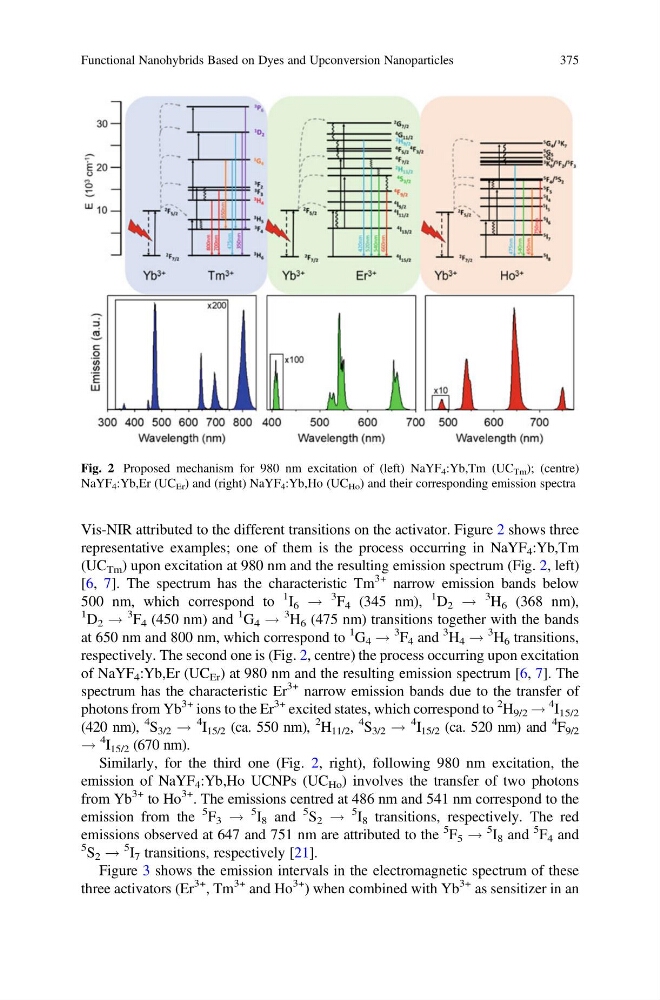
Vis-NIR attributed to the different transitions on the activator. Figure 2 shows three
representative examples; one of them is the process occurring in NaYF 4 :Yb,Tm
(UC Tm ) upon excitation at 980 nm and the resulting emission spectrum (Fig. 2, left)
[6, 7]. The spectrum has the characteristic Tm
3+ narrow emission bands below
500 nm, which correspond to
1 I 6 !
3 F 4 (345 nm),
1 D 2 !
3
H 6 (368 nm),
1 D 2 !
3 F 4 (450 nm) and
1 G 4 !
3 H 6 (475 nm) transitions together with the bands
at 650 nm and 800 nm, which correspond to
1 G 4 !
3
F 4 and
3 H 4 !
3 H 6 transitions,
respectively. The second one is (Fig. 2, centre) the process occurring upon excitation
of NaYF 4 :Yb,Er (UC Er ) at 980 nm and the resulting emission spectrum [6, 7]. The
spectrum has the characteristic Er
3+ narrow emission bands due to the transfer of
photons from Yb
3+ ions to the Er
3+ excited states, which correspond to
2 H 9/2 !
4 I 15/2
(420 nm),
4
S 3/2 !
4
I 15/2 (ca. 550 nm),
2
H 11/2 ,
4
S 3/2 !
4
I 15/2 (ca. 520 nm) and
4
F 9/2
!
4
I 15/2 (670 nm).
Similarly, for the third one (Fig. 2, right), following 980 nm excitation, the
emission of NaYF 4 :Yb,Ho UCNPs (UC Ho ) involves the transfer of two photons
from Yb
3+ to Ho
3+ . The emissions centred at 486 nm and 541 nm correspond to the
emission from the
5 F 3 !
5 I 8 and
5 S 2 !
5 I 8 transitions, respectively. The red
emissions observed at 647 and 751 nm are attributed to the
5 F 5 !
5 I 8 and
5 F 4 and
5 S 2 !
5 I 7 transitions, respectively [21].
Figure 3 shows the emission intervals in the electromagnetic spectrum of these
three activators (Er
3+ , Tm
3+ and Ho
3+ ) when combined with Yb
3+ as sensitizer in an
Fig. 2 Proposed mechanism for 980 nm excitation of (left) NaYF 4 :Yb,Tm (UC Tm ); (centre)
NaYF 4 :Yb,Er (UC Er ) and (right) NaYF 4 :Yb,Ho (UC Ho ) and their corresponding emission spectra
Functional Nanohybrids Based on Dyes and Upconversion Nanoparticles
375
representative examples; one of them is the process occurring in NaYF 4 :Yb,Tm
(UC Tm ) upon excitation at 980 nm and the resulting emission spectrum (Fig. 2, left)
[6, 7]. The spectrum has the characteristic Tm
3+ narrow emission bands below
500 nm, which correspond to
1 I 6 !
3 F 4 (345 nm),
1 D 2 !
3
H 6 (368 nm),
1 D 2 !
3 F 4 (450 nm) and
1 G 4 !
3 H 6 (475 nm) transitions together with the bands
at 650 nm and 800 nm, which correspond to
1 G 4 !
3
F 4 and
3 H 4 !
3 H 6 transitions,
respectively. The second one is (Fig. 2, centre) the process occurring upon excitation
of NaYF 4 :Yb,Er (UC Er ) at 980 nm and the resulting emission spectrum [6, 7]. The
spectrum has the characteristic Er
3+ narrow emission bands due to the transfer of
photons from Yb
3+ ions to the Er
3+ excited states, which correspond to
2 H 9/2 !
4 I 15/2
(420 nm),
4
S 3/2 !
4
I 15/2 (ca. 550 nm),
2
H 11/2 ,
4
S 3/2 !
4
I 15/2 (ca. 520 nm) and
4
F 9/2
!
4
I 15/2 (670 nm).
Similarly, for the third one (Fig. 2, right), following 980 nm excitation, the
emission of NaYF 4 :Yb,Ho UCNPs (UC Ho ) involves the transfer of two photons
from Yb
3+ to Ho
3+ . The emissions centred at 486 nm and 541 nm correspond to the
emission from the
5 F 3 !
5 I 8 and
5 S 2 !
5 I 8 transitions, respectively. The red
emissions observed at 647 and 751 nm are attributed to the
5 F 5 !
5 I 8 and
5 F 4 and
5 S 2 !
5 I 7 transitions, respectively [21].
Figure 3 shows the emission intervals in the electromagnetic spectrum of these
three activators (Er
3+ , Tm
3+ and Ho
3+ ) when combined with Yb
3+ as sensitizer in an
Fig. 2 Proposed mechanism for 980 nm excitation of (left) NaYF 4 :Yb,Tm (UC Tm ); (centre)
NaYF 4 :Yb,Er (UC Er ) and (right) NaYF 4 :Yb,Ho (UC Ho ) and their corresponding emission spectra
Functional Nanohybrids Based on Dyes and Upconversion Nanoparticles
375