

biological tissue because of two reasons: the tissue scattering and the absorption of
the biomolecules naturally present in the organisms [8–12]. These factors can be
minimized by shifting the excitation to longer wavelengths where the highest
transparency of biological samples occurs.
In this context, UCNPs can be excited at near-infrared (NIR) wavelengths thanks
to the presence of Yb
3+ , which is the most used sensitizer to absorb the excitation
energy due to its relatively large absorption cross section at ~980 nm [13, 14]. Nd
3+
is also used due to its absorption at 808 nm (where water absorption is minimal).
This is of high relevance for aqueous samples (especially in biological samples) to
avoid their heating.
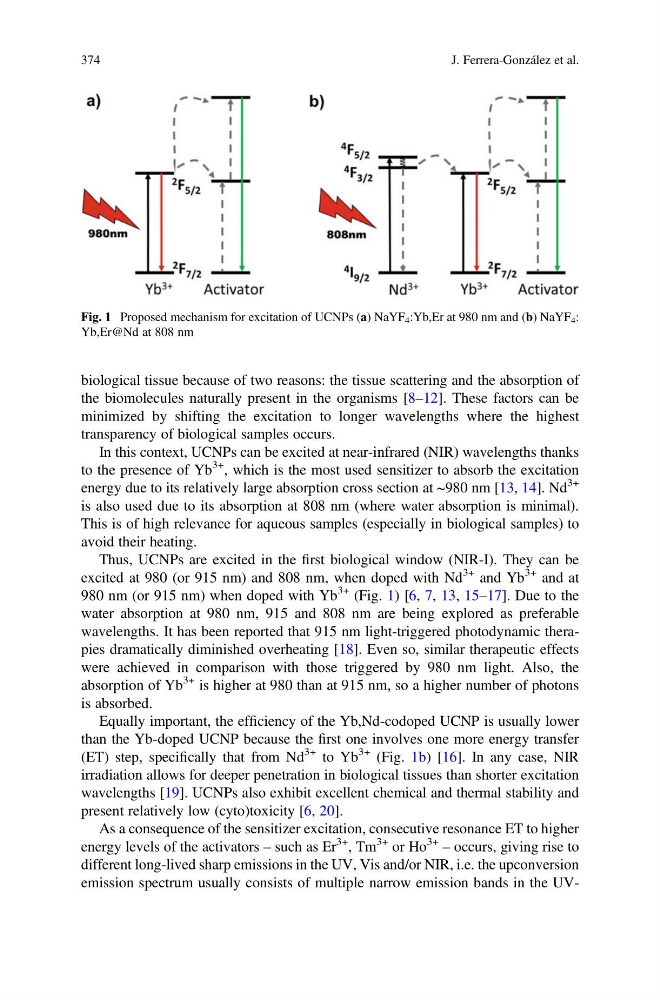
Thus, UCNPs are excited in the first biological window (NIR-I). They can be
excited at 980 (or 915 nm) and 808 nm, when doped with Nd
3+ and Yb
3+ and at
980 nm (or 915 nm) when doped with Yb
3+ (Fig. 1) [6, 7, 13, 15–17]. Due to the
water absorption at 980 nm, 915 and 808 nm are being explored as preferable
wavelengths. It has been reported that 915 nm light-triggered photodynamic therapies dramatically diminished overheating [18]. Even so, similar therapeutic effects
were achieved in comparison with those triggered by 980 nm light. Also, the
absorption of Yb
3+ is higher at 980 than at 915 nm, so a higher number of photons
is absorbed.
Equally important, the efficiency of the Yb,Nd-codoped UCNP is usually lower
than the Yb-doped UCNP because the first one involves one more energy transfer
(ET) step, specifically that from Nd
3+ to Yb
3+ (Fig. 1b) [16]. In any case, NIR
irradiation allows for deeper penetration in biological tissues than shorter excitation
wavelengths [19]. UCNPs also exhibit excellent chemical and thermal stability and
present relatively low (cyto)toxicity [6, 20].
As a consequence of the sensitizer excitation, consecutive resonance ET to higher
energy levels of the activators – such as Er
3+ , Tm
3+ or Ho
3+
– occurs, giving rise to
different long-lived sharp emissions in the UV, Vis and/or NIR, i.e. the upconversion
emission spectrum usually consists of multiple narrow emission bands in the UVFig. 1 Proposed mechanism for excitation of UCNPs (a) NaYF 4 :Yb,Er at 980 nm and (b) NaYF 4 :
Yb,Er@Nd at 808 nm
374
J. Ferrera-González et al.
the biomolecules naturally present in the organisms [8–12]. These factors can be
minimized by shifting the excitation to longer wavelengths where the highest
transparency of biological samples occurs.
In this context, UCNPs can be excited at near-infrared (NIR) wavelengths thanks
to the presence of Yb
3+ , which is the most used sensitizer to absorb the excitation
energy due to its relatively large absorption cross section at ~980 nm [13, 14]. Nd
3+
is also used due to its absorption at 808 nm (where water absorption is minimal).
This is of high relevance for aqueous samples (especially in biological samples) to
avoid their heating.
Thus, UCNPs are excited in the first biological window (NIR-I). They can be
excited at 980 (or 915 nm) and 808 nm, when doped with Nd
3+ and Yb
3+ and at
980 nm (or 915 nm) when doped with Yb
3+ (Fig. 1) [6, 7, 13, 15–17]. Due to the
water absorption at 980 nm, 915 and 808 nm are being explored as preferable
wavelengths. It has been reported that 915 nm light-triggered photodynamic therapies dramatically diminished overheating [18]. Even so, similar therapeutic effects
were achieved in comparison with those triggered by 980 nm light. Also, the
absorption of Yb
3+ is higher at 980 than at 915 nm, so a higher number of photons
is absorbed.
Equally important, the efficiency of the Yb,Nd-codoped UCNP is usually lower
than the Yb-doped UCNP because the first one involves one more energy transfer
(ET) step, specifically that from Nd
3+ to Yb
3+ (Fig. 1b) [16]. In any case, NIR
irradiation allows for deeper penetration in biological tissues than shorter excitation
wavelengths [19]. UCNPs also exhibit excellent chemical and thermal stability and
present relatively low (cyto)toxicity [6, 20].
As a consequence of the sensitizer excitation, consecutive resonance ET to higher
energy levels of the activators – such as Er
3+ , Tm
3+ or Ho
3+
– occurs, giving rise to
different long-lived sharp emissions in the UV, Vis and/or NIR, i.e. the upconversion
emission spectrum usually consists of multiple narrow emission bands in the UVFig. 1 Proposed mechanism for excitation of UCNPs (a) NaYF 4 :Yb,Er at 980 nm and (b) NaYF 4 :
Yb,Er@Nd at 808 nm
374
J. Ferrera-González et al.