

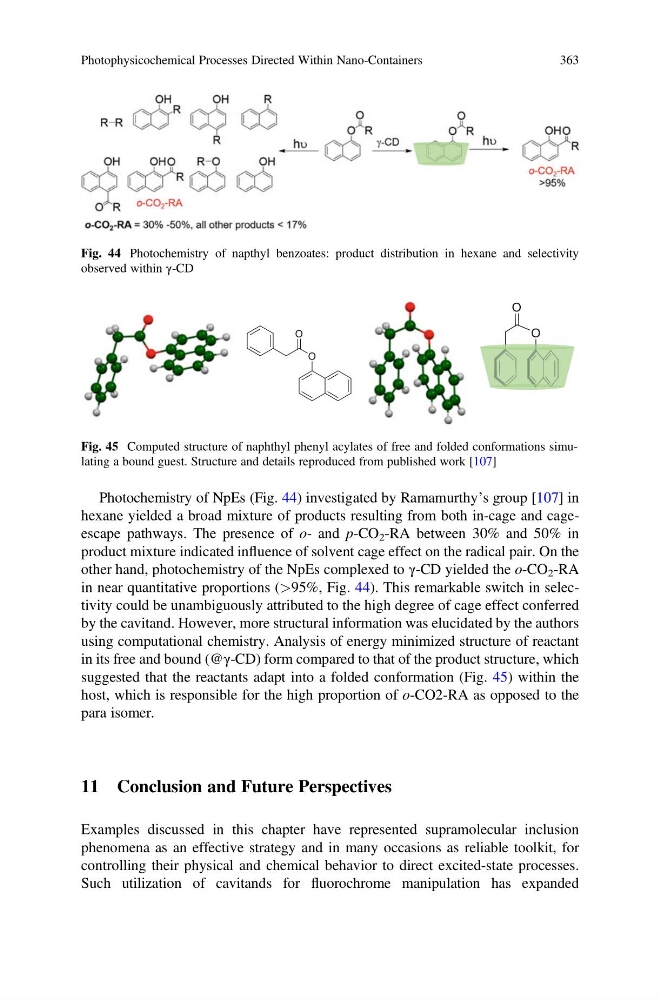
Photochemistry of NpEs (Fig. 44) investigated by Ramamurthy’s group [107] in
hexane yielded a broad mixture of products resulting from both in-cage and cageescape pathways. The presence of o- and p-CO 2 -RA between 30% and 50% in
product mixture indicated influence of solvent cage effect on the radical pair. On the
other hand, photochemistry of the NpEs complexed to γ-CD yielded the o-CO 2 -RA
in near quantitative proportions (>95%, Fig. 44). This remarkable switch in selectivity could be unambiguously attributed to the high degree of cage effect conferred
by the cavitand. However, more structural information was elucidated by the authors
using computational chemistry. Analysis of energy minimized structure of reactant
in its free and bound (@γ-CD) form compared to that of the product structure, which
suggested that the reactants adapt into a folded conformation (Fig. 45) within the
host, which is responsible for the high proportion of o-CO2-RA as opposed to the
para isomer.
11 Conclusion and Future Perspectives
Examples discussed in this chapter have represented supramolecular inclusion
phenomena as an effective strategy and in many occasions as reliable toolkit, for
controlling their physical and chemical behavior to direct excited-state processes.
Such utilization of cavitands for fluorochrome manipulation has expanded
Fig. 44 Photochemistry of napthyl benzoates: product distribution in hexane and selectivity
observed within γ-CD
Fig. 45 Computed structure of naphthyl phenyl acylates of free and folded conformations simulating a bound guest. Structure and details reproduced from published work [107]
Photophysicochemical Processes Directed Within Nano-Containers
363
hexane yielded a broad mixture of products resulting from both in-cage and cageescape pathways. The presence of o- and p-CO 2 -RA between 30% and 50% in
product mixture indicated influence of solvent cage effect on the radical pair. On the
other hand, photochemistry of the NpEs complexed to γ-CD yielded the o-CO 2 -RA
in near quantitative proportions (>95%, Fig. 44). This remarkable switch in selectivity could be unambiguously attributed to the high degree of cage effect conferred
by the cavitand. However, more structural information was elucidated by the authors
using computational chemistry. Analysis of energy minimized structure of reactant
in its free and bound (@γ-CD) form compared to that of the product structure, which
suggested that the reactants adapt into a folded conformation (Fig. 45) within the
host, which is responsible for the high proportion of o-CO2-RA as opposed to the
para isomer.
11 Conclusion and Future Perspectives
Examples discussed in this chapter have represented supramolecular inclusion
phenomena as an effective strategy and in many occasions as reliable toolkit, for
controlling their physical and chemical behavior to direct excited-state processes.
Such utilization of cavitands for fluorochrome manipulation has expanded
Fig. 44 Photochemistry of napthyl benzoates: product distribution in hexane and selectivity
observed within γ-CD
Fig. 45 Computed structure of naphthyl phenyl acylates of free and folded conformations simulating a bound guest. Structure and details reproduced from published work [107]
Photophysicochemical Processes Directed Within Nano-Containers
363