

molecular cavities of host systems such as cavitands [101, 102], micelles [103–105],
and other organized media [106].
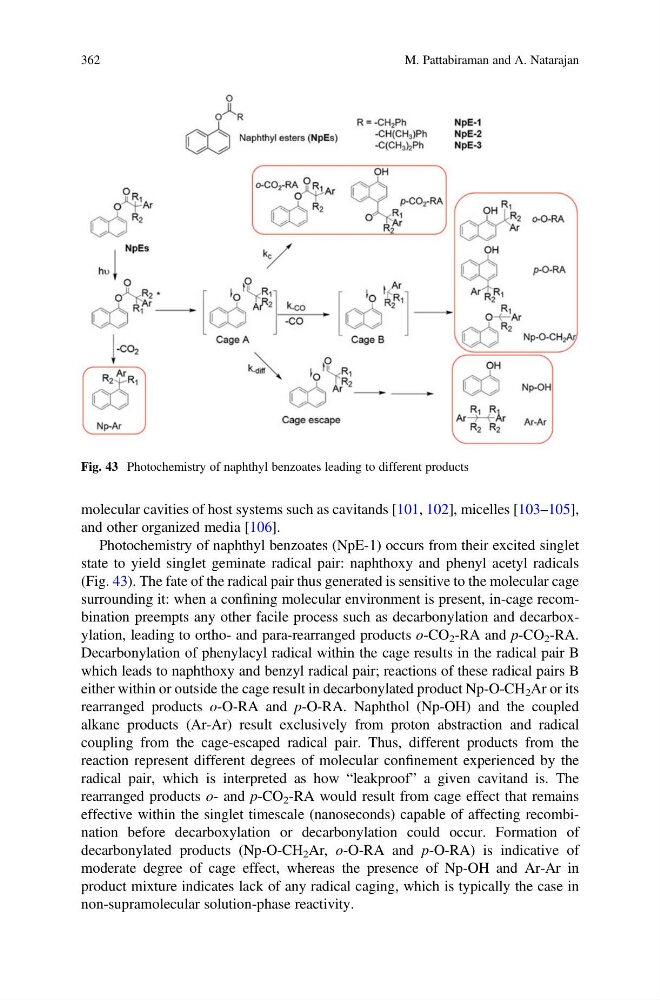
Photochemistry of naphthyl benzoates (NpE-1) occurs from their excited singlet
state to yield singlet geminate radical pair: naphthoxy and phenyl acetyl radicals
(Fig. 43). The fate of the radical pair thus generated is sensitive to the molecular cage
surrounding it: when a confining molecular environment is present, in-cage recombination preempts any other facile process such as decarbonylation and decarboxylation, leading to ortho- and para-rearranged products o-CO 2 -RA and p-CO 2 -RA.
Decarbonylation of phenylacyl radical within the cage results in the radical pair B
which leads to naphthoxy and benzyl radical pair; reactions of these radical pairs B
either within or outside the cage result in decarbonylated product Np-O-CH 2 Ar or its
rearranged products o-O-RA and p-O-RA. Naphthol (Np-OH) and the coupled
alkane products (Ar-Ar) result exclusively from proton abstraction and radical
coupling from the cage-escaped radical pair. Thus, different products from the
reaction represent different degrees of molecular confinement experienced by the
radical pair, which is interpreted as how “leakproof” a given cavitand is. The
rearranged products o- and p-CO 2 -RA would result from cage effect that remains
effective within the singlet timescale (nanoseconds) capable of affecting recombination before decarboxylation or decarbonylation could occur. Formation of
decarbonylated products (Np-O-CH 2 Ar, o-O-RA and p-O-RA) is indicative of
moderate degree of cage effect, whereas the presence of Np-OH and Ar-Ar in
product mixture indicates lack of any radical caging, which is typically the case in
non-supramolecular solution-phase reactivity.
Fig. 43 Photochemistry of naphthyl benzoates leading to different products
362
M. Pattabiraman and A. Natarajan
and other organized media [106].
Photochemistry of naphthyl benzoates (NpE-1) occurs from their excited singlet
state to yield singlet geminate radical pair: naphthoxy and phenyl acetyl radicals
(Fig. 43). The fate of the radical pair thus generated is sensitive to the molecular cage
surrounding it: when a confining molecular environment is present, in-cage recombination preempts any other facile process such as decarbonylation and decarboxylation, leading to ortho- and para-rearranged products o-CO 2 -RA and p-CO 2 -RA.
Decarbonylation of phenylacyl radical within the cage results in the radical pair B
which leads to naphthoxy and benzyl radical pair; reactions of these radical pairs B
either within or outside the cage result in decarbonylated product Np-O-CH 2 Ar or its
rearranged products o-O-RA and p-O-RA. Naphthol (Np-OH) and the coupled
alkane products (Ar-Ar) result exclusively from proton abstraction and radical
coupling from the cage-escaped radical pair. Thus, different products from the
reaction represent different degrees of molecular confinement experienced by the
radical pair, which is interpreted as how “leakproof” a given cavitand is. The
rearranged products o- and p-CO 2 -RA would result from cage effect that remains
effective within the singlet timescale (nanoseconds) capable of affecting recombination before decarboxylation or decarbonylation could occur. Formation of
decarbonylated products (Np-O-CH 2 Ar, o-O-RA and p-O-RA) is indicative of
moderate degree of cage effect, whereas the presence of Np-OH and Ar-Ar in
product mixture indicates lack of any radical caging, which is typically the case in
non-supramolecular solution-phase reactivity.
Fig. 43 Photochemistry of naphthyl benzoates leading to different products
362
M. Pattabiraman and A. Natarajan