

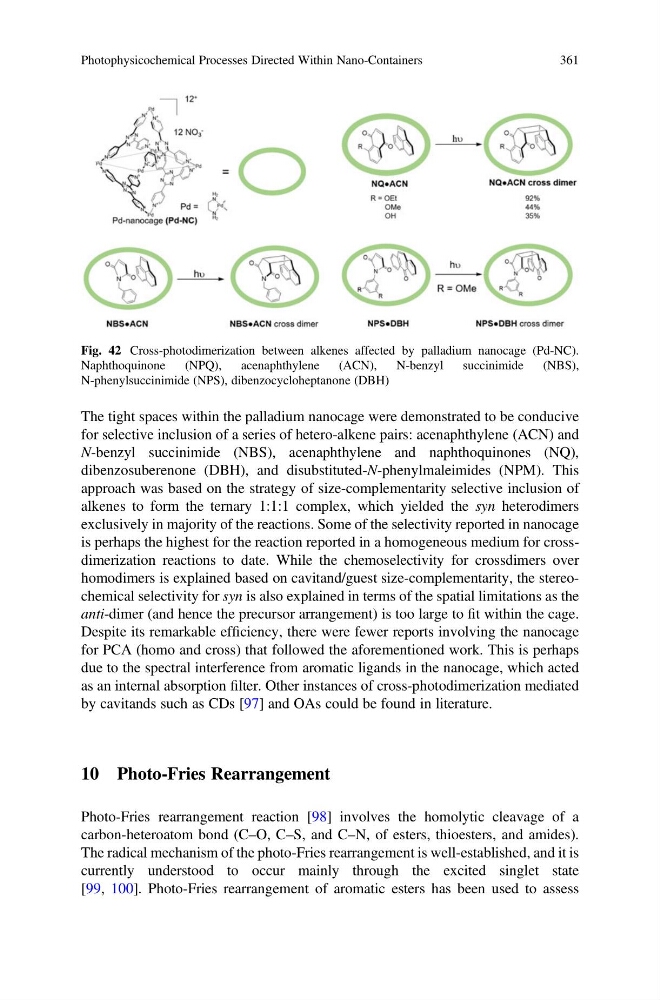
The tight spaces within the palladium nanocage were demonstrated to be conducive
for selective inclusion of a series of hetero-alkene pairs: acenaphthylene (ACN) and
N-benzyl succinimide (NBS), acenaphthylene and naphthoquinones (NQ),
dibenzosuberenone (DBH), and disubstituted-N-phenylmaleimides (NPM). This
approach was based on the strategy of size-complementarity selective inclusion of
alkenes to form the ternary 1:1:1 complex, which yielded the syn heterodimers
exclusively in majority of the reactions. Some of the selectivity reported in nanocage
is perhaps the highest for the reaction reported in a homogeneous medium for crossdimerization reactions to date. While the chemoselectivity for crossdimers over
homodimers is explained based on cavitand/guest size-complementarity, the stereochemical selectivity for syn is also explained in terms of the spatial limitations as the
anti-dimer (and hence the precursor arrangement) is too large to fit within the cage.
Despite its remarkable efficiency, there were fewer reports involving the nanocage
for PCA (homo and cross) that followed the aforementioned work. This is perhaps
due to the spectral interference from aromatic ligands in the nanocage, which acted
as an internal absorption filter. Other instances of cross-photodimerization mediated
by cavitands such as CDs [97] and OAs could be found in literature.
10 Photo-Fries Rearrangement
Photo-Fries rearrangement reaction [98] involves the homolytic cleavage of a
carbon-heteroatom bond (C–O, C–S, and C–N, of esters, thioesters, and amides).
The radical mechanism of the photo-Fries rearrangement is well-established, and it is
currently understood to occur mainly through the excited singlet state
[99, 100]. Photo-Fries rearrangement of aromatic esters has been used to assess
Fig. 42 Cross-photodimerization between alkenes affected by palladium nanocage (Pd-NC).
Naphthoquinone
(NPQ),
acenaphthylene
(ACN),
N-benzyl
succinimide
(NBS),
N-phenylsuccinimide (NPS), dibenzocycloheptanone (DBH)
Photophysicochemical Processes Directed Within Nano-Containers
361
for selective inclusion of a series of hetero-alkene pairs: acenaphthylene (ACN) and
N-benzyl succinimide (NBS), acenaphthylene and naphthoquinones (NQ),
dibenzosuberenone (DBH), and disubstituted-N-phenylmaleimides (NPM). This
approach was based on the strategy of size-complementarity selective inclusion of
alkenes to form the ternary 1:1:1 complex, which yielded the syn heterodimers
exclusively in majority of the reactions. Some of the selectivity reported in nanocage
is perhaps the highest for the reaction reported in a homogeneous medium for crossdimerization reactions to date. While the chemoselectivity for crossdimers over
homodimers is explained based on cavitand/guest size-complementarity, the stereochemical selectivity for syn is also explained in terms of the spatial limitations as the
anti-dimer (and hence the precursor arrangement) is too large to fit within the cage.
Despite its remarkable efficiency, there were fewer reports involving the nanocage
for PCA (homo and cross) that followed the aforementioned work. This is perhaps
due to the spectral interference from aromatic ligands in the nanocage, which acted
as an internal absorption filter. Other instances of cross-photodimerization mediated
by cavitands such as CDs [97] and OAs could be found in literature.
10 Photo-Fries Rearrangement
Photo-Fries rearrangement reaction [98] involves the homolytic cleavage of a
carbon-heteroatom bond (C–O, C–S, and C–N, of esters, thioesters, and amides).
The radical mechanism of the photo-Fries rearrangement is well-established, and it is
currently understood to occur mainly through the excited singlet state
[99, 100]. Photo-Fries rearrangement of aromatic esters has been used to assess
Fig. 42 Cross-photodimerization between alkenes affected by palladium nanocage (Pd-NC).
Naphthoquinone
(NPQ),
acenaphthylene
(ACN),
N-benzyl
succinimide
(NBS),
N-phenylsuccinimide (NPS), dibenzocycloheptanone (DBH)
Photophysicochemical Processes Directed Within Nano-Containers
361