

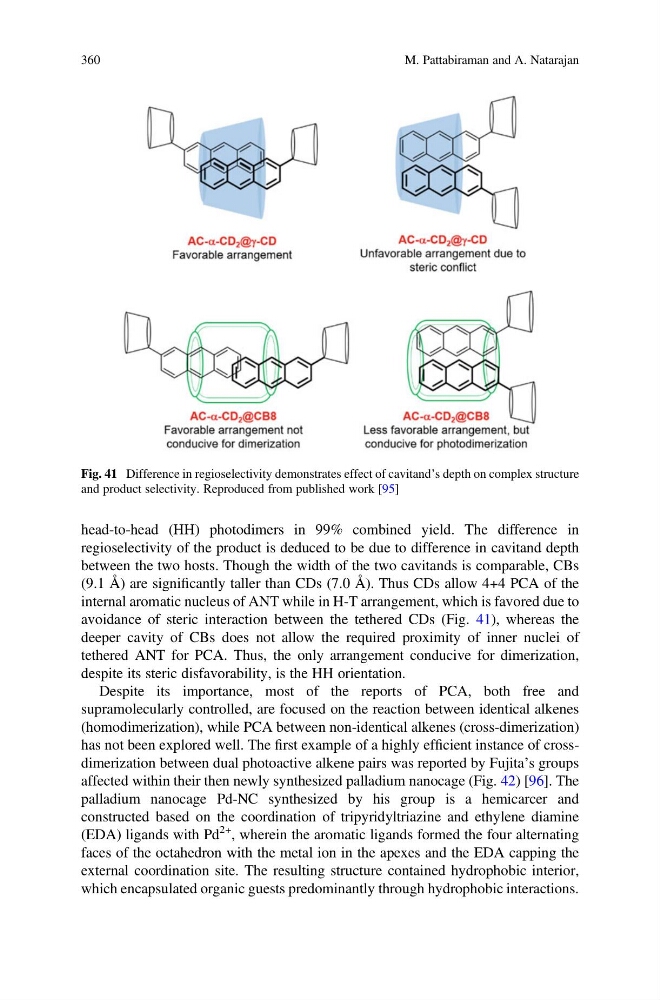
head-to-head (HH) photodimers in 99% combined yield. The difference in
regioselectivity of the product is deduced to be due to difference in cavitand depth
between the two hosts. Though the width of the two cavitands is comparable, CBs
(9.1 Å) are significantly taller than CDs (7.0 Å). Thus CDs allow 4+4 PCA of the
internal aromatic nucleus of ANT while in H-T arrangement, which is favored due to
avoidance of steric interaction between the tethered CDs (Fig. 41), whereas the
deeper cavity of CBs does not allow the required proximity of inner nuclei of
tethered ANT for PCA. Thus, the only arrangement conducive for dimerization,
despite its steric disfavorability, is the HH orientation.
Despite its importance, most of the reports of PCA, both free and
supramolecularly controlled, are focused on the reaction between identical alkenes
(homodimerization), while PCA between non-identical alkenes (cross-dimerization)
has not been explored well. The first example of a highly efficient instance of crossdimerization between dual photoactive alkene pairs was reported by Fujita’s groups
affected within their then newly synthesized palladium nanocage (Fig. 42) [96]. The
palladium nanocage Pd-NC synthesized by his group is a hemicarcer and
constructed based on the coordination of tripyridyltriazine and ethylene diamine
(EDA) ligands with Pd
2+ , wherein the aromatic ligands formed the four alternating
faces of the octahedron with the metal ion in the apexes and the EDA capping the
external coordination site. The resulting structure contained hydrophobic interior,
which encapsulated organic guests predominantly through hydrophobic interactions.
Fig. 41 Difference in regioselectivity demonstrates effect of cavitand’s depth on complex structure
and product selectivity. Reproduced from published work [95]
360
M. Pattabiraman and A. Natarajan
regioselectivity of the product is deduced to be due to difference in cavitand depth
between the two hosts. Though the width of the two cavitands is comparable, CBs
(9.1 Å) are significantly taller than CDs (7.0 Å). Thus CDs allow 4+4 PCA of the
internal aromatic nucleus of ANT while in H-T arrangement, which is favored due to
avoidance of steric interaction between the tethered CDs (Fig. 41), whereas the
deeper cavity of CBs does not allow the required proximity of inner nuclei of
tethered ANT for PCA. Thus, the only arrangement conducive for dimerization,
despite its steric disfavorability, is the HH orientation.
Despite its importance, most of the reports of PCA, both free and
supramolecularly controlled, are focused on the reaction between identical alkenes
(homodimerization), while PCA between non-identical alkenes (cross-dimerization)
has not been explored well. The first example of a highly efficient instance of crossdimerization between dual photoactive alkene pairs was reported by Fujita’s groups
affected within their then newly synthesized palladium nanocage (Fig. 42) [96]. The
palladium nanocage Pd-NC synthesized by his group is a hemicarcer and
constructed based on the coordination of tripyridyltriazine and ethylene diamine
(EDA) ligands with Pd
2+ , wherein the aromatic ligands formed the four alternating
faces of the octahedron with the metal ion in the apexes and the EDA capping the
external coordination site. The resulting structure contained hydrophobic interior,
which encapsulated organic guests predominantly through hydrophobic interactions.
Fig. 41 Difference in regioselectivity demonstrates effect of cavitand’s depth on complex structure
and product selectivity. Reproduced from published work [95]
360
M. Pattabiraman and A. Natarajan