

with two cyclizable π-bonds. Despite the presence of two reactive centers in the
molecule and propensity of such system to yield multitude of unintended products,
the ternary complex of the guest with γ-CD resulted in perfectly stacked arrangement
leading to formation of the syn-HH dimer.
The [4+4] PCA of polyaromatic hydrocarbons is also highly dependent on
intermolecular distance between the reactants. However, due to lack of a competing
photoisomerization pathway, and dimerization being the only reaction, aromatics
such as anthracenes (ANT) undergo only 4+4 PCA upon irradiation in homogeneous
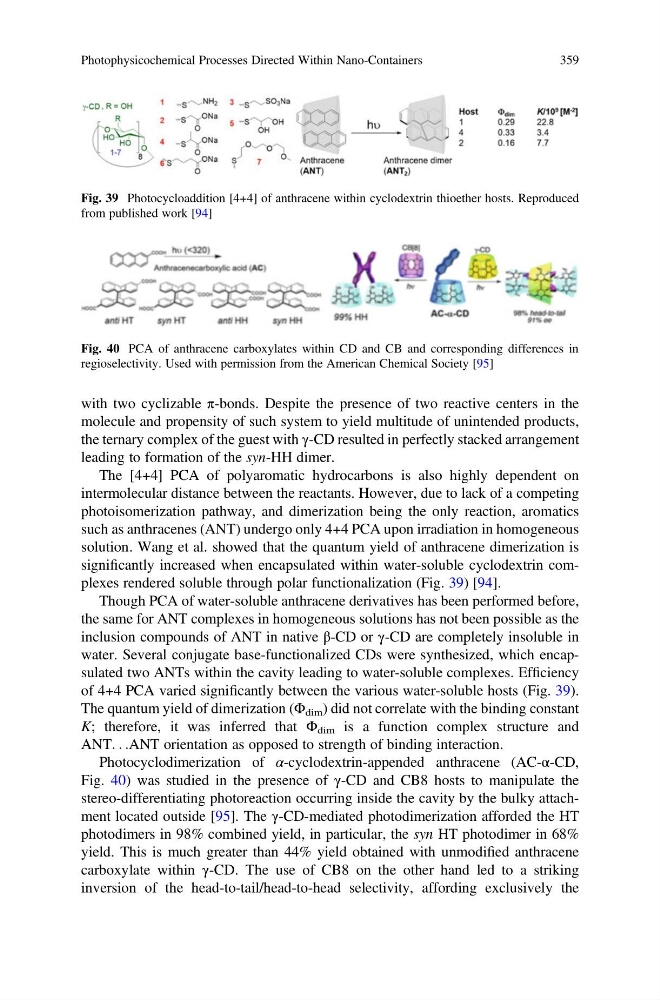
solution. Wang et al. showed that the quantum yield of anthracene dimerization is
significantly increased when encapsulated within water-soluble cyclodextrin complexes rendered soluble through polar functionalization (Fig. 39) [94].
Though PCA of water-soluble anthracene derivatives has been performed before,
the same for ANT complexes in homogeneous solutions has not been possible as the
inclusion compounds of ANT in native β-CD or γ-CD are completely insoluble in
water. Several conjugate base-functionalized CDs were synthesized, which encapsulated two ANTs within the cavity leading to water-soluble complexes. Efficiency
of 4+4 PCA varied significantly between the various water-soluble hosts (Fig. 39).
The quantum yield of dimerization (Φ dim ) did not correlate with the binding constant
K; therefore, it was inferred that Φ dim is a function complex structure and
ANT. . .ANT orientation as opposed to strength of binding interaction.
Photocyclodimerization of α-cyclodextrin-appended anthracene (AC-α-CD,
Fig. 40) was studied in the presence of γ-CD and CB8 hosts to manipulate the
stereo-differentiating photoreaction occurring inside the cavity by the bulky attachment located outside [95]. The γ-CD-mediated photodimerization afforded the HT
photodimers in 98% combined yield, in particular, the syn HT photodimer in 68%
yield. This is much greater than 44% yield obtained with unmodified anthracene
carboxylate within γ-CD. The use of CB8 on the other hand led to a striking
inversion of the head-to-tail/head-to-head selectivity, affording exclusively the
Fig. 39 Photocycloaddition [4+4] of anthracene within cyclodextrin thioether hosts. Reproduced
from published work [94]
Fig. 40 PCA of anthracene carboxylates within CD and CB and corresponding differences in
regioselectivity. Used with permission from the American Chemical Society [95]
Photophysicochemical Processes Directed Within Nano-Containers
359
molecule and propensity of such system to yield multitude of unintended products,
the ternary complex of the guest with γ-CD resulted in perfectly stacked arrangement
leading to formation of the syn-HH dimer.
The [4+4] PCA of polyaromatic hydrocarbons is also highly dependent on
intermolecular distance between the reactants. However, due to lack of a competing
photoisomerization pathway, and dimerization being the only reaction, aromatics
such as anthracenes (ANT) undergo only 4+4 PCA upon irradiation in homogeneous
solution. Wang et al. showed that the quantum yield of anthracene dimerization is
significantly increased when encapsulated within water-soluble cyclodextrin complexes rendered soluble through polar functionalization (Fig. 39) [94].
Though PCA of water-soluble anthracene derivatives has been performed before,
the same for ANT complexes in homogeneous solutions has not been possible as the
inclusion compounds of ANT in native β-CD or γ-CD are completely insoluble in
water. Several conjugate base-functionalized CDs were synthesized, which encapsulated two ANTs within the cavity leading to water-soluble complexes. Efficiency
of 4+4 PCA varied significantly between the various water-soluble hosts (Fig. 39).
The quantum yield of dimerization (Φ dim ) did not correlate with the binding constant
K; therefore, it was inferred that Φ dim is a function complex structure and
ANT. . .ANT orientation as opposed to strength of binding interaction.
Photocyclodimerization of α-cyclodextrin-appended anthracene (AC-α-CD,
Fig. 40) was studied in the presence of γ-CD and CB8 hosts to manipulate the
stereo-differentiating photoreaction occurring inside the cavity by the bulky attachment located outside [95]. The γ-CD-mediated photodimerization afforded the HT
photodimers in 98% combined yield, in particular, the syn HT photodimer in 68%
yield. This is much greater than 44% yield obtained with unmodified anthracene
carboxylate within γ-CD. The use of CB8 on the other hand led to a striking
inversion of the head-to-tail/head-to-head selectivity, affording exclusively the
Fig. 39 Photocycloaddition [4+4] of anthracene within cyclodextrin thioether hosts. Reproduced
from published work [94]
Fig. 40 PCA of anthracene carboxylates within CD and CB and corresponding differences in
regioselectivity. Used with permission from the American Chemical Society [95]
Photophysicochemical Processes Directed Within Nano-Containers
359