

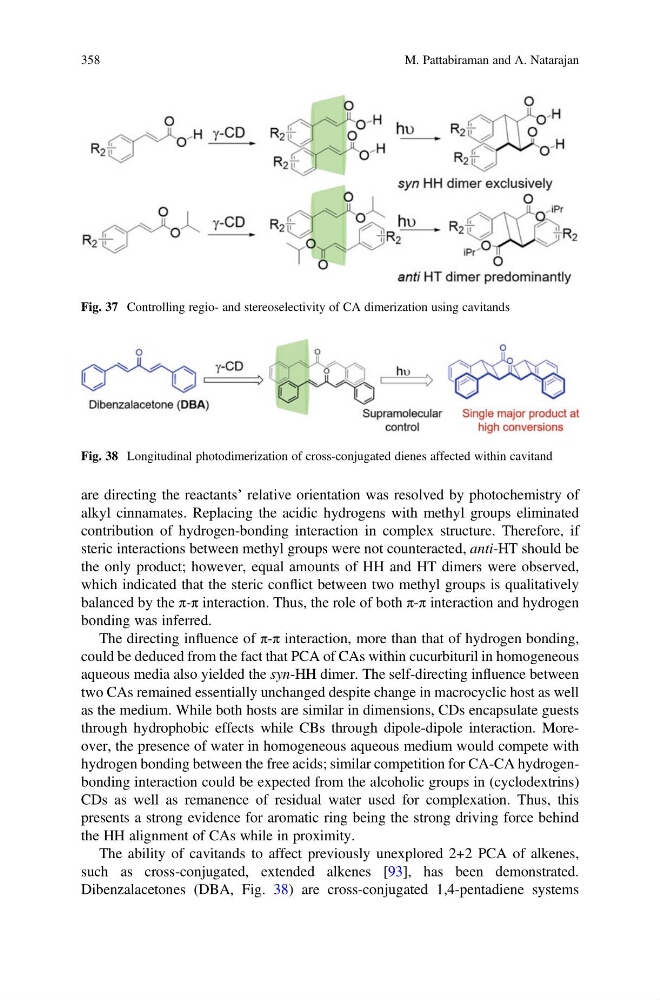
are directing the reactants’ relative orientation was resolved by photochemistry of
alkyl cinnamates. Replacing the acidic hydrogens with methyl groups eliminated
contribution of hydrogen-bonding interaction in complex structure. Therefore, if
steric interactions between methyl groups were not counteracted, anti-HT should be
the only product; however, equal amounts of HH and HT dimers were observed,
which indicated that the steric conflict between two methyl groups is qualitatively
balanced by the π-π interaction. Thus, the role of both π-π interaction and hydrogen
bonding was inferred.
The directing influence of π-π interaction, more than that of hydrogen bonding,
could be deduced from the fact that PCA of CAs within cucurbituril in homogeneous
aqueous media also yielded the syn-HH dimer. The self-directing influence between
two CAs remained essentially unchanged despite change in macrocyclic host as well
as the medium. While both hosts are similar in dimensions, CDs encapsulate guests
through hydrophobic effects while CBs through dipole-dipole interaction. Moreover, the presence of water in homogeneous aqueous medium would compete with
hydrogen bonding between the free acids; similar competition for CA-CA hydrogenbonding interaction could be expected from the alcoholic groups in (cyclodextrins)
CDs as well as remanence of residual water used for complexation. Thus, this
presents a strong evidence for aromatic ring being the strong driving force behind
the HH alignment of CAs while in proximity.
The ability of cavitands to affect previously unexplored 2+2 PCA of alkenes,
such as cross-conjugated, extended alkenes [93], has been demonstrated.
Dibenzalacetones (DBA, Fig. 38) are cross-conjugated 1,4-pentadiene systems
Fig. 37 Controlling regio- and stereoselectivity of CA dimerization using cavitands
Fig. 38 Longitudinal photodimerization of cross-conjugated dienes affected within cavitand
358
M. Pattabiraman and A. Natarajan
alkyl cinnamates. Replacing the acidic hydrogens with methyl groups eliminated
contribution of hydrogen-bonding interaction in complex structure. Therefore, if
steric interactions between methyl groups were not counteracted, anti-HT should be
the only product; however, equal amounts of HH and HT dimers were observed,
which indicated that the steric conflict between two methyl groups is qualitatively
balanced by the π-π interaction. Thus, the role of both π-π interaction and hydrogen
bonding was inferred.
The directing influence of π-π interaction, more than that of hydrogen bonding,
could be deduced from the fact that PCA of CAs within cucurbituril in homogeneous
aqueous media also yielded the syn-HH dimer. The self-directing influence between
two CAs remained essentially unchanged despite change in macrocyclic host as well
as the medium. While both hosts are similar in dimensions, CDs encapsulate guests
through hydrophobic effects while CBs through dipole-dipole interaction. Moreover, the presence of water in homogeneous aqueous medium would compete with
hydrogen bonding between the free acids; similar competition for CA-CA hydrogenbonding interaction could be expected from the alcoholic groups in (cyclodextrins)
CDs as well as remanence of residual water used for complexation. Thus, this
presents a strong evidence for aromatic ring being the strong driving force behind
the HH alignment of CAs while in proximity.
The ability of cavitands to affect previously unexplored 2+2 PCA of alkenes,
such as cross-conjugated, extended alkenes [93], has been demonstrated.
Dibenzalacetones (DBA, Fig. 38) are cross-conjugated 1,4-pentadiene systems
Fig. 37 Controlling regio- and stereoselectivity of CA dimerization using cavitands
Fig. 38 Longitudinal photodimerization of cross-conjugated dienes affected within cavitand
358
M. Pattabiraman and A. Natarajan