

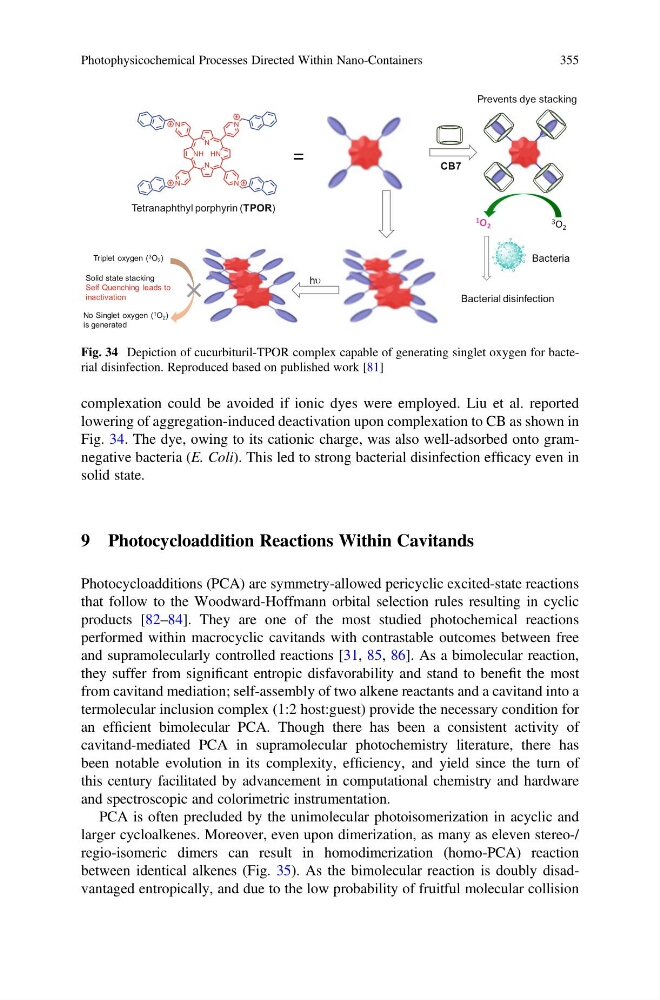
complexation could be avoided if ionic dyes were employed. Liu et al. reported
lowering of aggregation-induced deactivation upon complexation to CB as shown in
Fig. 34. The dye, owing to its cationic charge, was also well-adsorbed onto gramnegative bacteria (E. Coli). This led to strong bacterial disinfection efficacy even in
solid state.
9 Photocycloaddition Reactions Within Cavitands
Photocycloadditions (PCA) are symmetry-allowed pericyclic excited-state reactions
that follow to the Woodward-Hoffmann orbital selection rules resulting in cyclic
products [82–84]. They are one of the most studied photochemical reactions
performed within macrocyclic cavitands with contrastable outcomes between free
and supramolecularly controlled reactions [31, 85, 86]. As a bimolecular reaction,
they suffer from significant entropic disfavorability and stand to benefit the most
from cavitand mediation; self-assembly of two alkene reactants and a cavitand into a
termolecular inclusion complex (1:2 host:guest) provide the necessary condition for
an efficient bimolecular PCA. Though there has been a consistent activity of
cavitand-mediated PCA in supramolecular photochemistry literature, there has
been notable evolution in its complexity, efficiency, and yield since the turn of
this century facilitated by advancement in computational chemistry and hardware
and spectroscopic and colorimetric instrumentation.
PCA is often precluded by the unimolecular photoisomerization in acyclic and
larger cycloalkenes. Moreover, even upon dimerization, as many as eleven stereo-/
regio-isomeric dimers can result in homodimerization (homo-PCA) reaction
between identical alkenes (Fig. 35). As the bimolecular reaction is doubly disadvantaged entropically, and due to the low probability of fruitful molecular collision
=
Tetranaphthyl porphyrin (TPOR)
CB7
h
Solid state stacking
Self Quenching leads to
inactivation
Triplet oxygen ( 3 O 2 )
No Singlet oxygen ( 1 O 2 )
is generated
3 O 2
1 O 2
Bacteria
Bacterial disinfection
Prevents dye stacking
Fig. 34 Depiction of cucurbituril-TPOR complex capable of generating singlet oxygen for bacterial disinfection. Reproduced based on published work [81]
Photophysicochemical Processes Directed Within Nano-Containers
355
lowering of aggregation-induced deactivation upon complexation to CB as shown in
Fig. 34. The dye, owing to its cationic charge, was also well-adsorbed onto gramnegative bacteria (E. Coli). This led to strong bacterial disinfection efficacy even in
solid state.
9 Photocycloaddition Reactions Within Cavitands
Photocycloadditions (PCA) are symmetry-allowed pericyclic excited-state reactions
that follow to the Woodward-Hoffmann orbital selection rules resulting in cyclic
products [82–84]. They are one of the most studied photochemical reactions
performed within macrocyclic cavitands with contrastable outcomes between free
and supramolecularly controlled reactions [31, 85, 86]. As a bimolecular reaction,
they suffer from significant entropic disfavorability and stand to benefit the most
from cavitand mediation; self-assembly of two alkene reactants and a cavitand into a
termolecular inclusion complex (1:2 host:guest) provide the necessary condition for
an efficient bimolecular PCA. Though there has been a consistent activity of
cavitand-mediated PCA in supramolecular photochemistry literature, there has
been notable evolution in its complexity, efficiency, and yield since the turn of
this century facilitated by advancement in computational chemistry and hardware
and spectroscopic and colorimetric instrumentation.
PCA is often precluded by the unimolecular photoisomerization in acyclic and
larger cycloalkenes. Moreover, even upon dimerization, as many as eleven stereo-/
regio-isomeric dimers can result in homodimerization (homo-PCA) reaction
between identical alkenes (Fig. 35). As the bimolecular reaction is doubly disadvantaged entropically, and due to the low probability of fruitful molecular collision
=
Tetranaphthyl porphyrin (TPOR)
CB7
h
Solid state stacking
Self Quenching leads to
inactivation
Triplet oxygen ( 3 O 2 )
No Singlet oxygen ( 1 O 2 )
is generated
3 O 2
1 O 2
Bacteria
Bacterial disinfection
Prevents dye stacking
Fig. 34 Depiction of cucurbituril-TPOR complex capable of generating singlet oxygen for bacterial disinfection. Reproduced based on published work [81]
Photophysicochemical Processes Directed Within Nano-Containers
355