

occurring within the excited-state lifetime (typically in the range of nano- to microseconds), PCAs generally suffer from low quantum yields. PCAs from excited triplet
state are less likely to occur with regio- and/or stereoselectively.
The supramolecular approach employed to promote PCA of alkenes falls under
two categories: crystal engineering (CE), and cavitand mediation. The CE approach
achieves controlled PCA based on reduced rotational and translational freedom
experienced by molecules in organized solid state [87, 88]. This approach, pioneered
by G. M. J. Schmidt, is referred to as topochemical solid-state transformation
[89]. However, the inability to predict molecular packing of organic molecules in
crystals renders this method less general and very reactant-specific. The other
method, more general and reliable, for directing the reactivity of alkenes is the
cavitand-mediation approach. This involves confining two reacting alkenes in the
cavity of a large cavitand (Fig. 36) and pre-orienting them based on supramolecular
interactions toward a specific dimeric product upon excitation. Cavitand-mediated
photodimerization of alkenes has been known since the early 1980s. Early studies
were carried with cyclodextrins as templates.
The 2+2 PCA within cavitands has been demonstrated for several families of
alkenes, and each of them presents unique perspective into this reaction. Such efforts
focus on two main aspects of this reaction that are of fundamental science significance: quantum efficiency of dimerization and chemoselectivity. Quantum efficiency of photodimerization, over isomerization, indicates stability/dynamism of
ground-state termolecular complex, and stereoselectivity is an indication of multiplicity of excited-state and ground-state complex structure; however, it should also
be recognized that multiplicity and efficiency are interrelated. Several instances of
PCA of alkenes affected within cavitands have served as a proof of feasibility of
cycloadditions that either are not possible without supramolecular mediation or are
difficult to predict theoretically. This section will present a series of simple and
predictable PCAs affected within cavitands and its usefulness in understanding
molecular structure and bonding, which is deducible from weak interactions between
encapsulated guests.
Cinnamic acids (CAs) have been at the forefront of the study of PCA since
Schmidt studied their reactivity to deduce topochemical information (relative structure and orientation) of reactants, wherein the quantum efficiency of dimerization
was directly proportional to the proximity of the alkene bonds. Cucurbiturilmediated PCA of CAs was reported by our group (Fig. 36) [90, 91]. Both quantum
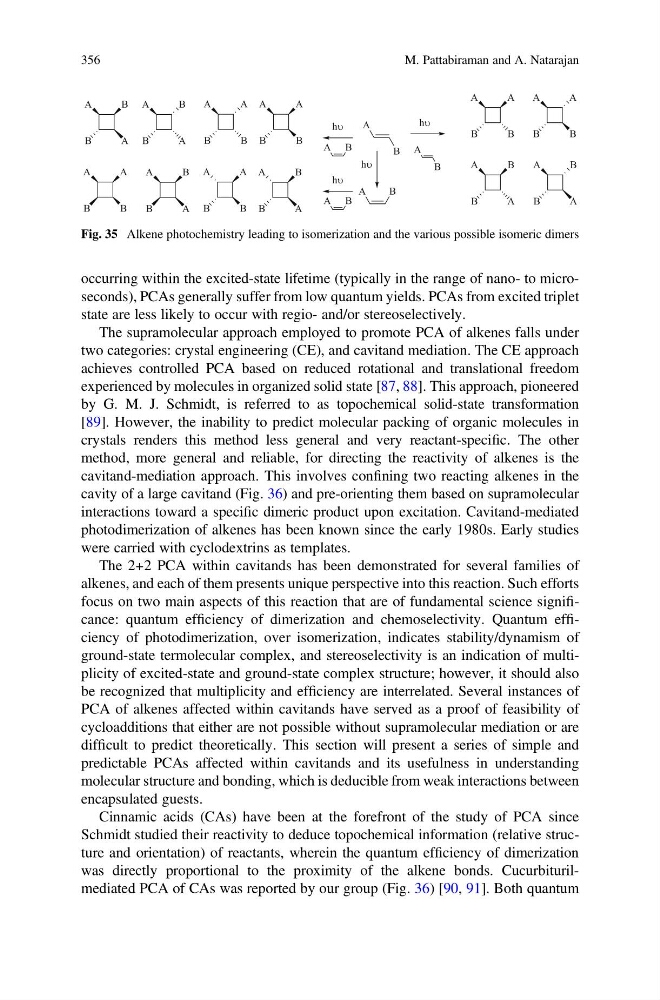
Fig. 35 Alkene photochemistry leading to isomerization and the various possible isomeric dimers
356
M. Pattabiraman and A. Natarajan
state are less likely to occur with regio- and/or stereoselectively.
The supramolecular approach employed to promote PCA of alkenes falls under
two categories: crystal engineering (CE), and cavitand mediation. The CE approach
achieves controlled PCA based on reduced rotational and translational freedom
experienced by molecules in organized solid state [87, 88]. This approach, pioneered
by G. M. J. Schmidt, is referred to as topochemical solid-state transformation
[89]. However, the inability to predict molecular packing of organic molecules in
crystals renders this method less general and very reactant-specific. The other
method, more general and reliable, for directing the reactivity of alkenes is the
cavitand-mediation approach. This involves confining two reacting alkenes in the
cavity of a large cavitand (Fig. 36) and pre-orienting them based on supramolecular
interactions toward a specific dimeric product upon excitation. Cavitand-mediated
photodimerization of alkenes has been known since the early 1980s. Early studies
were carried with cyclodextrins as templates.
The 2+2 PCA within cavitands has been demonstrated for several families of
alkenes, and each of them presents unique perspective into this reaction. Such efforts
focus on two main aspects of this reaction that are of fundamental science significance: quantum efficiency of dimerization and chemoselectivity. Quantum efficiency of photodimerization, over isomerization, indicates stability/dynamism of
ground-state termolecular complex, and stereoselectivity is an indication of multiplicity of excited-state and ground-state complex structure; however, it should also
be recognized that multiplicity and efficiency are interrelated. Several instances of
PCA of alkenes affected within cavitands have served as a proof of feasibility of
cycloadditions that either are not possible without supramolecular mediation or are
difficult to predict theoretically. This section will present a series of simple and
predictable PCAs affected within cavitands and its usefulness in understanding
molecular structure and bonding, which is deducible from weak interactions between
encapsulated guests.
Cinnamic acids (CAs) have been at the forefront of the study of PCA since
Schmidt studied their reactivity to deduce topochemical information (relative structure and orientation) of reactants, wherein the quantum efficiency of dimerization
was directly proportional to the proximity of the alkene bonds. Cucurbiturilmediated PCA of CAs was reported by our group (Fig. 36) [90, 91]. Both quantum
Fig. 35 Alkene photochemistry leading to isomerization and the various possible isomeric dimers
356
M. Pattabiraman and A. Natarajan