

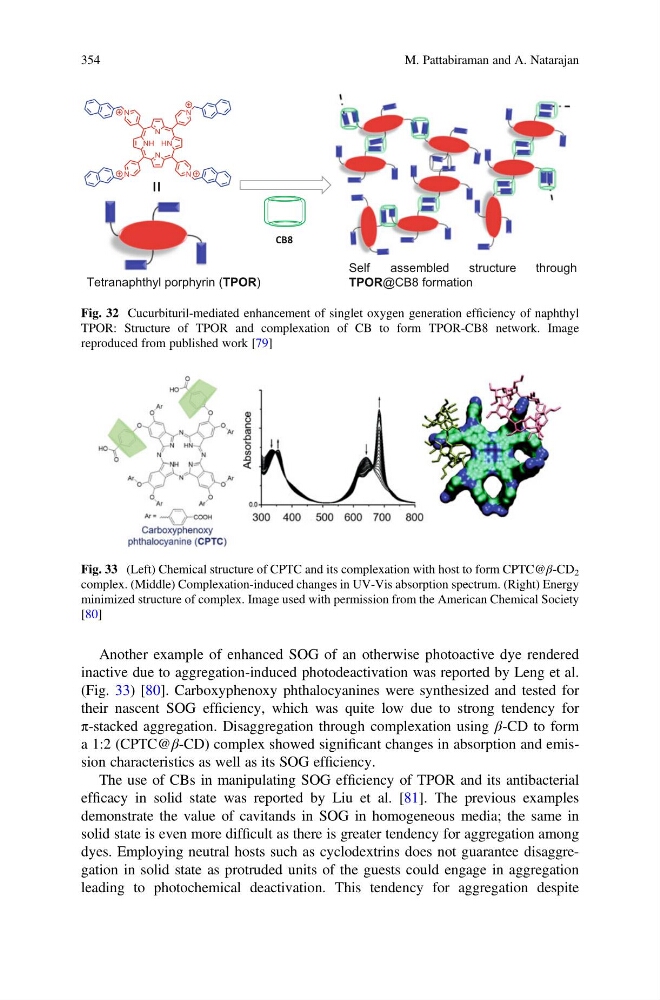
Another example of enhanced SOG of an otherwise photoactive dye rendered
inactive due to aggregation-induced photodeactivation was reported by Leng et al.
(Fig. 33) [80]. Carboxyphenoxy phthalocyanines were synthesized and tested for
their nascent SOG efficiency, which was quite low due to strong tendency for
π-stacked aggregation. Disaggregation through complexation using β-CD to form
a 1:2 (CPTC@β-CD) complex showed significant changes in absorption and emission characteristics as well as its SOG efficiency.
The use of CBs in manipulating SOG efficiency of TPOR and its antibacterial
efficacy in solid state was reported by Liu et al. [81]. The previous examples
demonstrate the value of cavitands in SOG in homogeneous media; the same in
solid state is even more difficult as there is greater tendency for aggregation among
dyes. Employing neutral hosts such as cyclodextrins does not guarantee disaggregation in solid state as protruded units of the guests could engage in aggregation
leading to photochemical deactivation. This tendency for aggregation despite
Tetranaphthyl porphyrin (TPOR)
Self
assembled
structure
through
=
CB8
TPOR@CB8 formation
Fig. 32 Cucurbituril-mediated enhancement of singlet oxygen generation efficiency of naphthyl
TPOR: Structure of TPOR and complexation of CB to form TPOR-CB8 network. Image
reproduced from published work [79]
Fig. 33 (Left) Chemical structure of CPTC and its complexation with host to form CPTC@β-CD 2
complex. (Middle) Complexation-induced changes in UV-Vis absorption spectrum. (Right) Energy
minimized structure of complex. Image used with permission from the American Chemical Society
[80]
354
M. Pattabiraman and A. Natarajan
inactive due to aggregation-induced photodeactivation was reported by Leng et al.
(Fig. 33) [80]. Carboxyphenoxy phthalocyanines were synthesized and tested for
their nascent SOG efficiency, which was quite low due to strong tendency for
π-stacked aggregation. Disaggregation through complexation using β-CD to form
a 1:2 (CPTC@β-CD) complex showed significant changes in absorption and emission characteristics as well as its SOG efficiency.
The use of CBs in manipulating SOG efficiency of TPOR and its antibacterial
efficacy in solid state was reported by Liu et al. [81]. The previous examples
demonstrate the value of cavitands in SOG in homogeneous media; the same in
solid state is even more difficult as there is greater tendency for aggregation among
dyes. Employing neutral hosts such as cyclodextrins does not guarantee disaggregation in solid state as protruded units of the guests could engage in aggregation
leading to photochemical deactivation. This tendency for aggregation despite
Tetranaphthyl porphyrin (TPOR)
Self
assembled
structure
through
=
CB8
TPOR@CB8 formation
Fig. 32 Cucurbituril-mediated enhancement of singlet oxygen generation efficiency of naphthyl
TPOR: Structure of TPOR and complexation of CB to form TPOR-CB8 network. Image
reproduced from published work [79]
Fig. 33 (Left) Chemical structure of CPTC and its complexation with host to form CPTC@β-CD 2
complex. (Middle) Complexation-induced changes in UV-Vis absorption spectrum. (Right) Energy
minimized structure of complex. Image used with permission from the American Chemical Society
[80]
354
M. Pattabiraman and A. Natarajan