

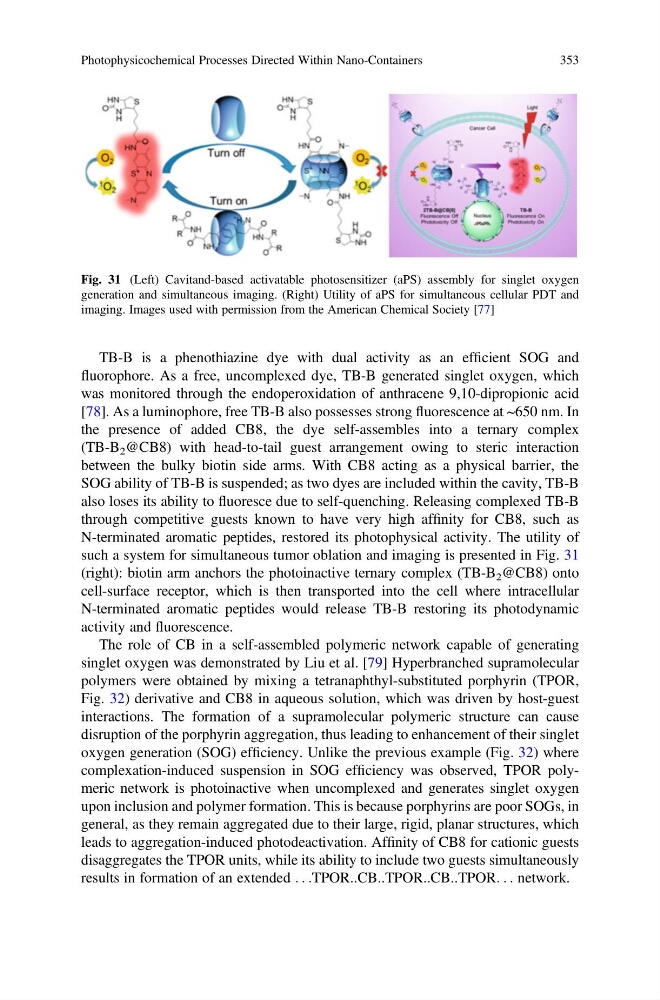
TB-B is a phenothiazine dye with dual activity as an efficient SOG and
fluorophore. As a free, uncomplexed dye, TB-B generated singlet oxygen, which
was monitored through the endoperoxidation of anthracene 9,10-dipropionic acid
[78]. As a luminophore, free TB-B also possesses strong fluorescence at ~650 nm. In
the presence of added CB8, the dye self-assembles into a ternary complex
(TB-B 2 @CB8) with head-to-tail guest arrangement owing to steric interaction
between the bulky biotin side arms. With CB8 acting as a physical barrier, the
SOG ability of TB-B is suspended; as two dyes are included within the cavity, TB-B
also loses its ability to fluoresce due to self-quenching. Releasing complexed TB-B
through competitive guests known to have very high affinity for CB8, such as
N-terminated aromatic peptides, restored its photophysical activity. The utility of
such a system for simultaneous tumor oblation and imaging is presented in Fig. 31
(right): biotin arm anchors the photoinactive ternary complex (TB-B 2 @CB8) onto
cell-surface receptor, which is then transported into the cell where intracellular
N-terminated aromatic peptides would release TB-B restoring its photodynamic
activity and fluorescence.
The role of CB in a self-assembled polymeric network capable of generating
singlet oxygen was demonstrated by Liu et al. [79] Hyperbranched supramolecular
polymers were obtained by mixing a tetranaphthyl-substituted porphyrin (TPOR,
Fig. 32) derivative and CB8 in aqueous solution, which was driven by host-guest
interactions. The formation of a supramolecular polymeric structure can cause
disruption of the porphyrin aggregation, thus leading to enhancement of their singlet
oxygen generation (SOG) efficiency. Unlike the previous example (Fig. 32) where
complexation-induced suspension in SOG efficiency was observed, TPOR polymeric network is photoinactive when uncomplexed and generates singlet oxygen
upon inclusion and polymer formation. This is because porphyrins are poor SOGs, in
general, as they remain aggregated due to their large, rigid, planar structures, which
leads to aggregation-induced photodeactivation. Affinity of CB8 for cationic guests
disaggregates the TPOR units, while its ability to include two guests simultaneously
results in formation of an extended . . .TPOR..CB..TPOR..CB..TPOR. . . network.
Fig. 31 (Left) Cavitand-based activatable photosensitizer (aPS) assembly for singlet oxygen
generation and simultaneous imaging. (Right) Utility of aPS for simultaneous cellular PDT and
imaging. Images used with permission from the American Chemical Society [77]
Photophysicochemical Processes Directed Within Nano-Containers
353
fluorophore. As a free, uncomplexed dye, TB-B generated singlet oxygen, which
was monitored through the endoperoxidation of anthracene 9,10-dipropionic acid
[78]. As a luminophore, free TB-B also possesses strong fluorescence at ~650 nm. In
the presence of added CB8, the dye self-assembles into a ternary complex
(TB-B 2 @CB8) with head-to-tail guest arrangement owing to steric interaction
between the bulky biotin side arms. With CB8 acting as a physical barrier, the
SOG ability of TB-B is suspended; as two dyes are included within the cavity, TB-B
also loses its ability to fluoresce due to self-quenching. Releasing complexed TB-B
through competitive guests known to have very high affinity for CB8, such as
N-terminated aromatic peptides, restored its photophysical activity. The utility of
such a system for simultaneous tumor oblation and imaging is presented in Fig. 31
(right): biotin arm anchors the photoinactive ternary complex (TB-B 2 @CB8) onto
cell-surface receptor, which is then transported into the cell where intracellular
N-terminated aromatic peptides would release TB-B restoring its photodynamic
activity and fluorescence.
The role of CB in a self-assembled polymeric network capable of generating
singlet oxygen was demonstrated by Liu et al. [79] Hyperbranched supramolecular
polymers were obtained by mixing a tetranaphthyl-substituted porphyrin (TPOR,
Fig. 32) derivative and CB8 in aqueous solution, which was driven by host-guest
interactions. The formation of a supramolecular polymeric structure can cause
disruption of the porphyrin aggregation, thus leading to enhancement of their singlet
oxygen generation (SOG) efficiency. Unlike the previous example (Fig. 32) where
complexation-induced suspension in SOG efficiency was observed, TPOR polymeric network is photoinactive when uncomplexed and generates singlet oxygen
upon inclusion and polymer formation. This is because porphyrins are poor SOGs, in
general, as they remain aggregated due to their large, rigid, planar structures, which
leads to aggregation-induced photodeactivation. Affinity of CB8 for cationic guests
disaggregates the TPOR units, while its ability to include two guests simultaneously
results in formation of an extended . . .TPOR..CB..TPOR..CB..TPOR. . . network.
Fig. 31 (Left) Cavitand-based activatable photosensitizer (aPS) assembly for singlet oxygen
generation and simultaneous imaging. (Right) Utility of aPS for simultaneous cellular PDT and
imaging. Images used with permission from the American Chemical Society [77]
Photophysicochemical Processes Directed Within Nano-Containers
353