

from the
1
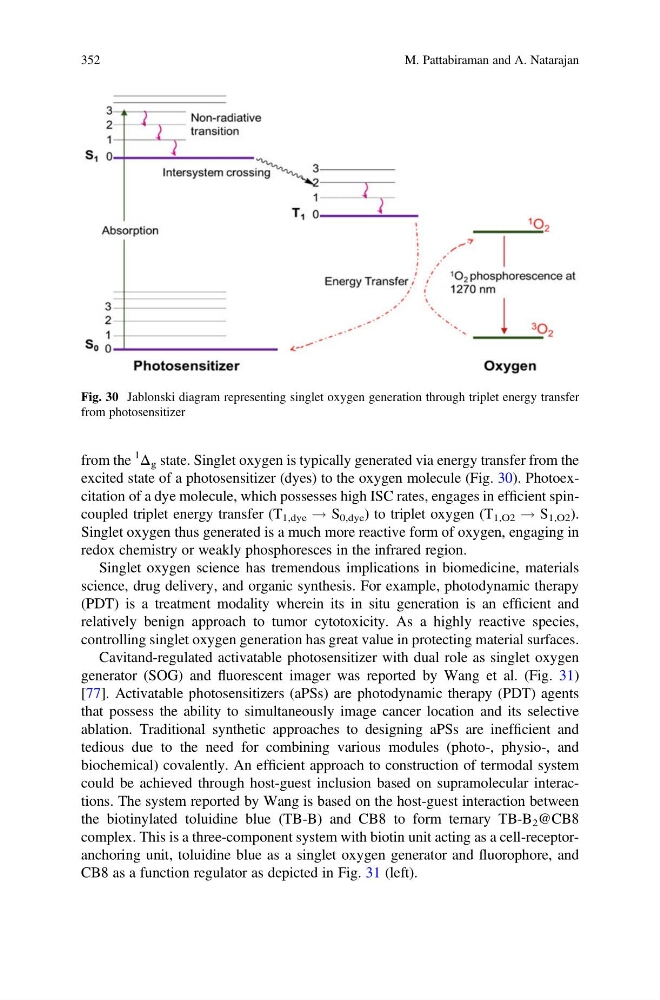
Δ g state. Singlet oxygen is typically generated via energy transfer from the
excited state of a photosensitizer (dyes) to the oxygen molecule (Fig. 30). Photoexcitation of a dye molecule, which possesses high ISC rates, engages in efficient spincoupled triplet energy transfer (T 1,dye ! S 0,dye ) to triplet oxygen (T 1,O2 ! S 1,O2 ).
Singlet oxygen thus generated is a much more reactive form of oxygen, engaging in
redox chemistry or weakly phosphoresces in the infrared region.
Singlet oxygen science has tremendous implications in biomedicine, materials
science, drug delivery, and organic synthesis. For example, photodynamic therapy
(PDT) is a treatment modality wherein its in situ generation is an efficient and
relatively benign approach to tumor cytotoxicity. As a highly reactive species,
controlling singlet oxygen generation has great value in protecting material surfaces.
Cavitand-regulated activatable photosensitizer with dual role as singlet oxygen
generator (SOG) and fluorescent imager was reported by Wang et al. (Fig. 31)
[77]. Activatable photosensitizers (aPSs) are photodynamic therapy (PDT) agents
that possess the ability to simultaneously image cancer location and its selective
ablation. Traditional synthetic approaches to designing aPSs are inefficient and
tedious due to the need for combining various modules (photo-, physio-, and
biochemical) covalently. An efficient approach to construction of termodal system
could be achieved through host-guest inclusion based on supramolecular interactions. The system reported by Wang is based on the host-guest interaction between
the biotinylated toluidine blue (TB-B) and CB8 to form ternary TB-B 2 @CB8
complex. This is a three-component system with biotin unit acting as a cell-receptoranchoring unit, toluidine blue as a singlet oxygen generator and fluorophore, and
CB8 as a function regulator as depicted in Fig. 31 (left).
Fig. 30 Jablonski diagram representing singlet oxygen generation through triplet energy transfer
from photosensitizer
352
M. Pattabiraman and A. Natarajan
1
Δ g state. Singlet oxygen is typically generated via energy transfer from the
excited state of a photosensitizer (dyes) to the oxygen molecule (Fig. 30). Photoexcitation of a dye molecule, which possesses high ISC rates, engages in efficient spincoupled triplet energy transfer (T 1,dye ! S 0,dye ) to triplet oxygen (T 1,O2 ! S 1,O2 ).
Singlet oxygen thus generated is a much more reactive form of oxygen, engaging in
redox chemistry or weakly phosphoresces in the infrared region.
Singlet oxygen science has tremendous implications in biomedicine, materials
science, drug delivery, and organic synthesis. For example, photodynamic therapy
(PDT) is a treatment modality wherein its in situ generation is an efficient and
relatively benign approach to tumor cytotoxicity. As a highly reactive species,
controlling singlet oxygen generation has great value in protecting material surfaces.
Cavitand-regulated activatable photosensitizer with dual role as singlet oxygen
generator (SOG) and fluorescent imager was reported by Wang et al. (Fig. 31)
[77]. Activatable photosensitizers (aPSs) are photodynamic therapy (PDT) agents
that possess the ability to simultaneously image cancer location and its selective
ablation. Traditional synthetic approaches to designing aPSs are inefficient and
tedious due to the need for combining various modules (photo-, physio-, and
biochemical) covalently. An efficient approach to construction of termodal system
could be achieved through host-guest inclusion based on supramolecular interactions. The system reported by Wang is based on the host-guest interaction between
the biotinylated toluidine blue (TB-B) and CB8 to form ternary TB-B 2 @CB8
complex. This is a three-component system with biotin unit acting as a cell-receptoranchoring unit, toluidine blue as a singlet oxygen generator and fluorophore, and
CB8 as a function regulator as depicted in Fig. 31 (left).
Fig. 30 Jablonski diagram representing singlet oxygen generation through triplet energy transfer
from photosensitizer
352
M. Pattabiraman and A. Natarajan