

CU-1* ! CU-3 (Fig. 28 bottom left: purple, blue, green). Emission spectra of
mixture of the three coumarins encapsulated within OAm 2 on clay showed predominant emission from the energy acceptor CU-3 irrespective of which donor was
excited (CU-1 at 320 nm and CU-2 at 380 nm, Fig. 28 bottom right). Mathematically
generated best-fit emission spectra based on individual ET efficiencies and statistical
analysis of surface distribution of the donor-acceptor arrangement were almost
identical to the empirical data (dotted red line vs. black line). The best-fit spectrum
was also useful in determining the individual ET efficiencies, which was comparable
to that of the two-component systems upon normalization. Comparison of energy
transfer efficiencies of the two-component and three-component systems clearly
demonstrated that excitation of CU-1 leads to emission from CU-3 (Fig. 28) through
an energy cascade pathway. Successful merging of supramolecular chemistry and
surface chemistry by demonstrating novel multistep energy transfer in a threecomponent dye-encapsulated system on a clay surface opens newer opportunities
for exploring such systems in an artificial light-harvesting phenomenon.
8 Singlet Oxygen
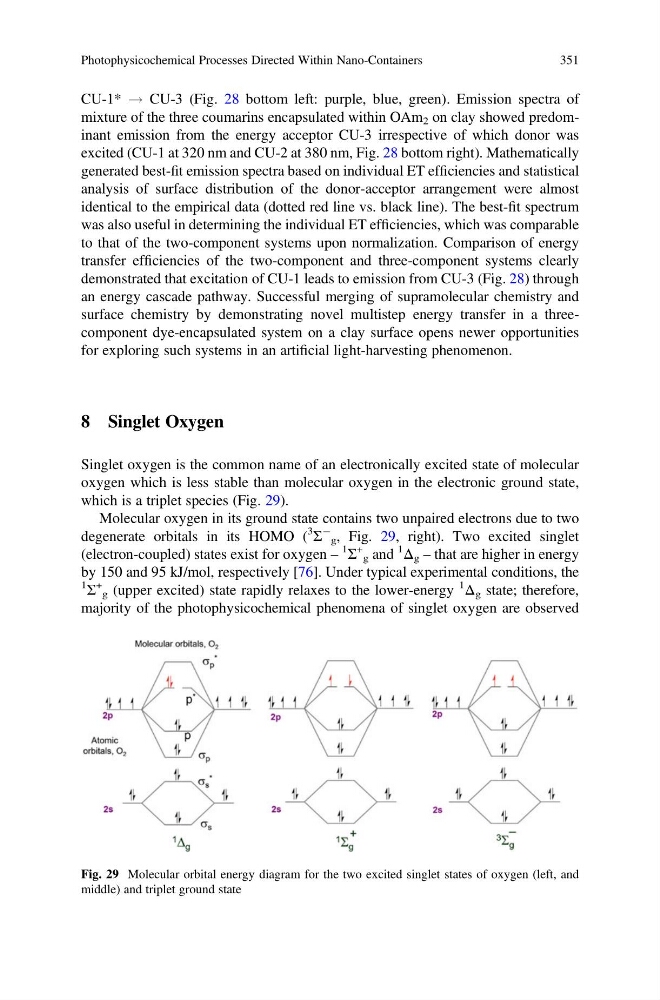
Singlet oxygen is the common name of an electronically excited state of molecular
oxygen which is less stable than molecular oxygen in the electronic ground state,
which is a triplet species (Fig. 29).
Molecular oxygen in its ground state contains two unpaired electrons due to two
degenerate orbitals in its HOMO (
3
Σ
À
g , Fig. 29, right). Two excited singlet
(electron-coupled) states exist for oxygen –
1
Σ
+
g and
1
Δ g – that are higher in energy
by 150 and 95 kJ/mol, respectively [76]. Under typical experimental conditions, the
1
Σ
+
g (upper excited) state rapidly relaxes to the lower-energy
1
Δ g state; therefore,
majority of the photophysicochemical phenomena of singlet oxygen are observed
Fig. 29 Molecular orbital energy diagram for the two excited singlet states of oxygen (left, and
middle) and triplet ground state
Photophysicochemical Processes Directed Within Nano-Containers
351
mixture of the three coumarins encapsulated within OAm 2 on clay showed predominant emission from the energy acceptor CU-3 irrespective of which donor was
excited (CU-1 at 320 nm and CU-2 at 380 nm, Fig. 28 bottom right). Mathematically
generated best-fit emission spectra based on individual ET efficiencies and statistical
analysis of surface distribution of the donor-acceptor arrangement were almost
identical to the empirical data (dotted red line vs. black line). The best-fit spectrum
was also useful in determining the individual ET efficiencies, which was comparable
to that of the two-component systems upon normalization. Comparison of energy
transfer efficiencies of the two-component and three-component systems clearly
demonstrated that excitation of CU-1 leads to emission from CU-3 (Fig. 28) through
an energy cascade pathway. Successful merging of supramolecular chemistry and
surface chemistry by demonstrating novel multistep energy transfer in a threecomponent dye-encapsulated system on a clay surface opens newer opportunities
for exploring such systems in an artificial light-harvesting phenomenon.
8 Singlet Oxygen
Singlet oxygen is the common name of an electronically excited state of molecular
oxygen which is less stable than molecular oxygen in the electronic ground state,
which is a triplet species (Fig. 29).
Molecular oxygen in its ground state contains two unpaired electrons due to two
degenerate orbitals in its HOMO (
3
Σ
À
g , Fig. 29, right). Two excited singlet
(electron-coupled) states exist for oxygen –
1
Σ
+
g and
1
Δ g – that are higher in energy
by 150 and 95 kJ/mol, respectively [76]. Under typical experimental conditions, the
1
Σ
+
g (upper excited) state rapidly relaxes to the lower-energy
1
Δ g state; therefore,
majority of the photophysicochemical phenomena of singlet oxygen are observed
Fig. 29 Molecular orbital energy diagram for the two excited singlet states of oxygen (left, and
middle) and triplet ground state
Photophysicochemical Processes Directed Within Nano-Containers
351