

surface and cationic arms of OAm
8+ resulted in a strongly adsorbed energy cascade
system.
Three coumarin derivatives (7-propoxy coumarin, coumarin-480, and coumarin540a: CU-1, CU-2, and CU-3, respectively) having different absorption and emission spectra were encapsulated within a water-soluble organic capsule formed by the
two positively charged ammonium-functionalized cavitand octaamines; none of the
dyes were adsorbed on the clay surface directly. The coumarins 1–3 absorb in
ultraviolet, violet, and blue regions and emit in violet, blue, and green regions,
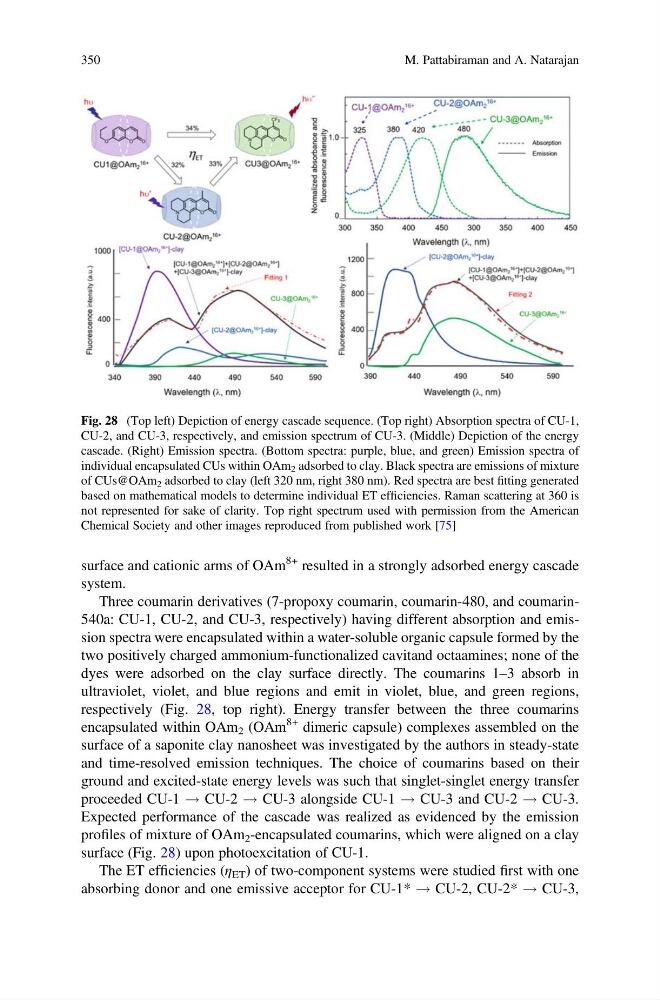
respectively (Fig. 28, top right). Energy transfer between the three coumarins
encapsulated within OAm 2 (OAm
8+ dimeric capsule) complexes assembled on the
surface of a saponite clay nanosheet was investigated by the authors in steady-state
and time-resolved emission techniques. The choice of coumarins based on their
ground and excited-state energy levels was such that singlet-singlet energy transfer
proceeded CU-1 ! CU-2 ! CU-3 alongside CU-1 ! CU-3 and CU-2 ! CU-3.
Expected performance of the cascade was realized as evidenced by the emission
profiles of mixture of OAm 2 -encapsulated coumarins, which were aligned on a clay
surface (Fig. 28) upon photoexcitation of CU-1.
The ET efficiencies (η ET ) of two-component systems were studied first with one
absorbing donor and one emissive acceptor for CU-1* ! CU-2, CU-2* ! CU-3,
Fig. 28 (Top left) Depiction of energy cascade sequence. (Top right) Absorption spectra of CU-1,
CU-2, and CU-3, respectively, and emission spectrum of CU-3. (Middle) Depiction of the energy
cascade. (Right) Emission spectra. (Bottom spectra: purple, blue, and green) Emission spectra of
individual encapsulated CUs within OAm 2 adsorbed to clay. Black spectra are emissions of mixture
of CUs@OAm 2 adsorbed to clay (left 320 nm, right 380 nm). Red spectra are best fitting generated
based on mathematical models to determine individual ET efficiencies. Raman scattering at 360 is
not represented for sake of clarity. Top right spectrum used with permission from the American
Chemical Society and other images reproduced from published work [75]
350
M. Pattabiraman and A. Natarajan
8+ resulted in a strongly adsorbed energy cascade
system.
Three coumarin derivatives (7-propoxy coumarin, coumarin-480, and coumarin540a: CU-1, CU-2, and CU-3, respectively) having different absorption and emission spectra were encapsulated within a water-soluble organic capsule formed by the
two positively charged ammonium-functionalized cavitand octaamines; none of the
dyes were adsorbed on the clay surface directly. The coumarins 1–3 absorb in
ultraviolet, violet, and blue regions and emit in violet, blue, and green regions,
respectively (Fig. 28, top right). Energy transfer between the three coumarins
encapsulated within OAm 2 (OAm
8+ dimeric capsule) complexes assembled on the
surface of a saponite clay nanosheet was investigated by the authors in steady-state
and time-resolved emission techniques. The choice of coumarins based on their
ground and excited-state energy levels was such that singlet-singlet energy transfer
proceeded CU-1 ! CU-2 ! CU-3 alongside CU-1 ! CU-3 and CU-2 ! CU-3.
Expected performance of the cascade was realized as evidenced by the emission
profiles of mixture of OAm 2 -encapsulated coumarins, which were aligned on a clay
surface (Fig. 28) upon photoexcitation of CU-1.
The ET efficiencies (η ET ) of two-component systems were studied first with one
absorbing donor and one emissive acceptor for CU-1* ! CU-2, CU-2* ! CU-3,
Fig. 28 (Top left) Depiction of energy cascade sequence. (Top right) Absorption spectra of CU-1,
CU-2, and CU-3, respectively, and emission spectrum of CU-3. (Middle) Depiction of the energy
cascade. (Right) Emission spectra. (Bottom spectra: purple, blue, and green) Emission spectra of
individual encapsulated CUs within OAm 2 adsorbed to clay. Black spectra are emissions of mixture
of CUs@OAm 2 adsorbed to clay (left 320 nm, right 380 nm). Red spectra are best fitting generated
based on mathematical models to determine individual ET efficiencies. Raman scattering at 360 is
not represented for sake of clarity. Top right spectrum used with permission from the American
Chemical Society and other images reproduced from published work [75]
350
M. Pattabiraman and A. Natarajan