

and NMR titration, the authors demonstrated the control over the supramolecular
excimer assembly between a benzothiazole dye (thioflavin TF) and a macrocyclic
host (CB8). The strong ion-dipole interactions provided by the carbonyl portals of
the CB8 adequately support the stabilization of two π-stacked TF, both in 1:2
(CB8-TF) and 2:2 stoichiometric ratio. The noncovalently stabilized assembly
brings out an intense novel excimer emission band at 570 nm, tunable in the presence
of Ca
2+ . Such tunable host-guest molecular assemblies find immense implications in
activating non-diffusional- and stoichiometry-controlled photoinduced processes
and excimer-based fluorescence on/off switches and provide design criteria for
tailor-made molecular assemblies based on supramolecular interactions [73, 74].
7 Energy Transfer Cascade
Energy transfer can occur between a photoexcited chromophore (donor) and a
fluorophore (acceptor) when the their LUMO energies are close to each other,
especially when acceptor LUMO is lower than that of donor’s. Energy transfer in
a two-component system is well-known, but there are only a few reports of multistep
energy transfer in three-component systems. Controlled energy transfer between a
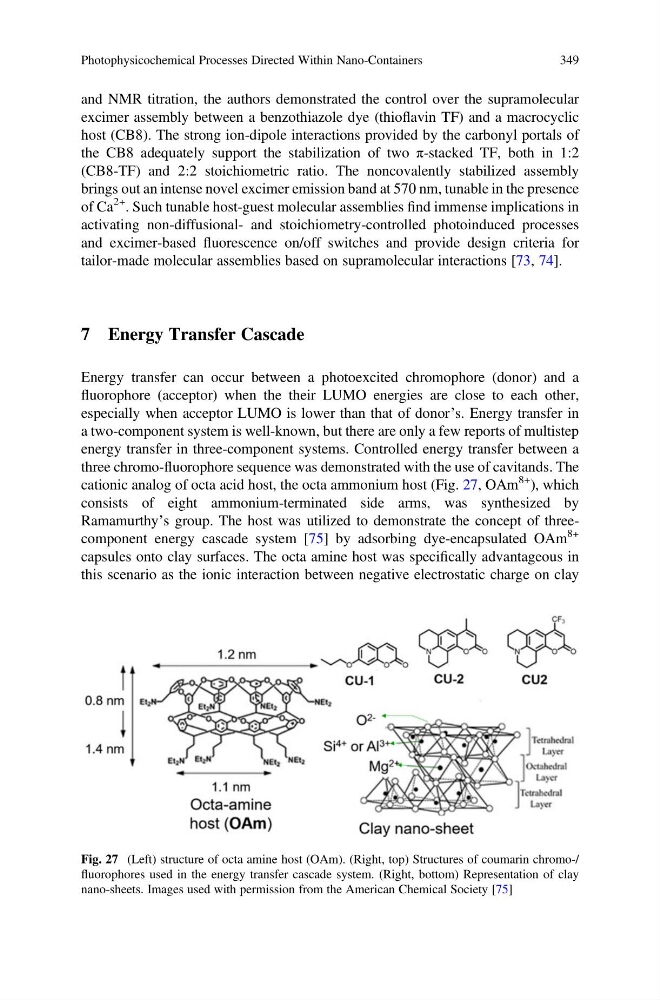
three chromo-fluorophore sequence was demonstrated with the use of cavitands. The
cationic analog of octa acid host, the octa ammonium host (Fig. 27, OAm
8+ ), which
consists of eight ammonium-terminated side arms, was synthesized by
Ramamurthy’s group. The host was utilized to demonstrate the concept of threecomponent energy cascade system [75] by adsorbing dye-encapsulated OAm
8+
capsules onto clay surfaces. The octa amine host was specifically advantageous in
this scenario as the ionic interaction between negative electrostatic charge on clay
Fig. 27 (Left) structure of octa amine host (OAm). (Right, top) Structures of coumarin chromo-/
fluorophores used in the energy transfer cascade system. (Right, bottom) Representation of clay
nano-sheets. Images used with permission from the American Chemical Society [75]
Photophysicochemical Processes Directed Within Nano-Containers
349
excimer assembly between a benzothiazole dye (thioflavin TF) and a macrocyclic
host (CB8). The strong ion-dipole interactions provided by the carbonyl portals of
the CB8 adequately support the stabilization of two π-stacked TF, both in 1:2
(CB8-TF) and 2:2 stoichiometric ratio. The noncovalently stabilized assembly
brings out an intense novel excimer emission band at 570 nm, tunable in the presence
of Ca
2+ . Such tunable host-guest molecular assemblies find immense implications in
activating non-diffusional- and stoichiometry-controlled photoinduced processes
and excimer-based fluorescence on/off switches and provide design criteria for
tailor-made molecular assemblies based on supramolecular interactions [73, 74].
7 Energy Transfer Cascade
Energy transfer can occur between a photoexcited chromophore (donor) and a
fluorophore (acceptor) when the their LUMO energies are close to each other,
especially when acceptor LUMO is lower than that of donor’s. Energy transfer in
a two-component system is well-known, but there are only a few reports of multistep
energy transfer in three-component systems. Controlled energy transfer between a
three chromo-fluorophore sequence was demonstrated with the use of cavitands. The
cationic analog of octa acid host, the octa ammonium host (Fig. 27, OAm
8+ ), which
consists of eight ammonium-terminated side arms, was synthesized by
Ramamurthy’s group. The host was utilized to demonstrate the concept of threecomponent energy cascade system [75] by adsorbing dye-encapsulated OAm
8+
capsules onto clay surfaces. The octa amine host was specifically advantageous in
this scenario as the ionic interaction between negative electrostatic charge on clay
Fig. 27 (Left) structure of octa amine host (OAm). (Right, top) Structures of coumarin chromo-/
fluorophores used in the energy transfer cascade system. (Right, bottom) Representation of clay
nano-sheets. Images used with permission from the American Chemical Society [75]
Photophysicochemical Processes Directed Within Nano-Containers
349