

approach to studying emissive properties of TF is of particular importance considering its role in biomedical imaging. TF is a cationic benzothiazole dye that has been
extensively applied in the early detection of amyloid fibril formation in tissues to
diagnose chronic disorders such as Alzheimer’s and Parkinson’s diseases. Binding
of TF with protein fibrils is shown to be quite specific, and detection is mainly based
on the characteristic fluorescence of TF (Φ f ¼ 0.0003) at 490 nm, which increases
dramatically (~1,000-fold) upon binding to cavities in the amyloid fibrils. In recent
years, the use of TF as an extrinsic fluorescent dye has increased significantly, due to
its versatility, sensitivity, and suitability for high-throughput screening in detecting
amyloid fibrils in tissues. Though the application of TF for the analysis of different
aggregating systems is rapidly rising [70], the exact mechanism for TF binding into
the cavities of the amyloid fibrils causing dramatic changes in its fluorescence
properties remains to be fully understood [71].
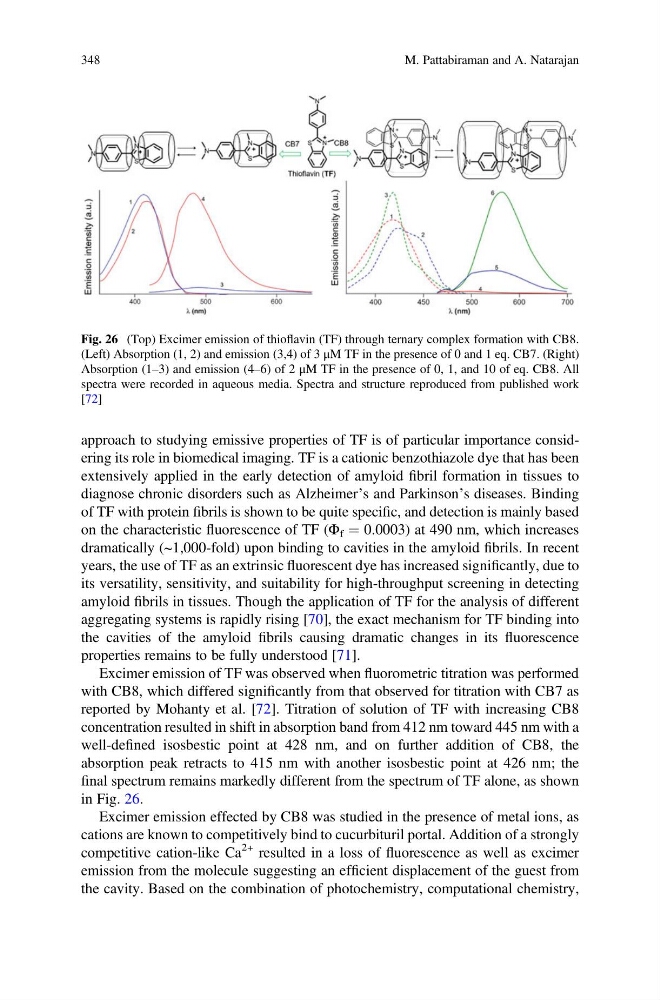
Excimer emission of TF was observed when fluorometric titration was performed
with CB8, which differed significantly from that observed for titration with CB7 as
reported by Mohanty et al. [72]. Titration of solution of TF with increasing CB8
concentration resulted in shift in absorption band from 412 nm toward 445 nm with a
well-defined isosbestic point at 428 nm, and on further addition of CB8, the
absorption peak retracts to 415 nm with another isosbestic point at 426 nm; the
final spectrum remains markedly different from the spectrum of TF alone, as shown
in Fig. 26.
Excimer emission effected by CB8 was studied in the presence of metal ions, as
cations are known to competitively bind to cucurbituril portal. Addition of a strongly
competitive cation-like Ca
2+ resulted in a loss of fluorescence as well as excimer
emission from the molecule suggesting an efficient displacement of the guest from
the cavity. Based on the combination of photochemistry, computational chemistry,
Fig. 26 (Top) Excimer emission of thioflavin (TF) through ternary complex formation with CB8.
(Left) Absorption (1, 2) and emission (3,4) of 3 μM TF in the presence of 0 and 1 eq. CB7. (Right)
Absorption (1–3) and emission (4–6) of 2 μM TF in the presence of 0, 1, and 10 of eq. CB8. All
spectra were recorded in aqueous media. Spectra and structure reproduced from published work
[72]
348
M. Pattabiraman and A. Natarajan
extensively applied in the early detection of amyloid fibril formation in tissues to
diagnose chronic disorders such as Alzheimer’s and Parkinson’s diseases. Binding
of TF with protein fibrils is shown to be quite specific, and detection is mainly based
on the characteristic fluorescence of TF (Φ f ¼ 0.0003) at 490 nm, which increases
dramatically (~1,000-fold) upon binding to cavities in the amyloid fibrils. In recent
years, the use of TF as an extrinsic fluorescent dye has increased significantly, due to
its versatility, sensitivity, and suitability for high-throughput screening in detecting
amyloid fibrils in tissues. Though the application of TF for the analysis of different
aggregating systems is rapidly rising [70], the exact mechanism for TF binding into
the cavities of the amyloid fibrils causing dramatic changes in its fluorescence
properties remains to be fully understood [71].
Excimer emission of TF was observed when fluorometric titration was performed
with CB8, which differed significantly from that observed for titration with CB7 as
reported by Mohanty et al. [72]. Titration of solution of TF with increasing CB8
concentration resulted in shift in absorption band from 412 nm toward 445 nm with a
well-defined isosbestic point at 428 nm, and on further addition of CB8, the
absorption peak retracts to 415 nm with another isosbestic point at 426 nm; the
final spectrum remains markedly different from the spectrum of TF alone, as shown
in Fig. 26.
Excimer emission effected by CB8 was studied in the presence of metal ions, as
cations are known to competitively bind to cucurbituril portal. Addition of a strongly
competitive cation-like Ca
2+ resulted in a loss of fluorescence as well as excimer
emission from the molecule suggesting an efficient displacement of the guest from
the cavity. Based on the combination of photochemistry, computational chemistry,
Fig. 26 (Top) Excimer emission of thioflavin (TF) through ternary complex formation with CB8.
(Left) Absorption (1, 2) and emission (3,4) of 3 μM TF in the presence of 0 and 1 eq. CB7. (Right)
Absorption (1–3) and emission (4–6) of 2 μM TF in the presence of 0, 1, and 10 of eq. CB8. All
spectra were recorded in aqueous media. Spectra and structure reproduced from published work
[72]
348
M. Pattabiraman and A. Natarajan