

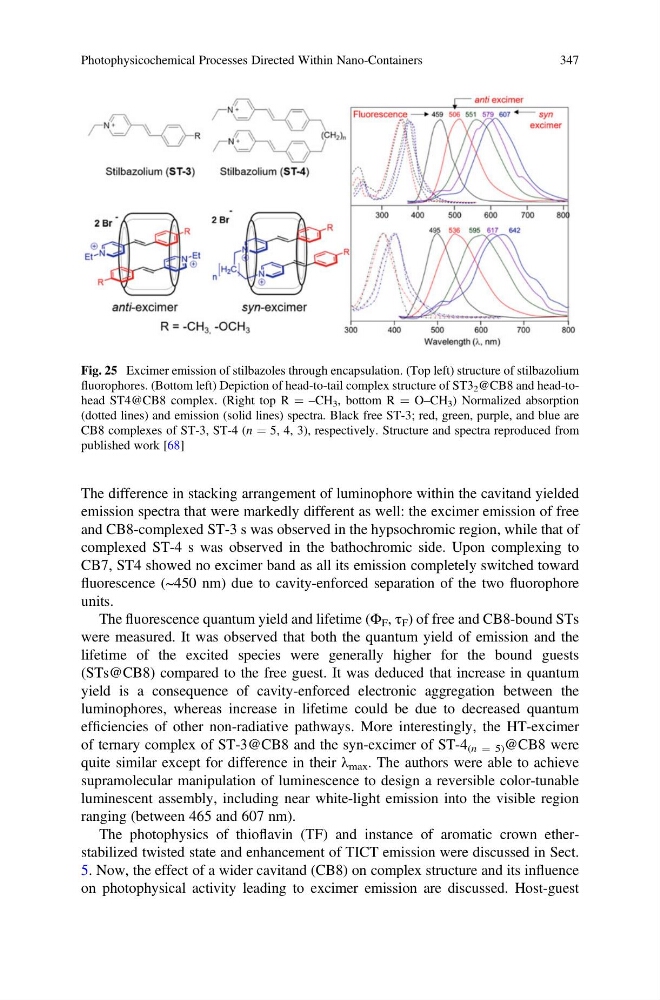
The difference in stacking arrangement of luminophore within the cavitand yielded
emission spectra that were markedly different as well: the excimer emission of free
and CB8-complexed ST-3 s was observed in the hypsochromic region, while that of
complexed ST-4 s was observed in the bathochromic side. Upon complexing to
CB7, ST4 showed no excimer band as all its emission completely switched toward
fluorescence (~450 nm) due to cavity-enforced separation of the two fluorophore
units.
The fluorescence quantum yield and lifetime (Φ F , τ F ) of free and CB8-bound STs
were measured. It was observed that both the quantum yield of emission and the
lifetime of the excited species were generally higher for the bound guests
(STs@CB8) compared to the free guest. It was deduced that increase in quantum
yield is a consequence of cavity-enforced electronic aggregation between the
luminophores, whereas increase in lifetime could be due to decreased quantum
efficiencies of other non-radiative pathways. More interestingly, the HT-excimer
of ternary complex of ST-3@CB8 and the syn-excimer of ST-4 (n ¼ 5) @CB8 were
quite similar except for difference in their λ max . The authors were able to achieve
supramolecular manipulation of luminescence to design a reversible color-tunable
luminescent assembly, including near white-light emission into the visible region
ranging (between 465 and 607 nm).
The photophysics of thioflavin (TF) and instance of aromatic crown etherstabilized twisted state and enhancement of TICT emission were discussed in Sect.
5. Now, the effect of a wider cavitand (CB8) on complex structure and its influence
on photophysical activity leading to excimer emission are discussed. Host-guest
Fig. 25 Excimer emission of stilbazoles through encapsulation. (Top left) structure of stilbazolium
fluorophores. (Bottom left) Depiction of head-to-tail complex structure of ST3 2 @CB8 and head-tohead ST4@CB8 complex. (Right top R ¼ –CH 3 , bottom R ¼ O–CH 3 ) Normalized absorption
(dotted lines) and emission (solid lines) spectra. Black free ST-3; red, green, purple, and blue are
CB8 complexes of ST-3, ST-4 (n ¼ 5, 4, 3), respectively. Structure and spectra reproduced from
published work [68]
Photophysicochemical Processes Directed Within Nano-Containers
347
emission spectra that were markedly different as well: the excimer emission of free
and CB8-complexed ST-3 s was observed in the hypsochromic region, while that of
complexed ST-4 s was observed in the bathochromic side. Upon complexing to
CB7, ST4 showed no excimer band as all its emission completely switched toward
fluorescence (~450 nm) due to cavity-enforced separation of the two fluorophore
units.
The fluorescence quantum yield and lifetime (Φ F , τ F ) of free and CB8-bound STs
were measured. It was observed that both the quantum yield of emission and the
lifetime of the excited species were generally higher for the bound guests
(STs@CB8) compared to the free guest. It was deduced that increase in quantum
yield is a consequence of cavity-enforced electronic aggregation between the
luminophores, whereas increase in lifetime could be due to decreased quantum
efficiencies of other non-radiative pathways. More interestingly, the HT-excimer
of ternary complex of ST-3@CB8 and the syn-excimer of ST-4 (n ¼ 5) @CB8 were
quite similar except for difference in their λ max . The authors were able to achieve
supramolecular manipulation of luminescence to design a reversible color-tunable
luminescent assembly, including near white-light emission into the visible region
ranging (between 465 and 607 nm).
The photophysics of thioflavin (TF) and instance of aromatic crown etherstabilized twisted state and enhancement of TICT emission were discussed in Sect.
5. Now, the effect of a wider cavitand (CB8) on complex structure and its influence
on photophysical activity leading to excimer emission are discussed. Host-guest
Fig. 25 Excimer emission of stilbazoles through encapsulation. (Top left) structure of stilbazolium
fluorophores. (Bottom left) Depiction of head-to-tail complex structure of ST3 2 @CB8 and head-tohead ST4@CB8 complex. (Right top R ¼ –CH 3 , bottom R ¼ O–CH 3 ) Normalized absorption
(dotted lines) and emission (solid lines) spectra. Black free ST-3; red, green, purple, and blue are
CB8 complexes of ST-3, ST-4 (n ¼ 5, 4, 3), respectively. Structure and spectra reproduced from
published work [68]
Photophysicochemical Processes Directed Within Nano-Containers
347