

absence of dimerization could be attributed to the slipped arrangement and to the
tight space that prevented the anthracene molecules from realigning to form bonds
across 9,9
0 and 10,10
0 positions.
This work by Kaanumalle et al. stands out from other cavitand-mediated emissions for two reasons: excimer emission within cavitands predominantly involves
pyrene as the chromophore and that the excited-state dynamics of anthracene was
directed away from a highly facile photodimerization pathway. This provided a
wealth of structural information pertinent to the slipped-sandwich arrangement of
the guests stacked within the OA capsule cavity.
Another example of a fluorophore that is usually not known to exhibit excimer
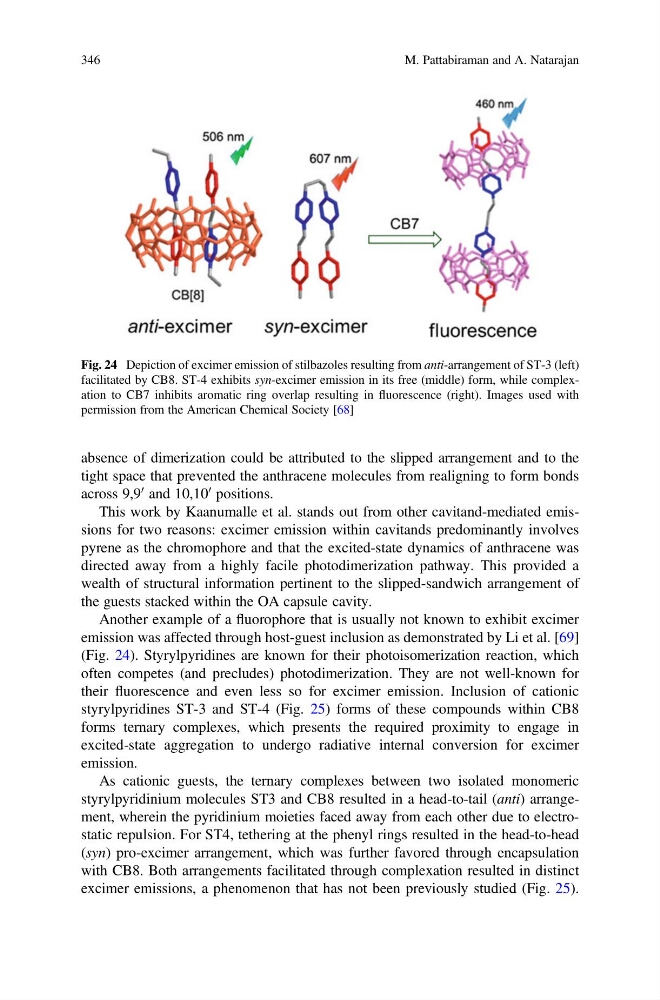
emission was affected through host-guest inclusion as demonstrated by Li et al. [69]
(Fig. 24). Styrylpyridines are known for their photoisomerization reaction, which
often competes (and precludes) photodimerization. They are not well-known for
their fluorescence and even less so for excimer emission. Inclusion of cationic
styrylpyridines ST-3 and ST-4 (Fig. 25) forms of these compounds within CB8
forms ternary complexes, which presents the required proximity to engage in
excited-state aggregation to undergo radiative internal conversion for excimer
emission.
As cationic guests, the ternary complexes between two isolated monomeric
styrylpyridinium molecules ST3 and CB8 resulted in a head-to-tail (anti) arrangement, wherein the pyridinium moieties faced away from each other due to electrostatic repulsion. For ST4, tethering at the phenyl rings resulted in the head-to-head
(syn) pro-excimer arrangement, which was further favored through encapsulation
with CB8. Both arrangements facilitated through complexation resulted in distinct
excimer emissions, a phenomenon that has not been previously studied (Fig. 25).
Fig. 24 Depiction of excimer emission of stilbazoles resulting from anti-arrangement of ST-3 (left)
facilitated by CB8. ST-4 exhibits syn-excimer emission in its free (middle) form, while complexation to CB7 inhibits aromatic ring overlap resulting in fluorescence (right). Images used with
permission from the American Chemical Society [68]
346
M. Pattabiraman and A. Natarajan
tight space that prevented the anthracene molecules from realigning to form bonds
across 9,9
0 and 10,10
0 positions.
This work by Kaanumalle et al. stands out from other cavitand-mediated emissions for two reasons: excimer emission within cavitands predominantly involves
pyrene as the chromophore and that the excited-state dynamics of anthracene was
directed away from a highly facile photodimerization pathway. This provided a
wealth of structural information pertinent to the slipped-sandwich arrangement of
the guests stacked within the OA capsule cavity.
Another example of a fluorophore that is usually not known to exhibit excimer
emission was affected through host-guest inclusion as demonstrated by Li et al. [69]
(Fig. 24). Styrylpyridines are known for their photoisomerization reaction, which
often competes (and precludes) photodimerization. They are not well-known for
their fluorescence and even less so for excimer emission. Inclusion of cationic
styrylpyridines ST-3 and ST-4 (Fig. 25) forms of these compounds within CB8
forms ternary complexes, which presents the required proximity to engage in
excited-state aggregation to undergo radiative internal conversion for excimer
emission.
As cationic guests, the ternary complexes between two isolated monomeric
styrylpyridinium molecules ST3 and CB8 resulted in a head-to-tail (anti) arrangement, wherein the pyridinium moieties faced away from each other due to electrostatic repulsion. For ST4, tethering at the phenyl rings resulted in the head-to-head
(syn) pro-excimer arrangement, which was further favored through encapsulation
with CB8. Both arrangements facilitated through complexation resulted in distinct
excimer emissions, a phenomenon that has not been previously studied (Fig. 25).
Fig. 24 Depiction of excimer emission of stilbazoles resulting from anti-arrangement of ST-3 (left)
facilitated by CB8. ST-4 exhibits syn-excimer emission in its free (middle) form, while complexation to CB7 inhibits aromatic ring overlap resulting in fluorescence (right). Images used with
permission from the American Chemical Society [68]
346
M. Pattabiraman and A. Natarajan