

fluorescence yield, but it can often be observed at low temperatures or in the pure
liquid or crystalline states. In other compounds, such as anthracene, tetracene, and
pentacene, the dimer interaction is so strong that a stable chemical dimer
(photodimer) is formed either from or in competition with the excimer.
Octa acid (OA, Figs. 2 and 3) is a synthetic cavitand with a deep binding pocket,
which is rendered soluble in basic aqueous media (pH > 8.5, solubility up to
10
À2 M) through its four carboxylic acid-terminated side arms. At concentrations
above 10
À3 M, it aggregates into a dimeric capsule. Both the monomeric cavitand
and dimeric capsule bind to guests to form 1:1, 2:1, or 2:2 host/guest complexes,
referred to caviplex or capsuleplex, respectively.
One of the most remarkable deviations from normal excited-state behavior of
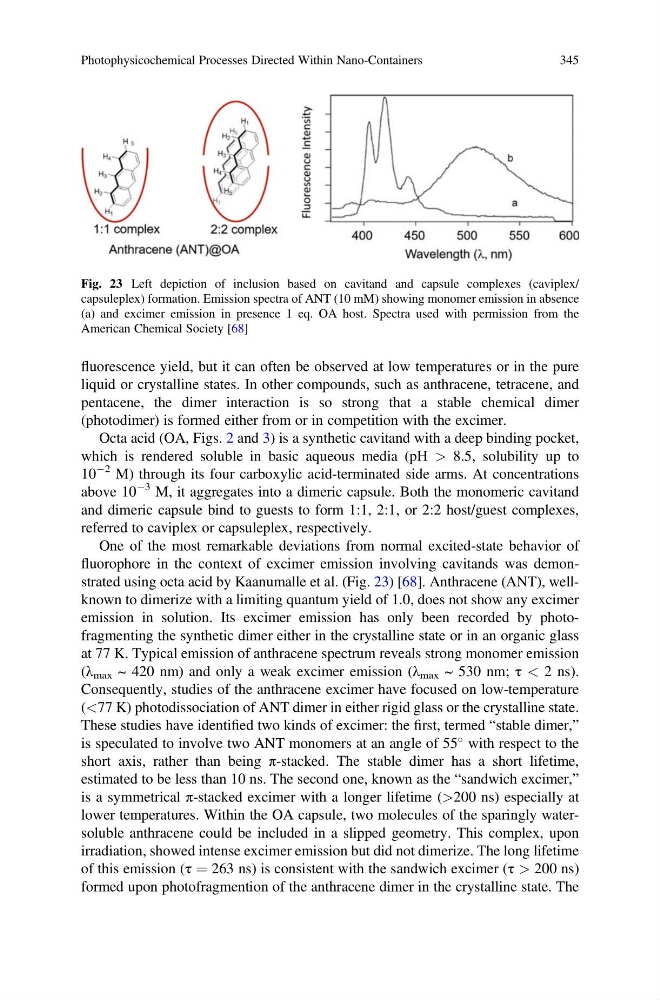
fluorophore in the context of excimer emission involving cavitands was demonstrated using octa acid by Kaanumalle et al. (Fig. 23) [68]. Anthracene (ANT), wellknown to dimerize with a limiting quantum yield of 1.0, does not show any excimer
emission in solution. Its excimer emission has only been recorded by photofragmenting the synthetic dimer either in the crystalline state or in an organic glass
at 77 K. Typical emission of anthracene spectrum reveals strong monomer emission
(λ max ~ 420 nm) and only a weak excimer emission (λ max ~ 530 nm; τ < 2 ns).
Consequently, studies of the anthracene excimer have focused on low-temperature
(<77 K) photodissociation of ANT dimer in either rigid glass or the crystalline state.
These studies have identified two kinds of excimer: the first, termed “stable dimer,”
is speculated to involve two ANT monomers at an angle of 55
with respect to the
short axis, rather than being π-stacked. The stable dimer has a short lifetime,
estimated to be less than 10 ns. The second one, known as the “sandwich excimer,”
is a symmetrical π-stacked excimer with a longer lifetime (>200 ns) especially at
lower temperatures. Within the OA capsule, two molecules of the sparingly watersoluble anthracene could be included in a slipped geometry. This complex, upon
irradiation, showed intense excimer emission but did not dimerize. The long lifetime
of this emission (τ ¼ 263 ns) is consistent with the sandwich excimer (τ > 200 ns)
formed upon photofragmention of the anthracene dimer in the crystalline state. The
Fig. 23 Left depiction of inclusion based on cavitand and capsule complexes (caviplex/
capsuleplex) formation. Emission spectra of ANT (10 mM) showing monomer emission in absence
(a) and excimer emission in presence 1 eq. OA host. Spectra used with permission from the
American Chemical Society [68]
Photophysicochemical Processes Directed Within Nano-Containers
345
liquid or crystalline states. In other compounds, such as anthracene, tetracene, and
pentacene, the dimer interaction is so strong that a stable chemical dimer
(photodimer) is formed either from or in competition with the excimer.
Octa acid (OA, Figs. 2 and 3) is a synthetic cavitand with a deep binding pocket,
which is rendered soluble in basic aqueous media (pH > 8.5, solubility up to
10
À2 M) through its four carboxylic acid-terminated side arms. At concentrations
above 10
À3 M, it aggregates into a dimeric capsule. Both the monomeric cavitand
and dimeric capsule bind to guests to form 1:1, 2:1, or 2:2 host/guest complexes,
referred to caviplex or capsuleplex, respectively.
One of the most remarkable deviations from normal excited-state behavior of
fluorophore in the context of excimer emission involving cavitands was demonstrated using octa acid by Kaanumalle et al. (Fig. 23) [68]. Anthracene (ANT), wellknown to dimerize with a limiting quantum yield of 1.0, does not show any excimer
emission in solution. Its excimer emission has only been recorded by photofragmenting the synthetic dimer either in the crystalline state or in an organic glass
at 77 K. Typical emission of anthracene spectrum reveals strong monomer emission
(λ max ~ 420 nm) and only a weak excimer emission (λ max ~ 530 nm; τ < 2 ns).
Consequently, studies of the anthracene excimer have focused on low-temperature
(<77 K) photodissociation of ANT dimer in either rigid glass or the crystalline state.
These studies have identified two kinds of excimer: the first, termed “stable dimer,”
is speculated to involve two ANT monomers at an angle of 55
with respect to the
short axis, rather than being π-stacked. The stable dimer has a short lifetime,
estimated to be less than 10 ns. The second one, known as the “sandwich excimer,”
is a symmetrical π-stacked excimer with a longer lifetime (>200 ns) especially at
lower temperatures. Within the OA capsule, two molecules of the sparingly watersoluble anthracene could be included in a slipped geometry. This complex, upon
irradiation, showed intense excimer emission but did not dimerize. The long lifetime
of this emission (τ ¼ 263 ns) is consistent with the sandwich excimer (τ > 200 ns)
formed upon photofragmention of the anthracene dimer in the crystalline state. The
Fig. 23 Left depiction of inclusion based on cavitand and capsule complexes (caviplex/
capsuleplex) formation. Emission spectra of ANT (10 mM) showing monomer emission in absence
(a) and excimer emission in presence 1 eq. OA host. Spectra used with permission from the
American Chemical Society [68]
Photophysicochemical Processes Directed Within Nano-Containers
345