

excited-state aggregation is referred to as an excimer, while heterochemical equivalents are referred to as exciplexes. The excited-state aggregated dimer (excimer) E*
is particularly different from a ground-state charge-transfer complex (CT), due to
electronic complementarity, which will exhibit a new bathochromic absorption;
absorption spectrum of excimer chromophores is unchanged.
Excimers and exciplexes are fluorescent, with broad structureless emissions that
appear at lower-energy region (higher wavelength) compared to that of the excited
monomer. Excimer formation is a physical reaction analogous to a bimolecular
chemical reaction. The reaction can be initiated by a short (10
À9 s) light flash, and
the subsequent variations in the concentrations of the reacting species can be
monitored by observation of the intensities of fluorescence of the excited monomer
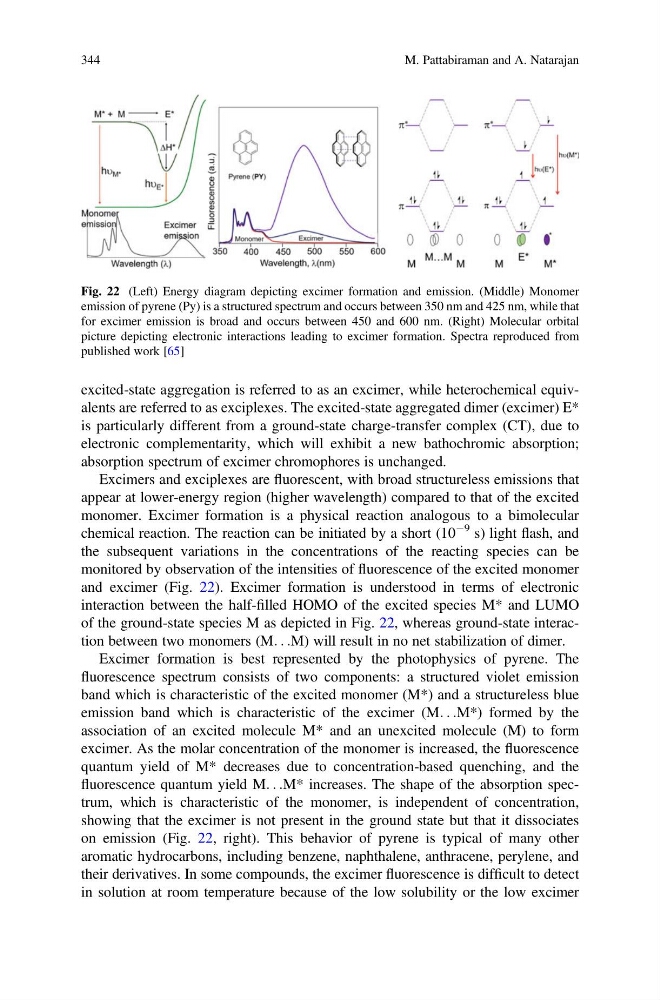
and excimer (Fig. 22). Excimer formation is understood in terms of electronic
interaction between the half-filled HOMO of the excited species M* and LUMO
of the ground-state species M as depicted in Fig. 22, whereas ground-state interaction between two monomers (M. . .M) will result in no net stabilization of dimer.
Excimer formation is best represented by the photophysics of pyrene. The
fluorescence spectrum consists of two components: a structured violet emission
band which is characteristic of the excited monomer (M*) and a structureless blue
emission band which is characteristic of the excimer (M. . .M*) formed by the
association of an excited molecule M* and an unexcited molecule (M) to form
excimer. As the molar concentration of the monomer is increased, the fluorescence
quantum yield of M* decreases due to concentration-based quenching, and the
fluorescence quantum yield M. . .M* increases. The shape of the absorption spectrum, which is characteristic of the monomer, is independent of concentration,
showing that the excimer is not present in the ground state but that it dissociates
on emission (Fig. 22, right). This behavior of pyrene is typical of many other
aromatic hydrocarbons, including benzene, naphthalene, anthracene, perylene, and
their derivatives. In some compounds, the excimer fluorescence is difficult to detect
in solution at room temperature because of the low solubility or the low excimer
Fig. 22 (Left) Energy diagram depicting excimer formation and emission. (Middle) Monomer
emission of pyrene (Py) is a structured spectrum and occurs between 350 nm and 425 nm, while that
for excimer emission is broad and occurs between 450 and 600 nm. (Right) Molecular orbital
picture depicting electronic interactions leading to excimer formation. Spectra reproduced from
published work [65]
344
M. Pattabiraman and A. Natarajan
is particularly different from a ground-state charge-transfer complex (CT), due to
electronic complementarity, which will exhibit a new bathochromic absorption;
absorption spectrum of excimer chromophores is unchanged.
Excimers and exciplexes are fluorescent, with broad structureless emissions that
appear at lower-energy region (higher wavelength) compared to that of the excited
monomer. Excimer formation is a physical reaction analogous to a bimolecular
chemical reaction. The reaction can be initiated by a short (10
À9 s) light flash, and
the subsequent variations in the concentrations of the reacting species can be
monitored by observation of the intensities of fluorescence of the excited monomer
and excimer (Fig. 22). Excimer formation is understood in terms of electronic
interaction between the half-filled HOMO of the excited species M* and LUMO
of the ground-state species M as depicted in Fig. 22, whereas ground-state interaction between two monomers (M. . .M) will result in no net stabilization of dimer.
Excimer formation is best represented by the photophysics of pyrene. The
fluorescence spectrum consists of two components: a structured violet emission
band which is characteristic of the excited monomer (M*) and a structureless blue
emission band which is characteristic of the excimer (M. . .M*) formed by the
association of an excited molecule M* and an unexcited molecule (M) to form
excimer. As the molar concentration of the monomer is increased, the fluorescence
quantum yield of M* decreases due to concentration-based quenching, and the
fluorescence quantum yield M. . .M* increases. The shape of the absorption spectrum, which is characteristic of the monomer, is independent of concentration,
showing that the excimer is not present in the ground state but that it dissociates
on emission (Fig. 22, right). This behavior of pyrene is typical of many other
aromatic hydrocarbons, including benzene, naphthalene, anthracene, perylene, and
their derivatives. In some compounds, the excimer fluorescence is difficult to detect
in solution at room temperature because of the low solubility or the low excimer
Fig. 22 (Left) Energy diagram depicting excimer formation and emission. (Middle) Monomer
emission of pyrene (Py) is a structured spectrum and occurs between 350 nm and 425 nm, while that
for excimer emission is broad and occurs between 450 and 600 nm. (Right) Molecular orbital
picture depicting electronic interactions leading to excimer formation. Spectra reproduced from
published work [65]
344
M. Pattabiraman and A. Natarajan