

that could influence excited-state conformational change, such as viscosity and
molecular (electronic, steric) rotational barriers, which makes TICT-based
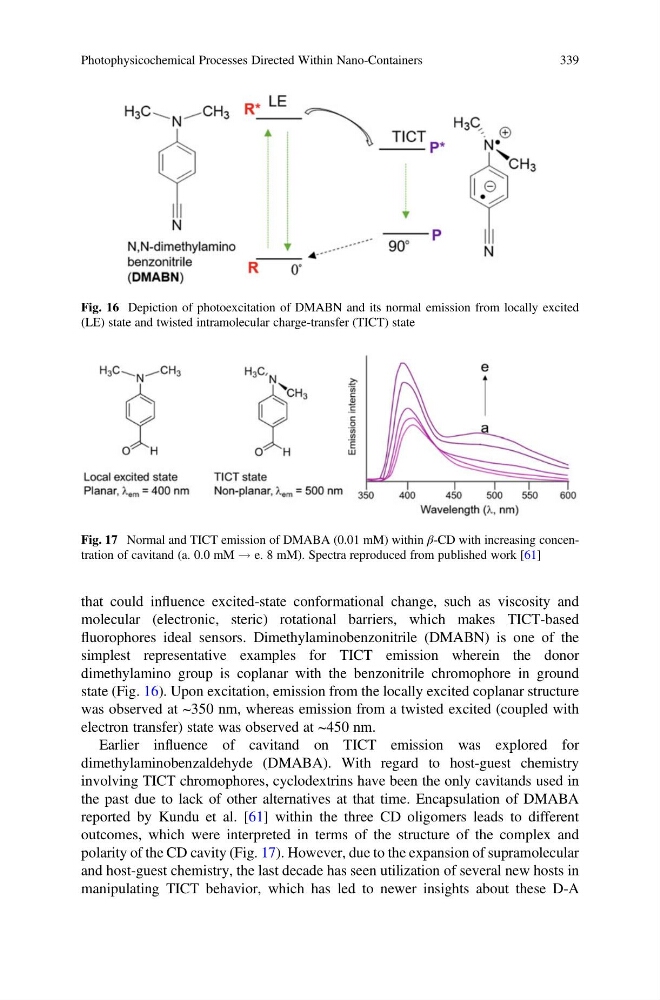
fluorophores ideal sensors. Dimethylaminobenzonitrile (DMABN) is one of the
simplest representative examples for TICT emission wherein the donor
dimethylamino group is coplanar with the benzonitrile chromophore in ground
state (Fig. 16). Upon excitation, emission from the locally excited coplanar structure
was observed at ~350 nm, whereas emission from a twisted excited (coupled with
electron transfer) state was observed at ~450 nm.
Earlier influence of cavitand on TICT emission was explored for
dimethylaminobenzaldehyde (DMABA). With regard to host-guest chemistry
involving TICT chromophores, cyclodextrins have been the only cavitands used in
the past due to lack of other alternatives at that time. Encapsulation of DMABA
reported by Kundu et al. [61] within the three CD oligomers leads to different
outcomes, which were interpreted in terms of the structure of the complex and
polarity of the CD cavity (Fig. 17). However, due to the expansion of supramolecular
and host-guest chemistry, the last decade has seen utilization of several new hosts in
manipulating TICT behavior, which has led to newer insights about these D-A
Fig. 16 Depiction of photoexcitation of DMABN and its normal emission from locally excited
(LE) state and twisted intramolecular charge-transfer (TICT) state
Fig. 17 Normal and TICT emission of DMABA (0.01 mM) within β-CD with increasing concentration of cavitand (a. 0.0 mM ! e. 8 mM). Spectra reproduced from published work [61]
Photophysicochemical Processes Directed Within Nano-Containers
339
molecular (electronic, steric) rotational barriers, which makes TICT-based
fluorophores ideal sensors. Dimethylaminobenzonitrile (DMABN) is one of the
simplest representative examples for TICT emission wherein the donor
dimethylamino group is coplanar with the benzonitrile chromophore in ground
state (Fig. 16). Upon excitation, emission from the locally excited coplanar structure
was observed at ~350 nm, whereas emission from a twisted excited (coupled with
electron transfer) state was observed at ~450 nm.
Earlier influence of cavitand on TICT emission was explored for
dimethylaminobenzaldehyde (DMABA). With regard to host-guest chemistry
involving TICT chromophores, cyclodextrins have been the only cavitands used in
the past due to lack of other alternatives at that time. Encapsulation of DMABA
reported by Kundu et al. [61] within the three CD oligomers leads to different
outcomes, which were interpreted in terms of the structure of the complex and
polarity of the CD cavity (Fig. 17). However, due to the expansion of supramolecular
and host-guest chemistry, the last decade has seen utilization of several new hosts in
manipulating TICT behavior, which has led to newer insights about these D-A
Fig. 16 Depiction of photoexcitation of DMABN and its normal emission from locally excited
(LE) state and twisted intramolecular charge-transfer (TICT) state
Fig. 17 Normal and TICT emission of DMABA (0.01 mM) within β-CD with increasing concentration of cavitand (a. 0.0 mM ! e. 8 mM). Spectra reproduced from published work [61]
Photophysicochemical Processes Directed Within Nano-Containers
339