

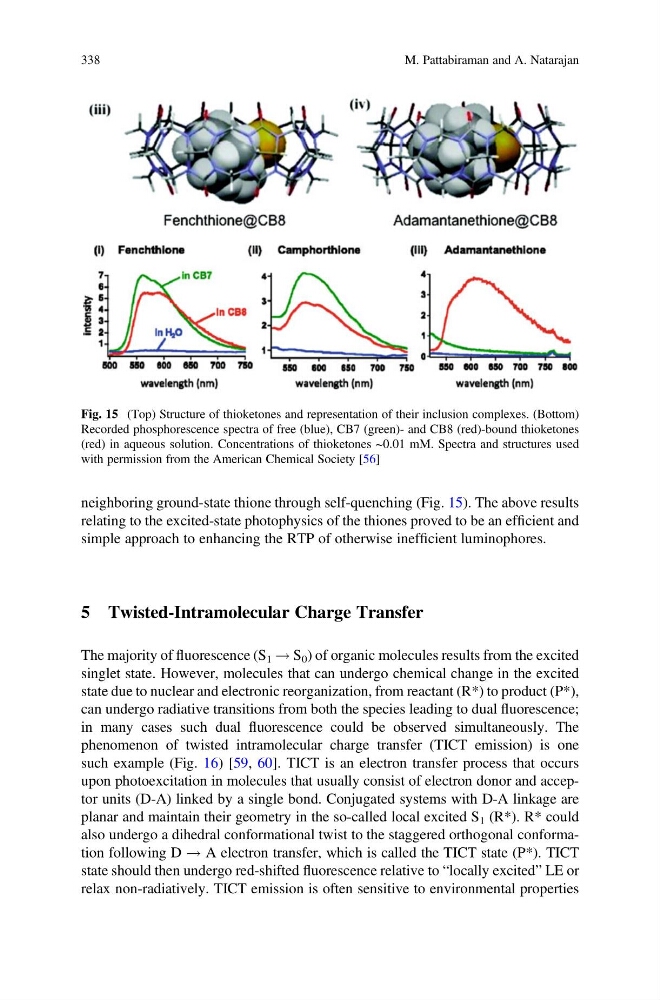
neighboring ground-state thione through self-quenching (Fig. 15). The above results
relating to the excited-state photophysics of the thiones proved to be an efficient and
simple approach to enhancing the RTP of otherwise inefficient luminophores.
5 Twisted-Intramolecular Charge Transfer
The majority of fluorescence (S 1 ! S 0 ) of organic molecules results from the excited
singlet state. However, molecules that can undergo chemical change in the excited
state due to nuclear and electronic reorganization, from reactant (R*) to product (P*),
can undergo radiative transitions from both the species leading to dual fluorescence;
in many cases such dual fluorescence could be observed simultaneously. The
phenomenon of twisted intramolecular charge transfer (TICT emission) is one
such example (Fig. 16) [59, 60]. TICT is an electron transfer process that occurs
upon photoexcitation in molecules that usually consist of electron donor and acceptor units (D-A) linked by a single bond. Conjugated systems with D-A linkage are
planar and maintain their geometry in the so-called local excited S 1 (R*). R* could
also undergo a dihedral conformational twist to the staggered orthogonal conformation following D ! A electron transfer, which is called the TICT state (P*). TICT
state should then undergo red-shifted fluorescence relative to “locally excited” LE or
relax non-radiatively. TICT emission is often sensitive to environmental properties
Fig. 15 (Top) Structure of thioketones and representation of their inclusion complexes. (Bottom)
Recorded phosphorescence spectra of free (blue), CB7 (green)- and CB8 (red)-bound thioketones
(red) in aqueous solution. Concentrations of thioketones ~0.01 mM. Spectra and structures used
with permission from the American Chemical Society [56]
338
M. Pattabiraman and A. Natarajan
relating to the excited-state photophysics of the thiones proved to be an efficient and
simple approach to enhancing the RTP of otherwise inefficient luminophores.
5 Twisted-Intramolecular Charge Transfer
The majority of fluorescence (S 1 ! S 0 ) of organic molecules results from the excited
singlet state. However, molecules that can undergo chemical change in the excited
state due to nuclear and electronic reorganization, from reactant (R*) to product (P*),
can undergo radiative transitions from both the species leading to dual fluorescence;
in many cases such dual fluorescence could be observed simultaneously. The
phenomenon of twisted intramolecular charge transfer (TICT emission) is one
such example (Fig. 16) [59, 60]. TICT is an electron transfer process that occurs
upon photoexcitation in molecules that usually consist of electron donor and acceptor units (D-A) linked by a single bond. Conjugated systems with D-A linkage are
planar and maintain their geometry in the so-called local excited S 1 (R*). R* could
also undergo a dihedral conformational twist to the staggered orthogonal conformation following D ! A electron transfer, which is called the TICT state (P*). TICT
state should then undergo red-shifted fluorescence relative to “locally excited” LE or
relax non-radiatively. TICT emission is often sensitive to environmental properties
Fig. 15 (Top) Structure of thioketones and representation of their inclusion complexes. (Bottom)
Recorded phosphorescence spectra of free (blue), CB7 (green)- and CB8 (red)-bound thioketones
(red) in aqueous solution. Concentrations of thioketones ~0.01 mM. Spectra and structures used
with permission from the American Chemical Society [56]
338
M. Pattabiraman and A. Natarajan