

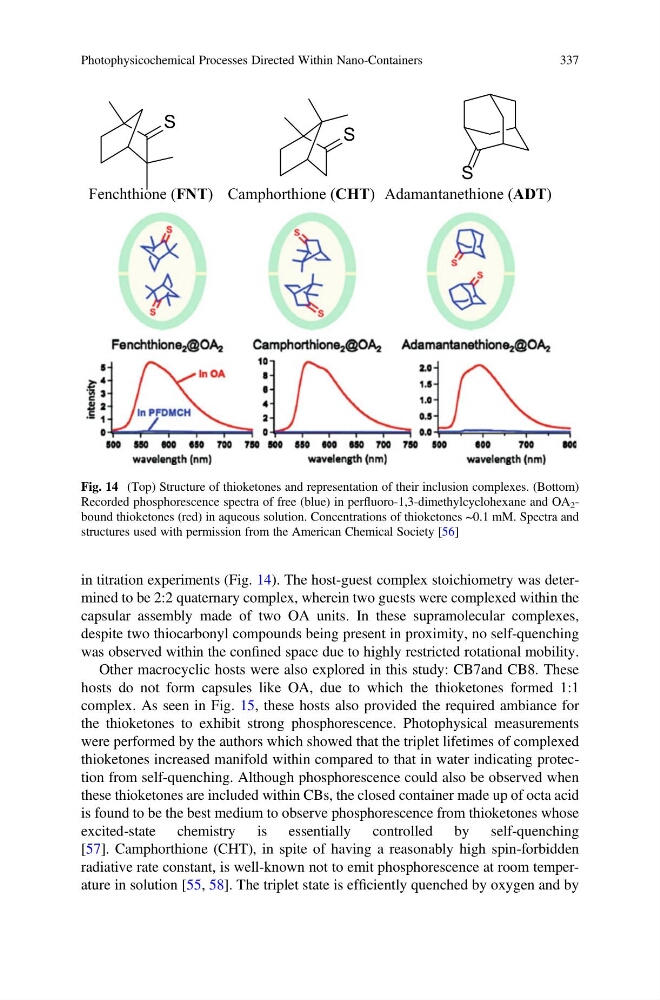
in titration experiments (Fig. 14). The host-guest complex stoichiometry was determined to be 2:2 quaternary complex, wherein two guests were complexed within the
capsular assembly made of two OA units. In these supramolecular complexes,
despite two thiocarbonyl compounds being present in proximity, no self-quenching
was observed within the confined space due to highly restricted rotational mobility.
Other macrocyclic hosts were also explored in this study: CB7and CB8. These
hosts do not form capsules like OA, due to which the thioketones formed 1:1
complex. As seen in Fig. 15, these hosts also provided the required ambiance for
the thioketones to exhibit strong phosphorescence. Photophysical measurements
were performed by the authors which showed that the triplet lifetimes of complexed
thioketones increased manifold within compared to that in water indicating protection from self-quenching. Although phosphorescence could also be observed when
these thioketones are included within CBs, the closed container made up of octa acid
is found to be the best medium to observe phosphorescence from thioketones whose
excited-state chemistry is essentially controlled by self-quenching
[57]. Camphorthione (CHT), in spite of having a reasonably high spin-forbidden
radiative rate constant, is well-known not to emit phosphorescence at room temperature in solution [55, 58]. The triplet state is efficiently quenched by oxygen and by
S
S
S
Fenchthione (FNT) Camphorthione (CHT) Adamantanethione (ADT)
Fig. 14 (Top) Structure of thioketones and representation of their inclusion complexes. (Bottom)
Recorded phosphorescence spectra of free (blue) in perfluoro-1,3-dimethylcyclohexane and OA 2 -
bound thioketones (red) in aqueous solution. Concentrations of thioketones ~0.1 mM. Spectra and
structures used with permission from the American Chemical Society [56]
Photophysicochemical Processes Directed Within Nano-Containers
337
capsular assembly made of two OA units. In these supramolecular complexes,
despite two thiocarbonyl compounds being present in proximity, no self-quenching
was observed within the confined space due to highly restricted rotational mobility.
Other macrocyclic hosts were also explored in this study: CB7and CB8. These
hosts do not form capsules like OA, due to which the thioketones formed 1:1
complex. As seen in Fig. 15, these hosts also provided the required ambiance for
the thioketones to exhibit strong phosphorescence. Photophysical measurements
were performed by the authors which showed that the triplet lifetimes of complexed
thioketones increased manifold within compared to that in water indicating protection from self-quenching. Although phosphorescence could also be observed when
these thioketones are included within CBs, the closed container made up of octa acid
is found to be the best medium to observe phosphorescence from thioketones whose
excited-state chemistry is essentially controlled by self-quenching
[57]. Camphorthione (CHT), in spite of having a reasonably high spin-forbidden
radiative rate constant, is well-known not to emit phosphorescence at room temperature in solution [55, 58]. The triplet state is efficiently quenched by oxygen and by
S
S
S
Fenchthione (FNT) Camphorthione (CHT) Adamantanethione (ADT)
Fig. 14 (Top) Structure of thioketones and representation of their inclusion complexes. (Bottom)
Recorded phosphorescence spectra of free (blue) in perfluoro-1,3-dimethylcyclohexane and OA 2 -
bound thioketones (red) in aqueous solution. Concentrations of thioketones ~0.1 mM. Spectra and
structures used with permission from the American Chemical Society [56]
Photophysicochemical Processes Directed Within Nano-Containers
337