

such conformational locking in TP
+
@CB7 resulted in radiationless relaxation of the
triplet state (T 1 ~~> S 0 ) and, hence, no emission.
The remarkably high room temperature phosphorescence quantum yield of the
TP
+
@CB8 complex resulted in a noticeable characteristic yellow color to the
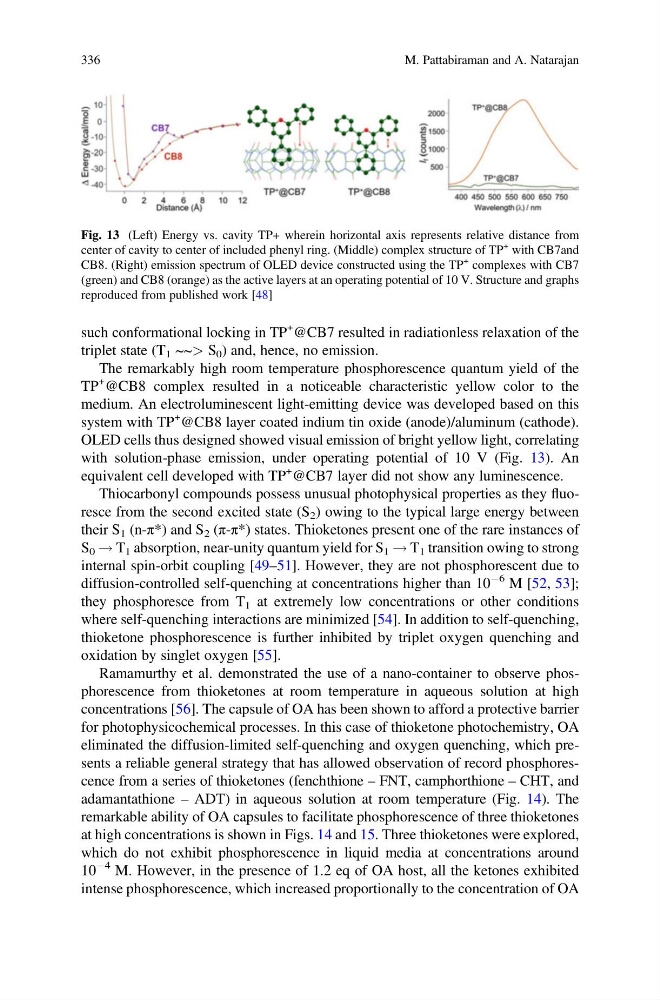
medium. An electroluminescent light-emitting device was developed based on this
system with TP
+
@CB8 layer coated indium tin oxide (anode)/aluminum (cathode).
OLED cells thus designed showed visual emission of bright yellow light, correlating
with solution-phase emission, under operating potential of 10 V (Fig. 13). An
equivalent cell developed with TP
+
@CB7 layer did not show any luminescence.
Thiocarbonyl compounds possess unusual photophysical properties as they fluoresce from the second excited state (S 2 ) owing to the typical large energy between
their S 1 (n-π*) and S 2 (π-π*) states. Thioketones present one of the rare instances of
S 0 ! T 1 absorption, near-unity quantum yield for S 1 ! T 1 transition owing to strong
internal spin-orbit coupling [49–51]. However, they are not phosphorescent due to
diffusion-controlled self-quenching at concentrations higher than 10
À6 M [52, 53];
they phosphoresce from T 1 at extremely low concentrations or other conditions
where self-quenching interactions are minimized [54]. In addition to self-quenching,
thioketone phosphorescence is further inhibited by triplet oxygen quenching and
oxidation by singlet oxygen [55].
Ramamurthy et al. demonstrated the use of a nano-container to observe phosphorescence from thioketones at room temperature in aqueous solution at high
concentrations [56]. The capsule of OA has been shown to afford a protective barrier
for photophysicochemical processes. In this case of thioketone photochemistry, OA
eliminated the diffusion-limited self-quenching and oxygen quenching, which presents a reliable general strategy that has allowed observation of record phosphorescence from a series of thioketones (fenchthione – FNT, camphorthione – CHT, and
adamantathione – ADT) in aqueous solution at room temperature (Fig. 14). The
remarkable ability of OA capsules to facilitate phosphorescence of three thioketones
at high concentrations is shown in Figs. 14 and 15. Three thioketones were explored,
which do not exhibit phosphorescence in liquid media at concentrations around
10
À4 M. However, in the presence of 1.2 eq of OA host, all the ketones exhibited
intense phosphorescence, which increased proportionally to the concentration of OA
Fig. 13 (Left) Energy vs. cavity TP+ wherein horizontal axis represents relative distance from
center of cavity to center of included phenyl ring. (Middle) complex structure of TP
+ with CB7and
CB8. (Right) emission spectrum of OLED device constructed using the TP
+ complexes with CB7
(green) and CB8 (orange) as the active layers at an operating potential of 10 V. Structure and graphs
reproduced from published work [48]
336
M. Pattabiraman and A. Natarajan
+
@CB7 resulted in radiationless relaxation of the
triplet state (T 1 ~~> S 0 ) and, hence, no emission.
The remarkably high room temperature phosphorescence quantum yield of the
TP
+
@CB8 complex resulted in a noticeable characteristic yellow color to the
medium. An electroluminescent light-emitting device was developed based on this
system with TP
+
@CB8 layer coated indium tin oxide (anode)/aluminum (cathode).
OLED cells thus designed showed visual emission of bright yellow light, correlating
with solution-phase emission, under operating potential of 10 V (Fig. 13). An
equivalent cell developed with TP
+
@CB7 layer did not show any luminescence.
Thiocarbonyl compounds possess unusual photophysical properties as they fluoresce from the second excited state (S 2 ) owing to the typical large energy between
their S 1 (n-π*) and S 2 (π-π*) states. Thioketones present one of the rare instances of
S 0 ! T 1 absorption, near-unity quantum yield for S 1 ! T 1 transition owing to strong
internal spin-orbit coupling [49–51]. However, they are not phosphorescent due to
diffusion-controlled self-quenching at concentrations higher than 10
À6 M [52, 53];
they phosphoresce from T 1 at extremely low concentrations or other conditions
where self-quenching interactions are minimized [54]. In addition to self-quenching,
thioketone phosphorescence is further inhibited by triplet oxygen quenching and
oxidation by singlet oxygen [55].
Ramamurthy et al. demonstrated the use of a nano-container to observe phosphorescence from thioketones at room temperature in aqueous solution at high
concentrations [56]. The capsule of OA has been shown to afford a protective barrier
for photophysicochemical processes. In this case of thioketone photochemistry, OA
eliminated the diffusion-limited self-quenching and oxygen quenching, which presents a reliable general strategy that has allowed observation of record phosphorescence from a series of thioketones (fenchthione – FNT, camphorthione – CHT, and
adamantathione – ADT) in aqueous solution at room temperature (Fig. 14). The
remarkable ability of OA capsules to facilitate phosphorescence of three thioketones
at high concentrations is shown in Figs. 14 and 15. Three thioketones were explored,
which do not exhibit phosphorescence in liquid media at concentrations around
10
À4 M. However, in the presence of 1.2 eq of OA host, all the ketones exhibited
intense phosphorescence, which increased proportionally to the concentration of OA
Fig. 13 (Left) Energy vs. cavity TP+ wherein horizontal axis represents relative distance from
center of cavity to center of included phenyl ring. (Middle) complex structure of TP
+ with CB7and
CB8. (Right) emission spectrum of OLED device constructed using the TP
+ complexes with CB7
(green) and CB8 (orange) as the active layers at an operating potential of 10 V. Structure and graphs
reproduced from published work [48]
336
M. Pattabiraman and A. Natarajan