

fluorescence wavelength maximum (λ fl ) or quantum yield (Φ fl ) were observed as
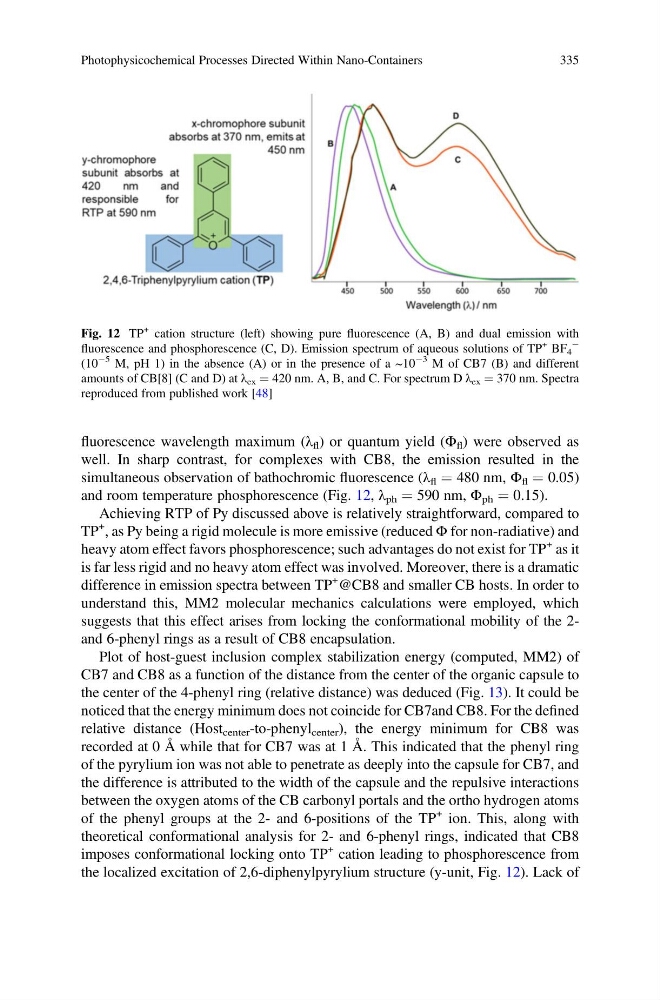
well. In sharp contrast, for complexes with CB8, the emission resulted in the
simultaneous observation of bathochromic fluorescence (λ fl ¼ 480 nm, Φ fl ¼ 0.05)
and room temperature phosphorescence (Fig. 12, λ ph ¼ 590 nm, Φ ph ¼ 0.15).
Achieving RTP of Py discussed above is relatively straightforward, compared to
TP
+
, as Py being a rigid molecule is more emissive (reduced Φ for non-radiative) and
heavy atom effect favors phosphorescence; such advantages do not exist for TP
+ as it
is far less rigid and no heavy atom effect was involved. Moreover, there is a dramatic
difference in emission spectra between TP
+ @CB8 and smaller CB hosts. In order to
understand this, MM2 molecular mechanics calculations were employed, which
suggests that this effect arises from locking the conformational mobility of the 2and 6-phenyl rings as a result of CB8 encapsulation.
Plot of host-guest inclusion complex stabilization energy (computed, MM2) of
CB7 and CB8 as a function of the distance from the center of the organic capsule to
the center of the 4-phenyl ring (relative distance) was deduced (Fig. 13). It could be
noticed that the energy minimum does not coincide for CB7and CB8. For the defined
relative distance (Host center -to-phenyl center ), the energy minimum for CB8 was
recorded at 0 Å while that for CB7 was at 1 Å. This indicated that the phenyl ring
of the pyrylium ion was not able to penetrate as deeply into the capsule for CB7, and
the difference is attributed to the width of the capsule and the repulsive interactions
between the oxygen atoms of the CB carbonyl portals and the ortho hydrogen atoms
of the phenyl groups at the 2- and 6-positions of the TP
+ ion. This, along with
theoretical conformational analysis for 2- and 6-phenyl rings, indicated that CB8
imposes conformational locking onto TP
+ cation leading to phosphorescence from
the localized excitation of 2,6-diphenylpyrylium structure (y-unit, Fig. 12). Lack of
Fig. 12 TP
+ cation structure (left) showing pure fluorescence (A, B) and dual emission with
fluorescence and phosphorescence (C, D). Emission spectrum of aqueous solutions of TP
+ BF 4
À
(10
À5 M, pH 1) in the absence (A) or in the presence of a ~10
À3 M of CB7 (B) and different
amounts of CB[8] (C and D) at λ ex ¼ 420 nm. A, B, and C. For spectrum D λ ex ¼ 370 nm. Spectra
reproduced from published work [48]
Photophysicochemical Processes Directed Within Nano-Containers
335
well. In sharp contrast, for complexes with CB8, the emission resulted in the
simultaneous observation of bathochromic fluorescence (λ fl ¼ 480 nm, Φ fl ¼ 0.05)
and room temperature phosphorescence (Fig. 12, λ ph ¼ 590 nm, Φ ph ¼ 0.15).
Achieving RTP of Py discussed above is relatively straightforward, compared to
TP
+
, as Py being a rigid molecule is more emissive (reduced Φ for non-radiative) and
heavy atom effect favors phosphorescence; such advantages do not exist for TP
+ as it
is far less rigid and no heavy atom effect was involved. Moreover, there is a dramatic
difference in emission spectra between TP
+ @CB8 and smaller CB hosts. In order to
understand this, MM2 molecular mechanics calculations were employed, which
suggests that this effect arises from locking the conformational mobility of the 2and 6-phenyl rings as a result of CB8 encapsulation.
Plot of host-guest inclusion complex stabilization energy (computed, MM2) of
CB7 and CB8 as a function of the distance from the center of the organic capsule to
the center of the 4-phenyl ring (relative distance) was deduced (Fig. 13). It could be
noticed that the energy minimum does not coincide for CB7and CB8. For the defined
relative distance (Host center -to-phenyl center ), the energy minimum for CB8 was
recorded at 0 Å while that for CB7 was at 1 Å. This indicated that the phenyl ring
of the pyrylium ion was not able to penetrate as deeply into the capsule for CB7, and
the difference is attributed to the width of the capsule and the repulsive interactions
between the oxygen atoms of the CB carbonyl portals and the ortho hydrogen atoms
of the phenyl groups at the 2- and 6-positions of the TP
+ ion. This, along with
theoretical conformational analysis for 2- and 6-phenyl rings, indicated that CB8
imposes conformational locking onto TP
+ cation leading to phosphorescence from
the localized excitation of 2,6-diphenylpyrylium structure (y-unit, Fig. 12). Lack of
Fig. 12 TP
+ cation structure (left) showing pure fluorescence (A, B) and dual emission with
fluorescence and phosphorescence (C, D). Emission spectrum of aqueous solutions of TP
+ BF 4
À
(10
À5 M, pH 1) in the absence (A) or in the presence of a ~10
À3 M of CB7 (B) and different
amounts of CB[8] (C and D) at λ ex ¼ 420 nm. A, B, and C. For spectrum D λ ex ¼ 370 nm. Spectra
reproduced from published work [48]
Photophysicochemical Processes Directed Within Nano-Containers
335