

systems and some exciting new examples of potential applications. Especially,
comparison of differential effects of cavity polarity and dimension on the relative
LE vs. TICT emission and their cumulative intensities affords wealth of information
that has not been previously available.
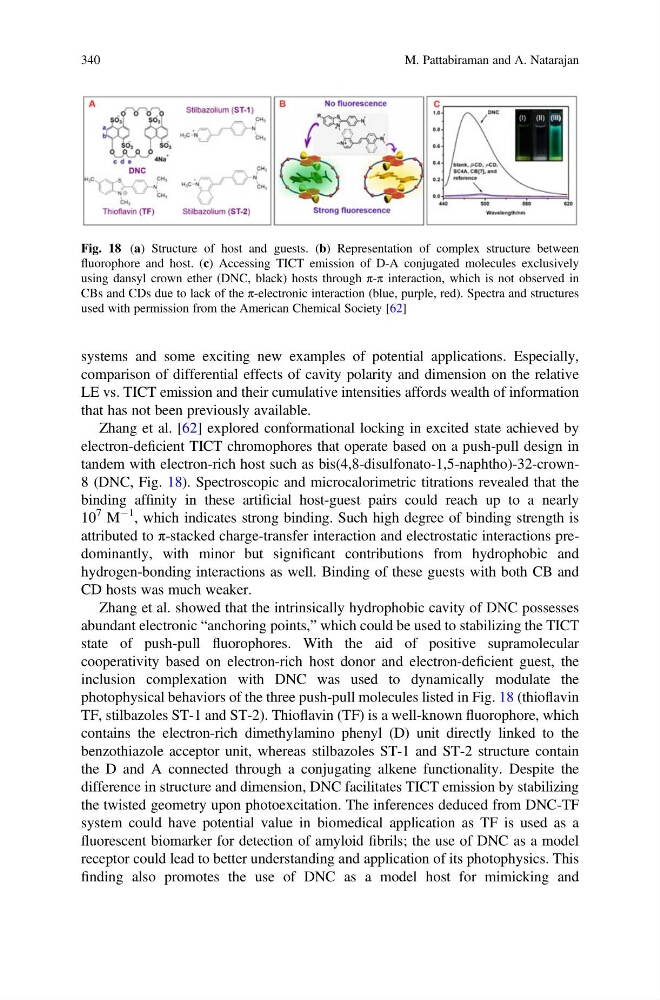
Zhang et al. [62] explored conformational locking in excited state achieved by
electron-deficient TICT chromophores that operate based on a push-pull design in
tandem with electron-rich host such as bis(4,8-disulfonato-1,5-naphtho)-32-crown8 (DNC, Fig. 18). Spectroscopic and microcalorimetric titrations revealed that the
binding affinity in these artificial host-guest pairs could reach up to a nearly
10
7 M
À1 , which indicates strong binding. Such high degree of binding strength is
attributed to π-stacked charge-transfer interaction and electrostatic interactions predominantly, with minor but significant contributions from hydrophobic and
hydrogen-bonding interactions as well. Binding of these guests with both CB and
CD hosts was much weaker.
Zhang et al. showed that the intrinsically hydrophobic cavity of DNC possesses
abundant electronic “anchoring points,” which could be used to stabilizing the TICT
state of push-pull fluorophores. With the aid of positive supramolecular
cooperativity based on electron-rich host donor and electron-deficient guest, the
inclusion complexation with DNC was used to dynamically modulate the
photophysical behaviors of the three push-pull molecules listed in Fig. 18 (thioflavin
TF, stilbazoles ST-1 and ST-2). Thioflavin (TF) is a well-known fluorophore, which
contains the electron-rich dimethylamino phenyl (D) unit directly linked to the
benzothiazole acceptor unit, whereas stilbazoles ST-1 and ST-2 structure contain
the D and A connected through a conjugating alkene functionality. Despite the
difference in structure and dimension, DNC facilitates TICT emission by stabilizing
the twisted geometry upon photoexcitation. The inferences deduced from DNC-TF
system could have potential value in biomedical application as TF is used as a
fluorescent biomarker for detection of amyloid fibrils; the use of DNC as a model
receptor could lead to better understanding and application of its photophysics. This
finding also promotes the use of DNC as a model host for mimicking and
Fig. 18 (a) Structure of host and guests. (b) Representation of complex structure between
fluorophore and host. (c) Accessing TICT emission of D-A conjugated molecules exclusively
using dansyl crown ether (DNC, black) hosts through π-π interaction, which is not observed in
CBs and CDs due to lack of the π-electronic interaction (blue, purple, red). Spectra and structures
used with permission from the American Chemical Society [62]
340
M. Pattabiraman and A. Natarajan
comparison of differential effects of cavity polarity and dimension on the relative
LE vs. TICT emission and their cumulative intensities affords wealth of information
that has not been previously available.
Zhang et al. [62] explored conformational locking in excited state achieved by
electron-deficient TICT chromophores that operate based on a push-pull design in
tandem with electron-rich host such as bis(4,8-disulfonato-1,5-naphtho)-32-crown8 (DNC, Fig. 18). Spectroscopic and microcalorimetric titrations revealed that the
binding affinity in these artificial host-guest pairs could reach up to a nearly
10
7 M
À1 , which indicates strong binding. Such high degree of binding strength is
attributed to π-stacked charge-transfer interaction and electrostatic interactions predominantly, with minor but significant contributions from hydrophobic and
hydrogen-bonding interactions as well. Binding of these guests with both CB and
CD hosts was much weaker.
Zhang et al. showed that the intrinsically hydrophobic cavity of DNC possesses
abundant electronic “anchoring points,” which could be used to stabilizing the TICT
state of push-pull fluorophores. With the aid of positive supramolecular
cooperativity based on electron-rich host donor and electron-deficient guest, the
inclusion complexation with DNC was used to dynamically modulate the
photophysical behaviors of the three push-pull molecules listed in Fig. 18 (thioflavin
TF, stilbazoles ST-1 and ST-2). Thioflavin (TF) is a well-known fluorophore, which
contains the electron-rich dimethylamino phenyl (D) unit directly linked to the
benzothiazole acceptor unit, whereas stilbazoles ST-1 and ST-2 structure contain
the D and A connected through a conjugating alkene functionality. Despite the
difference in structure and dimension, DNC facilitates TICT emission by stabilizing
the twisted geometry upon photoexcitation. The inferences deduced from DNC-TF
system could have potential value in biomedical application as TF is used as a
fluorescent biomarker for detection of amyloid fibrils; the use of DNC as a model
receptor could lead to better understanding and application of its photophysics. This
finding also promotes the use of DNC as a model host for mimicking and
Fig. 18 (a) Structure of host and guests. (b) Representation of complex structure between
fluorophore and host. (c) Accessing TICT emission of D-A conjugated molecules exclusively
using dansyl crown ether (DNC, black) hosts through π-π interaction, which is not observed in
CBs and CDs due to lack of the π-electronic interaction (blue, purple, red). Spectra and structures
used with permission from the American Chemical Society [62]
340
M. Pattabiraman and A. Natarajan