

Ramamurthy’s group demonstrated the application of deep cavitand OA capsules
in achieving RTP of pyrene (Py) by co-encapsulating the luminophore with heavy
atom effect [43]. Phosphorescence from pyrene especially at room temperature is
uncommon. This emission was recorded utilizing a combination of supramolecular
inclusion complex and the heavy atom effect. Poor intersystem crossing from S 1 to
T 1 , small radiative rate constant from T 1 , and large rate constant for oxygen
quenching hinder the phosphorescence of aromatic hydrocarbons like pyrene (Py).
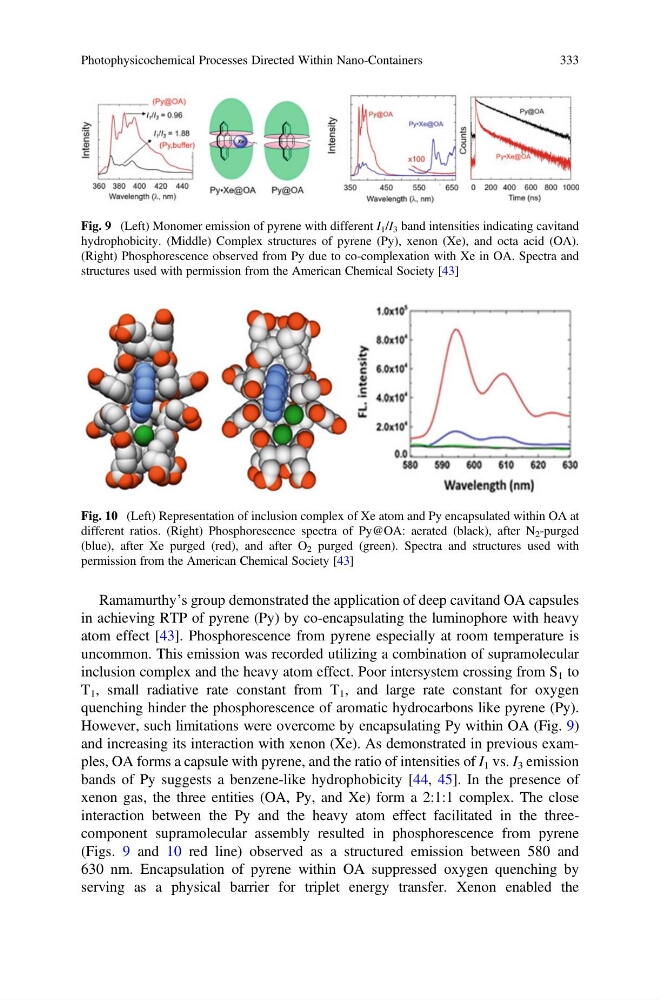
However, such limitations were overcome by encapsulating Py within OA (Fig. 9)
and increasing its interaction with xenon (Xe). As demonstrated in previous examples, OA forms a capsule with pyrene, and the ratio of intensities of I 1 vs. I 3 emission
bands of Py suggests a benzene-like hydrophobicity [44, 45]. In the presence of
xenon gas, the three entities (OA, Py, and Xe) form a 2:1:1 complex. The close
interaction between the Py and the heavy atom effect facilitated in the threecomponent supramolecular assembly resulted in phosphorescence from pyrene
(Figs. 9 and 10 red line) observed as a structured emission between 580 and
630 nm. Encapsulation of pyrene within OA suppressed oxygen quenching by
serving as a physical barrier for triplet energy transfer. Xenon enabled the
Fig. 9 (Left) Monomer emission of pyrene with different I 1 /I 3 band intensities indicating cavitand
hydrophobicity. (Middle) Complex structures of pyrene (Py), xenon (Xe), and octa acid (OA).
(Right) Phosphorescence observed from Py due to co-complexation with Xe in OA. Spectra and
structures used with permission from the American Chemical Society [43]
Fig. 10 (Left) Representation of inclusion complex of Xe atom and Py encapsulated within OA at
different ratios. (Right) Phosphorescence spectra of Py@OA: aerated (black), after N 2 -purged
(blue), after Xe purged (red), and after O 2 purged (green). Spectra and structures used with
permission from the American Chemical Society [43]
Photophysicochemical Processes Directed Within Nano-Containers
333
in achieving RTP of pyrene (Py) by co-encapsulating the luminophore with heavy
atom effect [43]. Phosphorescence from pyrene especially at room temperature is
uncommon. This emission was recorded utilizing a combination of supramolecular
inclusion complex and the heavy atom effect. Poor intersystem crossing from S 1 to
T 1 , small radiative rate constant from T 1 , and large rate constant for oxygen
quenching hinder the phosphorescence of aromatic hydrocarbons like pyrene (Py).
However, such limitations were overcome by encapsulating Py within OA (Fig. 9)
and increasing its interaction with xenon (Xe). As demonstrated in previous examples, OA forms a capsule with pyrene, and the ratio of intensities of I 1 vs. I 3 emission
bands of Py suggests a benzene-like hydrophobicity [44, 45]. In the presence of
xenon gas, the three entities (OA, Py, and Xe) form a 2:1:1 complex. The close
interaction between the Py and the heavy atom effect facilitated in the threecomponent supramolecular assembly resulted in phosphorescence from pyrene
(Figs. 9 and 10 red line) observed as a structured emission between 580 and
630 nm. Encapsulation of pyrene within OA suppressed oxygen quenching by
serving as a physical barrier for triplet energy transfer. Xenon enabled the
Fig. 9 (Left) Monomer emission of pyrene with different I 1 /I 3 band intensities indicating cavitand
hydrophobicity. (Middle) Complex structures of pyrene (Py), xenon (Xe), and octa acid (OA).
(Right) Phosphorescence observed from Py due to co-complexation with Xe in OA. Spectra and
structures used with permission from the American Chemical Society [43]
Fig. 10 (Left) Representation of inclusion complex of Xe atom and Py encapsulated within OA at
different ratios. (Right) Phosphorescence spectra of Py@OA: aerated (black), after N 2 -purged
(blue), after Xe purged (red), and after O 2 purged (green). Spectra and structures used with
permission from the American Chemical Society [43]
Photophysicochemical Processes Directed Within Nano-Containers
333