

However, some compounds have triplet lifetimes up to minutes or even hours,
allowing these substances to effectively store light energy in the form of very slowly
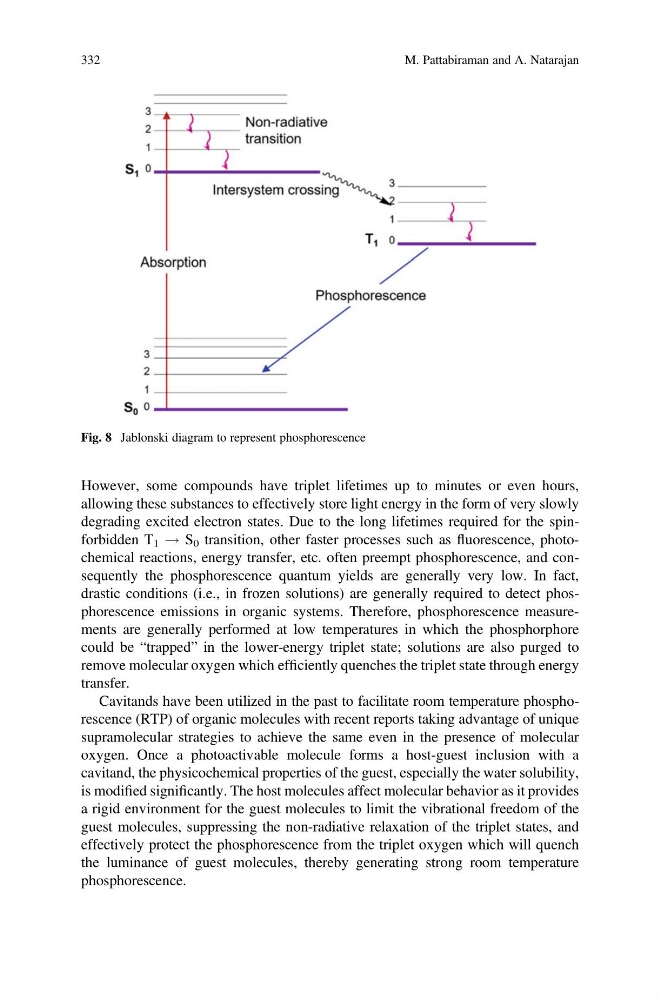
degrading excited electron states. Due to the long lifetimes required for the spinforbidden T 1 ! S 0 transition, other faster processes such as fluorescence, photochemical reactions, energy transfer, etc. often preempt phosphorescence, and consequently the phosphorescence quantum yields are generally very low. In fact,
drastic conditions (i.e., in frozen solutions) are generally required to detect phosphorescence emissions in organic systems. Therefore, phosphorescence measurements are generally performed at low temperatures in which the phosphorphore
could be “trapped” in the lower-energy triplet state; solutions are also purged to
remove molecular oxygen which efficiently quenches the triplet state through energy
transfer.
Cavitands have been utilized in the past to facilitate room temperature phosphorescence (RTP) of organic molecules with recent reports taking advantage of unique
supramolecular strategies to achieve the same even in the presence of molecular
oxygen. Once a photoactivable molecule forms a host-guest inclusion with a
cavitand, the physicochemical properties of the guest, especially the water solubility,
is modified significantly. The host molecules affect molecular behavior as it provides
a rigid environment for the guest molecules to limit the vibrational freedom of the
guest molecules, suppressing the non-radiative relaxation of the triplet states, and
effectively protect the phosphorescence from the triplet oxygen which will quench
the luminance of guest molecules, thereby generating strong room temperature
phosphorescence.
Fig. 8 Jablonski diagram to represent phosphorescence
332
M. Pattabiraman and A. Natarajan
allowing these substances to effectively store light energy in the form of very slowly
degrading excited electron states. Due to the long lifetimes required for the spinforbidden T 1 ! S 0 transition, other faster processes such as fluorescence, photochemical reactions, energy transfer, etc. often preempt phosphorescence, and consequently the phosphorescence quantum yields are generally very low. In fact,
drastic conditions (i.e., in frozen solutions) are generally required to detect phosphorescence emissions in organic systems. Therefore, phosphorescence measurements are generally performed at low temperatures in which the phosphorphore
could be “trapped” in the lower-energy triplet state; solutions are also purged to
remove molecular oxygen which efficiently quenches the triplet state through energy
transfer.
Cavitands have been utilized in the past to facilitate room temperature phosphorescence (RTP) of organic molecules with recent reports taking advantage of unique
supramolecular strategies to achieve the same even in the presence of molecular
oxygen. Once a photoactivable molecule forms a host-guest inclusion with a
cavitand, the physicochemical properties of the guest, especially the water solubility,
is modified significantly. The host molecules affect molecular behavior as it provides
a rigid environment for the guest molecules to limit the vibrational freedom of the
guest molecules, suppressing the non-radiative relaxation of the triplet states, and
effectively protect the phosphorescence from the triplet oxygen which will quench
the luminance of guest molecules, thereby generating strong room temperature
phosphorescence.
Fig. 8 Jablonski diagram to represent phosphorescence
332
M. Pattabiraman and A. Natarajan